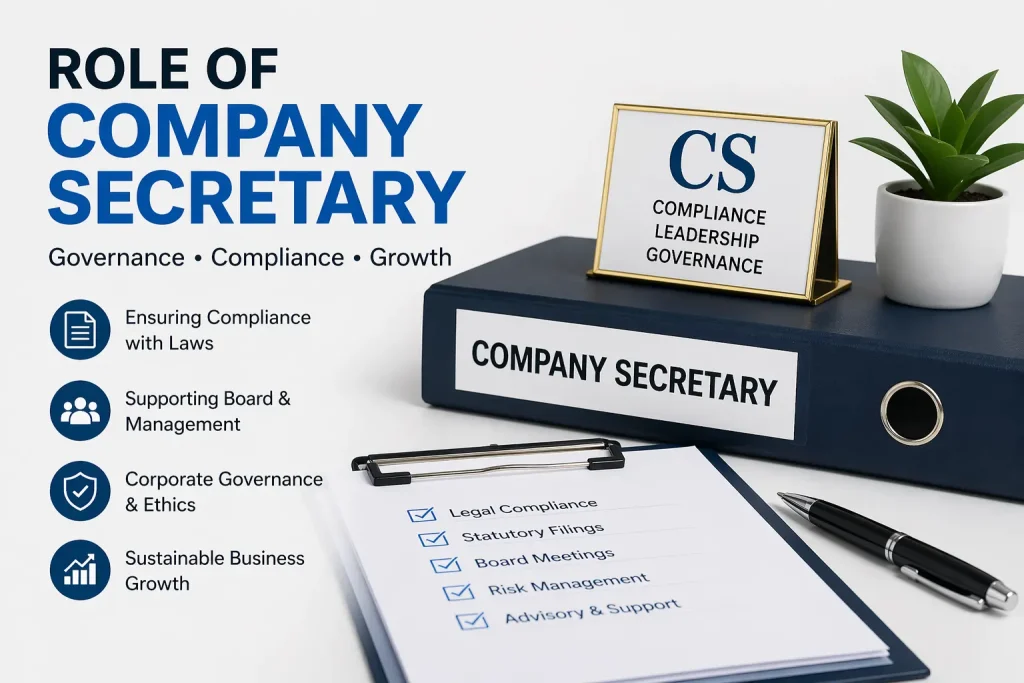
Role of Company Secretary in India – Functions, Responsibilities & Business Importance (2026)
The role of a Company Secretary in India goes far beyond compliance filings. A Company Secretary acts as a strategic advisor, ensuring that a business operates within the legal framework while maintaining strong governance, structured decision-making, and regulatory discipline.
From selecting the right business structure such as a Private Limited Company, LLP, or other entities, to managing ongoing ROC compliance, documentation, and legal responsibilities, the Company Secretary plays a crucial role in supporting entrepreneurs at every stage of their business journey.
In today’s dynamic regulatory environment, businesses require more than just compliance support — they need professional guidance to navigate legal complexities, reduce risks, and build a strong foundation for sustainable growth.
A well-guided business is not just compliant — it is structured, protected, and positioned for long-term success. The Company Secretary plays a key role in making this possible.
Who is a Company Secretary?
A Company Secretary (CS) is a qualified professional recognized under the Companies Act, 2013, responsible for ensuring that a company complies with legal, regulatory, and corporate governance requirements. A Company Secretary is a member of the Institute of Company Secretaries of India (ICSI) and plays a key role in maintaining the legal health of an organization.
Under the Companies Act, 2013, a Company Secretary is classified as a Key Managerial Personnel (KMP) in certain companies and is responsible for ensuring compliance with statutory obligations, maintaining records, and supporting the Board of Directors in governance matters.
In practical terms, a Company Secretary acts as a bridge between the company, its directors, regulatory authorities, and stakeholders. The role is not limited to filing forms — it involves guiding businesses on legal structure, ensuring proper documentation, and helping management take compliant and informed decisions.
⚖️ Compliance Officer
Ensures the company adheres to all provisions under company law and related regulations.
📊 Governance Advisor
Supports the Board in conducting meetings, maintaining records, and following governance standards.
🧾 Documentation Expert
Maintains statutory registers, resolutions, and legal documents required for compliance.
🤝 Business Advisor
Guides businesses on structuring, compliance strategy, and risk mitigation.
In today’s regulatory environment, the role of a Company Secretary has evolved into a strategic position that combines legal compliance, corporate governance, and business advisory.
Key Roles and Responsibilities of a Company Secretary
The role of a Company Secretary extends across multiple laws and regulatory frameworks. While the Companies Act, 2013 forms the core, a Company Secretary also ensures compliance under LLP regulations, taxation laws, foreign exchange laws, and other business-related statutes.
📑 1. Compliance under Companies Act, 2013
Ensuring statutory compliance for companies including filings, governance, and documentation as required under the Companies Act.
- Annual filings (AOC-4, MGT-7)
- DIR-3 KYC and director compliance
- Board meetings, AGM, and resolutions
🏢 2. LLP Act Compliance & Management
For LLPs, a Company Secretary supports compliance under the LLP Act, 2008 including filings and structural management.
- Annual return (Form 11) and Statement of Accounts (Form 8)
- Partner changes and LLP agreement amendments
- Compliance tracking and documentation
🌍 3. Foreign Exchange (FEMA) Compliance
In cases involving foreign investment or transactions, compliance under FEMA is critical and handled with regulatory precision.
- FDI reporting and compliance
- External commercial borrowings (ECB)
- RBI filings and approvals
📊 4. Tax & Regulatory Compliance (GST & Income Tax)
While primarily handled by tax professionals, a Company Secretary ensures alignment of company compliance with GST and Income Tax requirements.
- Coordination with tax filings and reporting
- Ensuring regulatory consistency
- Supporting audit and compliance documentation
⚖️ 5. Labour Law & Employment Compliance
Ensuring compliance with employment and labour laws applicable to businesses.
- PF and ESI compliance
- Shops & Establishment regulations
- Employment documentation and policies
📈 6. Corporate Advisory, Structuring & Capital Planning
A Company Secretary provides strategic advice on structuring business operations, raising capital, and ensuring long-term sustainability.
- Business restructuring (LLP, Pvt Ltd, OPC conversions)
- Capital raising strategies and compliance
- Risk minimization and governance planning
The role of a Company Secretary today is multi-dimensional, covering legal, financial, and regulatory aspects across various laws to ensure a business operates smoothly and remains compliant at all times.
Functions of a Company Secretary under the Companies Act, 2013
The functions of a Company Secretary are specifically defined under Section 205 of the Companies Act, 2013. These functions establish the Company Secretary as a key professional responsible for ensuring compliance, governance, and regulatory coordination within an organization.
As per Section 205 of the Companies Act, 2013, a Company Secretary is required to ensure that the company complies with applicable laws, provides guidance to the Board of Directors, and performs duties as may be prescribed under the Act and other laws.
Monitoring and ensuring compliance with the Companies Act, rules, and other applicable laws to avoid penalties and legal risks.
Providing guidance to directors on their duties, responsibilities, and compliance requirements.
Ensuring that meetings and processes follow Secretarial Standards issued by ICSI.
Supporting the company in maintaining transparency, accountability, and ethical practices.
Acting as a representative for the company before regulatory authorities such as ROC and MCA.
Carrying out other duties as prescribed under the Act and assigned by the Board of Directors.
These statutory functions clearly establish the Company Secretary as a key managerial professional responsible for ensuring that a company operates within the legal framework while maintaining high standards of governance.
These functions are applicable especially where the Company Secretary is appointed as Key Managerial Personnel.
Role of a Company Secretary at Different Stages of Business
The role of a Company Secretary evolves with the growth of a business. From initial setup to expansion and compliance management, a Company Secretary plays a critical role at every stage of the business lifecycle.
🚀 1. Startup Stage – Business Formation & Structuring
At the startup stage, the Company Secretary acts as a strategic advisor in selecting the right business structure and ensuring proper legal foundation.
- Advising on entity selection (Private Limited, LLP, OPC, etc.)
- Company or LLP registration and documentation
- Initial compliance setup and statutory records
📈 2. Growth Stage – Compliance & Governance
As the business grows, compliance requirements increase. The Company Secretary ensures that all regulatory obligations are met without disruption.
- Regular ROC filings and compliance monitoring
- Board meetings and governance processes
- Maintaining statutory registers and documentation
💼 3. Expansion Stage – Structuring & Investment Support
During expansion, businesses require restructuring, capital infusion, and regulatory approvals. The Company Secretary plays a key role in these activities.
- Handling share allotment and capital restructuring
- Compliance for funding and investor onboarding
- Advising on mergers, conversions, and restructuring
⚠️ 4. Compliance Risk / Crisis Stage – Notices & Legal Issues
In situations involving non-compliance, notices, or disputes, the Company Secretary provides structured solutions and ensures timely resolution.
- Handling MCA and ROC notices
- Managing penalties, adjudication, and filings
- Resolving director disputes and compliance issues
🔄 5. Restructuring / Closure Stage
When businesses restructure or close operations, compliance becomes critical to avoid future liabilities.
- Conversion between entities (LLP, Pvt Ltd, OPC)
- Strike-off and closure procedures
- Final compliance and documentation
A Company Secretary is not just involved at one stage of business — they play a continuous role in ensuring that the business is legally compliant, well-structured, and prepared for future growth.
Know more about company registration → Company Registration in Bangalore
Practical Business Scenarios Where a Company Secretary Plays a Critical Role
While the role of a Company Secretary may appear structured on paper, its real value becomes evident in practical business situations. Many companies realise the importance of professional guidance only when faced with compliance challenges or critical decisions.
⚠️ ROC Notice or Compliance Default
A company receives a notice from MCA or ROC due to delayed filings or non-compliance. Without proper response, this may lead to penalties or legal action.
Role of CS: Analysing the notice, preparing response, ensuring timely filing, and resolving the issue within legal framework.
🏢 Company Incorporation & Structuring
An entrepreneur plans to start a business but is unsure whether to choose a Private Limited Company, LLP, or other structure.
Role of CS: Advising on the most suitable structure, handling registration, and setting up compliance framework.
📈 Investment & Capital Raising
A company is planning to raise funds or onboard investors, requiring compliance with legal and regulatory procedures.
Role of CS: Ensuring compliance for share allotment, documentation, regulatory filings, and investor structuring.
⚖️ Director Disputes or Governance Issues
Disagreements between directors or improper governance practices can affect business operations and legal standing.
Role of CS: Ensuring proper documentation, guiding legal compliance, and supporting structured resolution.
🔄 Business Restructuring or Conversion
A business plans to convert from LLP to Private Limited Company or restructure its operations.
Role of CS: Managing legal process, documentation, and compliance for smooth transition.
These real-world situations highlight that the role of a Company Secretary is not limited to routine compliance — it becomes crucial in decision-making, risk management, and business continuity.
For handling such cases, visit our Company Secretary services page
Why a Company Secretary is Important for Every Business
Understanding the role of a Company Secretary is important, but knowing why this role is critical for business success is equally essential. In today’s regulatory environment, compliance is not optional — it is a necessity for survival and growth.
🛡️ Legal Protection & Risk Reduction
Ensures compliance with laws, reducing the risk of penalties, notices, and legal complications.
📊 Strong Corporate Governance
Maintains transparency, accountability, and proper decision-making processes within the organization.
📈 Business Growth & Structuring
Helps in structuring business operations, raising capital, and ensuring smooth expansion.
🤝 Investor & Stakeholder Confidence
Proper compliance and governance build trust with investors, banks, and stakeholders.
Many businesses realize the importance of a Company Secretary only after facing compliance issues. However, proactive guidance can prevent risks and ensure smooth operations from the beginning.
To understand this in detail, read our complete guide on Importance of Company Secretary for Business .
For businesses in Bangalore, professional guidance ensures compliance with both central and local regulatory requirements
Full-Time vs Practicing Company Secretary – What is Right for Your Business?
Businesses often face the decision of whether to appoint a full-time Company Secretary or engage a practicing professional. The right choice depends on the size of the company, compliance requirements, and operational needs.
👨💼 Full-Time Company Secretary
- Mandatory for certain companies based on paid-up capital
- Works internally within the company
- Handles daily compliance and governance tasks
- Higher cost due to salary and employment benefits
🤝 Practicing Company Secretary
- Suitable for startups and SMEs
- Provides expert advisory across multiple areas
- Cost-effective and flexible engagement
- Access to broader experience and case exposure
For most startups and growing businesses, engaging a practicing Company Secretary is a practical approach as it provides professional expertise without the cost of a full-time resource.
As businesses scale and compliance requirements increase, the need for a full-time Company Secretary may arise. Until then, professional advisory support ensures compliance and structured growth.
For professional support, explore our Company Secretary Services in Bangalore .
As per Companies Act, certain companies are required to appoint a full-time Company Secretary based on capital thresholds
Consequences of Not Having Proper Company Secretary Support
Ignoring compliance or not having proper professional support can lead to serious legal and financial consequences for a business. Many companies face challenges not due to lack of intent, but due to lack of proper guidance.
💰 Heavy Penalties & Late Fees
Delays in ROC filings such as AOC-4 and MGT-7 can result in significant penalties and recurring late fees.
⚠️ MCA / ROC Notices & Legal Actions
Non-compliance may trigger notices, adjudication proceedings, and legal complications.
🚫 Director Disqualification
Continuous non-filing of returns may lead to disqualification of directors, affecting their ability to operate businesses.
🛑 Company Strike-Off Risk
Companies that fail to comply with statutory requirements may be struck off from MCA records.
📉 Business Disruptions & Loss of Credibility
Compliance issues can affect banking, funding, and overall credibility of the business.
⚖️ Legal & Operational Risks
Improper documentation and non-compliance can lead to disputes, legal exposure, and operational challenges.
Compliance is not just a legal requirement — it is a foundation for business stability, credibility, and long-term success.
Many of these consequences can be avoided with timely compliance and professional guidance
Role of Company Secretary in Bangalore’s Business Environment
Bangalore, being one of India’s leading startup and business hubs, has a dynamic and evolving regulatory environment. Companies operating in Bangalore are required to comply with central laws such as the Companies Act, LLP Act, and taxation laws, along with applicable local regulations.
In such an environment, the role of a Company Secretary becomes crucial in ensuring that businesses remain compliant, structured, and prepared for regulatory requirements. From startups in technology sectors to established enterprises, proper compliance management is essential for smooth operations.
🏢 Startup Ecosystem Compliance
High number of startups require structured compliance from the early stage.
📑 ROC Bangalore Jurisdiction
Companies fall under ROC Bangalore, requiring timely filings and compliance adherence.
📈 Investor & Funding Readiness
Proper compliance is essential for startups seeking funding and investor confidence.
⚖️ Regulatory Complexity
Businesses must comply with multiple laws including corporate, tax, and labour regulations.
For businesses looking for professional support, explore our Company Secretary Services in Bangalore .
In a competitive business environment like Bangalore, proper compliance and governance are not just legal requirements — they are essential for credibility, growth, and long-term sustainability.
Many companies in Bangalore face compliance challenges due to rapid growth and evolving regulatory requirements
Need Professional Guidance on Company Compliance?
Understanding the role of a Company Secretary is the first step. Implementing compliance correctly is where professional guidance becomes essential. Whether you are starting a business or managing ongoing compliance, expert support ensures clarity and peace of mind.
If you need assistance with company registration, ROC filings, or handling compliance matters, you can explore our professional services or connect with us for guidance.
Guidance available for startups, SMEs, and growing businesses.
Quick response available for urgent compliance matters.
How much does a Company Secretary charge for ROC filing? It varies from company to company; it starts from 5K for small companies.
Frequently Asked Questions – Company Secretary Role & Fees
A Company Secretary ensures compliance with company law, handles ROC filings, maintains statutory records, and supports directors in legal and governance matters.
As per the Companies Act, 2013, certain companies must appoint a full-time Company Secretary based on their paid-up capital. However, even smaller companies require professional support for compliance.
The cost depends on the scope of work. For startups and SMEs, engaging a practicing Company Secretary is cost-effective compared to hiring a full-time resource. Fees vary based on compliance requirements and services involved.
Yes, most startups and growing businesses engage practicing Company Secretaries on a consultancy basis to handle compliance, filings, and advisory requirements.
Services include company registration, ROC filings, compliance management, handling MCA notices, maintaining records, and advisory on legal and regulatory matters.
A business should engage a Company Secretary at the time of incorporation and continue for ongoing compliance, filings, and legal support to avoid penalties and risks.
Non-compliance can lead to penalties, MCA notices, director disqualification, and even strike-off of the company. Proper guidance helps avoid such issues.
A full-time Company Secretary works within the company, while a practicing Company Secretary provides external professional services, often more flexible and cost-effective for small and medium businesses.

About the Author – CS Prakasha C R
Company Secretary | Chartered Accountant | Advocate
CS Prakasha C R is a qualified Company Secretary, Chartered Accountant, and Advocate with over 20 years of experience in corporate law, ROC compliance, and regulatory advisory. Having worked with reputed organizations such as Levi’s, Toyota, and Essar, he has guided 1900+ businesses in Bangalore across company law, taxation, and legal compliance matters.
Expertise: Company Law, ROC Compliance, MCA Filings, Business Structuring, Legal Advisory
Explore More Company Secretary Insights
Last updated on: 23 April 2026
Property Verification Lawyer in Bangalore: 1–2 Day Legal Due Diligence & Title Search