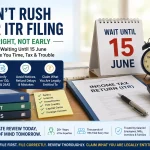
Filing your Income Tax Return (ITR) for Financial Year 2025–26 is not just about compliance—it is about optimising your tax, claiming eligible refunds, and avoiding future notices. With recent changes in tax structure, disclosure requirements, and system-based validation, accurate filing has become more important than ever.
Under the new tax regime, individuals can benefit from reduced tax rates and standard deduction, resulting in nil or minimal tax liability up to approximately ₹12.75 lakhs (subject to conditions). However, choosing between old vs new regime requires proper evaluation based on your income, deductions, and financial planning.
Many taxpayers—especially salaried employees, consultants, and business owners—face issues such as excess TDS deduction, incorrect HRA claims, mismatch in AIS/26AS, or missed deductions, leading to refund loss or notices. Proper filing ensures that your eligible tax refund is claimed legally and without complications.
With over 20+ years of experience in Bangalore, our CA-assisted team has handled ITR filings for salaried individuals, freelancers, and businesses, focusing on tax planning, compliance, and refund optimisation.
This page will guide you on due dates, documents required, tax planning strategies, and how to file your ITR correctly for FY 2025–26.
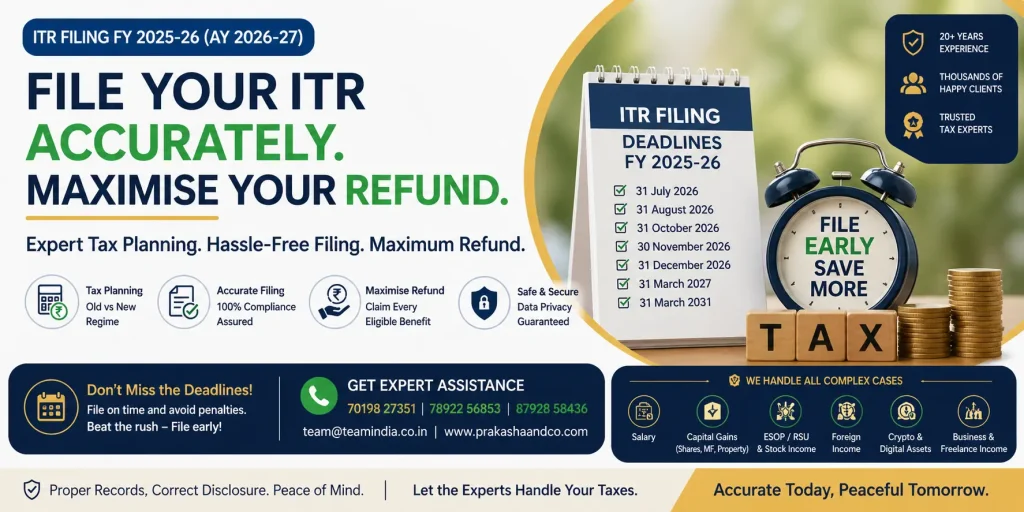
Key Indian Income Tax Deadlines (FY 2025–26 / AY 2026–27)
Staying aware of important due dates is essential to avoid penalties, ensure timely refunds, and maintain compliance. Below are the key deadlines applicable for Financial Year 2025–26:
- 31st July 2026: Due date for salaried individuals and non-audit cases (ITR-1 & ITR-2)
- 31st August 2026: Due date for non-audit business/professional cases (ITR-3 & ITR-4)
- 31st October 2026: Due date for tax audit cases
- 30th November 2026: Deadline for transfer pricing reports
- 31st December 2026: Last date to file Belated Return or Revised Return (with applicable conditions)
- 31st March 2027: Extended deadline to file Revised Return (as per recent Budget updates)
- 31st March 2031: Deadline for filing Updated Return (ITR-U) up to 4 years from end of relevant Assessment Year
Important Note: In recent years, the Income Tax Department has increased scrutiny on refund claims, especially where deductions or exemptions are not properly supported by documents. Many taxpayers have received alerts to revise their returns due to mismatch in claims.
Therefore, it is important to ensure that your ITR is filed with accurate disclosures and proper supporting records, particularly under the new tax regime and applicable provisions.
Documents You Should Keep Ready (Before Filing Starts)
- Form 16: Salary details and TDS deducted
- HRA Details: Rent receipts, landlord PAN (if applicable)
- LTA Bills: Travel proofs if exemption is claimed
- Investment Proofs: 80C, 80D, donations, etc.
- Medical Insurance & Expense Proofs
- Bank Statements & Interest Certificates
- AIS & Form 26AS: To verify income and TDS details
Proper documentation and reconciliation help in claiming eligible refunds without delay and reduce the risk of notices or adjustments.
Once the Income Tax portal enables filing for AY 2026–27, we will notify you to proceed with your ITR filing through our team. We recommend keeping all documents ready in advance to ensure smooth and timely filing.
Tax Planning for FY 2025–26 – Old vs New Regime
One of the most important decisions while filing your Income Tax Return is choosing between the old tax regime and the new tax regime. Each regime has its own benefits, and selecting the right option depends on your income structure, deductions, and financial planning.
New Tax Regime – Simplified Structure
The new tax regime offers lower tax rates with minimal deductions. With standard deduction and rebate benefits, individuals can effectively have nil or minimal tax liability up to approximately ₹12.75 lakhs (subject to conditions).
- No need to maintain multiple investment proofs
- Simplified tax calculation
- Suitable for individuals with fewer deductions
However, incorrect selection of the regime without proper evaluation may result in loss of eligible deductions and higher tax outflow.
Old Tax Regime – Deduction Based Planning
The old regime allows various deductions and exemptions, which can significantly reduce taxable income when planned properly.
- Section 80C: LIC, PF, ELSS, housing loan principal
- Section 80D: Medical insurance
- HRA Exemption: Rent paid with proper documentation
- LTA, Donations, Other Deductions
This regime is beneficial for individuals who actively invest and maintain proper records to claim deductions.
How to Choose the Right Regime?
Choosing between the two regimes should not be based on assumption. It requires proper comparison and calculation based on your income, deductions, and future planning.
- Compare tax liability under both regimes
- Consider long-term investments and savings
- Evaluate impact on refunds and TDS
Proper tax planning helps in legally reducing tax liability and maximising eligible refunds.
Additional Tax Saving Strategies (Value Add)
- Flexi Benefits Structuring: Salary restructuring (where possible) to optimise tax components.
- HUF Formation: Creating a Hindu Undivided Family (HUF) to manage separate income such as interest or rental income, helping in tax optimisation.
- Proper Income Disclosure: Ensuring all income (salary, interest, rent, capital gains) is correctly reported to avoid notices and enable correct refund claims.
In recent filing cycles, we have observed cases where refund claims were flagged for revision due to incorrect regime selection or unsupported deductions. Hence, careful planning and accurate filing are essential.
Tax Planning for FY 2025–26 – Old vs New Regime (Choose the Right Option)
Choosing between the old tax regime and the new tax regime is one of the most important decisions while filing your Income Tax Return. The right choice can significantly reduce your tax liability and help you claim eligible refunds.
Under the new tax regime, individuals can benefit from lower tax rates and standard deduction, resulting in nil or minimal tax liability up to approximately ₹12.75 lakhs (subject to conditions). However, this comes with limited deductions.
Important Relief for Taxpayers
Even if the wrong tax regime is selected initially or TDS is deducted without proper planning, you can still choose the most beneficial regime at the time of filing your ITR (for salaried/non-business cases).
This means your tax liability can be recalculated correctly while filing, and any excess tax deducted (TDS) can be claimed back as refund, provided proper disclosures and supporting documents are available.
However, for individuals having business or professional income, switching between regimes is subject to specific conditions and restrictions under the Income Tax Act, and needs careful planning.
Why Proper Tax Planning is Important
- Ensures correct selection between old vs new regime
- Helps in claiming all eligible deductions and exemptions
- Avoids refund reduction or notices due to incorrect claims
- Optimises tax liability legally
In recent filing cycles, we have seen multiple cases where refund claims were flagged or reduced due to incorrect regime selection, mismatch in AIS/26AS, or unsupported deductions such as HRA, LTA, and medical claims.
Additional Tax Saving Opportunities
- Flexi Benefit Structuring: Optimising salary components to reduce taxable income
- HUF Formation: Creating a separate tax entity to manage rental or interest income efficiently
- Accurate Disclosure: Proper reporting of income and deductions to ensure smooth refund processing
With proper tax planning at the time of filing, it is possible to reduce tax liability and recover excess tax paid through refund—even if initial deductions were not planned correctly.
Once the ITR filing window opens, you may proceed using the contact option available on this page. Our team will review your income, compare both regimes, and assist in filing your return with the most beneficial tax outcome.
Documents Required for ITR Filing (Simple Checklist)
Most of your tax details are already available in the Income Tax portal once we log in using your PAN. This includes salary details, TDS, and other income reported to the department.
Our process involves reviewing your available data, identifying any gaps or mismatches, and then collecting only the additional details required to complete your filing accurately.
What is Already Available (After Login)
- Form 26AS – TDS and tax payments
- AIS (Annual Information Statement) – income from various sources
- TIS (Taxpayer Information Summary)
- Salary and bank interest details (reported by employer/banks)
What You Need to Share (If Applicable)
- Form 16: Salary and TDS details from employer
- HRA Details: Rent receipts and landlord PAN (if required)
- LTA Bills: Travel proofs if exemption claimed
- Investment Proofs: LIC, ELSS, PF, insurance (80C, 80D, etc.)
- Bank Statements / Interest Certificates
- Demat / Trading Statements: For capital gains
- Property Details: Sale/purchase or rental income
- Business / Freelance Income: Basic income & expense details
Our Review Process
- Login and download your AIS & 26AS
- Cross-check income, TDS, and disclosures
- Identify mismatches or missing entries
- Advise on tax regime selection (old vs new)
- Apply eligible deductions and exemptions
- File ITR with proper compliance and refund optimisation
With this structured approach, we ensure your return is accurate, compliant, and your eligible refund is claimed without issues.
Once the ITR filing window opens, you can proceed by sharing your details through the contact option available on this page. Our team will handle the complete process end-to-end.
How to Maximise Your Income Tax Refund
Many taxpayers assume that filing ITR is just a compliance requirement. In reality, it is the process through which you can claim back excess tax (TDS) deducted during the year.
In our experience, a large number of salaried individuals, freelancers, and business owners are eligible for refunds but either miss claiming them or face delays due to incorrect filing.
Common Situations Where Refund Arises
- TDS deducted higher than actual tax liability
- Wrong tax regime selected by employer
- Eligible deductions not considered (80C, 80D, HRA, etc.)
- Interest income or other income not properly adjusted
- Advance tax paid in excess
Our Approach to Refund Optimisation
- Review AIS, Form 26AS, and Form 16 in detail
- Identify excess TDS and mismatch entries
- Compare tax liability under both regimes
- Apply all eligible deductions with proper documentation
- Ensure correct disclosure to avoid future notices
Even if excess tax has been deducted due to incorrect planning during the year, it can be corrected at the time of filing and claimed as refund.
In recent cases, we have also observed that refund claims are being flagged for revision where deductions are not properly supported by documents or mismatch exists with AIS/26AS. Hence, accurate filing is critical.
Important Points to Ensure Smooth Refund
- Verify all income sources before filing
- Ensure TDS is correctly reflected in 26AS
- Maintain proper proof for deductions (HRA, medical, etc.)
- Choose correct tax regime
- Use correct bank account for refund credit
Proper planning and accurate filing help in faster refund processing and reduce the chances of notices or adjustments.
Once the filing window opens, you may proceed using the contact option available on this page. Our team will review your case and ensure that your eligible refund is claimed correctly.
Professional Fees for ITR Filing
Our fees for Income Tax Return (ITR) filing are based on the complexity of your income, level of review required, and refund optimisation involved. We follow a transparent approach and discuss the scope before proceeding.
Indicative Fee Range
-
Salaried Individuals (Basic): ₹1,000 – ₹2,500
(Single Form 16, basic income, minimal deductions) -
Salaried with Multiple Income Sources: ₹2,500 – ₹5,000
(Includes interest income, HRA, deductions, minor capital gains) -
Freelancers / Consultants: ₹3,000 – ₹7,500
(Form 16A, multiple clients, expense claims) -
Business / Professional Income: ₹5,000 onwards
(Books review, profit calculation, compliance handling) -
Capital Gains / Property Cases: ₹3,000 – ₹10,000+
(Includes detailed computation and documentation review)
What is Included in Our Service
- Detailed review of AIS, Form 26AS, and income details
- Tax regime comparison (old vs new)
- Identification of eligible deductions and exemptions
- Refund optimisation and error correction
- Accurate filing with compliance checks
Final fees will be confirmed after reviewing your income details to ensure appropriate scope and accurate filing.
Once the ITR filing window opens, you may proceed using the contact option available on this page. Our team will guide you through the process and handle the filing end-to-end.
Frequently Asked Questions on ITR Filing (Salaried & Professionals)
Can you assist with my ITR filing? I am a salaried employee and want proper tax planning.
Yes. We assist salaried individuals in complete ITR filing along with tax planning. Our approach includes reviewing your income, comparing tax regimes, applying eligible deductions, and ensuring your return is filed accurately with maximum eligible refund.
I usually file my ITR myself. This year my income has increased and I have multiple sources—should I take professional help?
When income increases or includes multiple sources such as investments, capital gains, or foreign income, proper disclosure becomes important. Professional review helps in avoiding errors, selecting the right tax regime, and ensuring that your return is compliant and optimised.
Can you handle ITR filing for ESOPs, RSUs, and stock market income?
Yes. We handle ESOPs, RSUs, and capital gains from shares and mutual funds. These require correct classification (perquisite, capital gain, etc.), accurate calculation, and proper disclosure to avoid notices and ensure correct tax treatment.
I have foreign income or foreign assets. Can you assist with that?
Yes. Foreign income and asset disclosure require careful reporting under applicable schedules in the ITR. We assist in proper disclosure, compliance with reporting requirements, and avoiding penalties due to non-reporting.
Can you help with crypto or digital asset income reporting?
Yes. Income from crypto or digital assets needs to be reported separately with specific tax treatment. We ensure correct reporting and compliance as per current Income Tax provisions.
Will you help me maximise my tax refund?
Our process focuses on identifying excess TDS, applying eligible deductions, and selecting the correct tax regime. This helps in legally maximising your refund while ensuring full compliance.
What if I choose the wrong tax regime or miss deductions?
For salaried individuals, the tax regime can be evaluated and selected at the time of filing. If excess tax has been deducted, it can be corrected and claimed as refund, subject to proper documentation.
Will my ITR filing be safe and compliant?
Yes. We ensure proper review of AIS, Form 26AS, income details, and deductions before filing. This reduces the chances of mismatch, notices, or refund issues.
What details do I need to share to get started?
Basic details such as Form 16, investment proofs (if applicable), and any additional income information. Most of the data is already available on the Income Tax portal, and we guide you on any additional requirements.
How early should I start my ITR filing?
It is advisable to keep your documents ready in advance. Once the filing window opens, early filing helps in faster refund processing and avoids last-minute issues.
If you are looking for a reliable team to handle your ITR filing with proper tax planning and compliance, you may proceed using the contact option available on this page. Our team will review your case and assist you end-to-end.
About the Author

Property Verification Lawyer in Bangalore: 1–2 Day Legal Due Diligence & Title Search