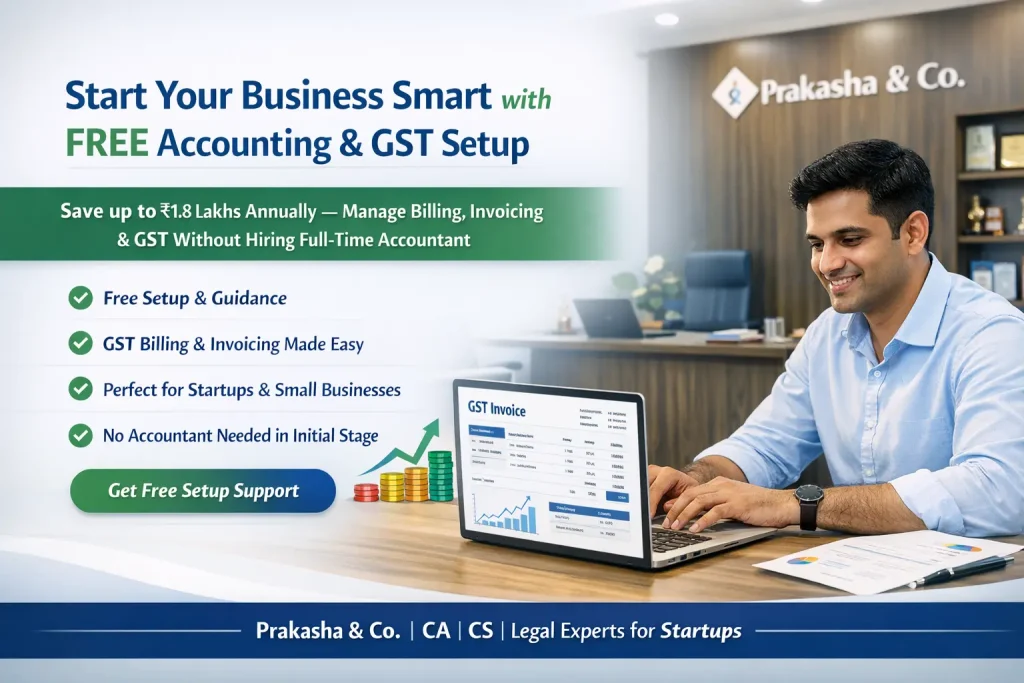
This guide explains how to manage business accounting and GST for startups in a cost-effective and practical way.
Quick Summary:
- Save up to ₹1.8 Lakhs/year
- Use free GST accounting tools
- No full-time accountant needed initially
- Get expert setup support
Struggling to manage accounting and GST for your startup without spending ₹10,000–₹15,000 every month?
You are not alone. Most new businesses in India start with a great idea but face one common challenge — managing accounting and GST compliance with limited budget.
In the initial days, startups typically face:
- Limited or no revenue
- Few or no clients to invoice
- Budget constraints for hiring an accountant or CA
- Focus on marketing, sales, and business setup
However, compliance requirements under the Goods and Services Tax (GST) Act and Income Tax Act, 1961 still apply from day one.
This means you are expected to:
- Maintain proper books of accounts
- Issue GST-compliant invoices
- Track income, expenses, and taxes
How can startups manage business accounting and GST for startups without hiring an accountant?
The answer is simple: Start smart with a structured, low-cost setup using free tools and the right guidance.
A Smart, Cost-Saving Approach for Startups (2026)
This guide is designed for startups, freelancers, and small business owners who want to handle their business accounting and GST efficiently without high costs.
- ✔ Manage accounting & GST independently
- ✔ Use free and easy-to-use tools
- ✔ Create invoices, quotations, and reports in minutes
- ✔ Stay compliant without technical complexity
- ✔ Save up to ₹1.8 Lakhs per year in professional fees
Why This Guide is Practical (Not Just Theory)
This is not just another list of tools. It is based on real experience in handling:
- Business registrations
- GST compliance and filings
- Accounting and bookkeeping
- Payroll and tax advisory
So, you will learn how to actually implement business accounting and GST for startups, not just read about it.
Who Should Use This Approach?
- New startups (0–2 years)
- Freelancers and consultants
- Small business owners with limited budget
- Entrepreneurs looking to reduce initial costs
- Businesses not ready for a full-time accountant
Important Note Before You Start
This method is ideal for the initial stage of your business.
As your business grows, you will require professional support for:
- GST and income tax filings
- Advanced tax planning
- Audit and compliance requirements
We will also guide you on when to shift from self-management to expert support.
What You’ll Learn Next
Now, let’s understand why most startups struggle with accounting and GST in their early days — and how you can avoid the same mistakes.
How to Manage Business Accounting and GST for Startups
Many challenges arise when managing business accounting and GST for startups without a structured system.
Why Startups Struggle with Accounting & GST in the Initial Stage
Most startups do not fail because of lack of ideas — they struggle due to poor financial management and compliance challenges in the early stage.
Understanding these practical difficulties will help you take the right approach from day one.
1. No Immediate Revenue or Billing Activity
In the initial phase, many businesses are still:
- Building their product or service
- Approaching clients and testing the market
- Setting up operations and branding
As a result, there are no regular invoices or cash flow, making it difficult to justify spending on accounting or GST services.
2. Limited Budget and Cost Sensitivity
Startups usually operate with tight budgets. Every expense is carefully evaluated.
Typical monthly costs for compliance include:
- Accounting and bookkeeping: ₹3,000 – ₹5,000
- GST return filing: ₹2,000 – ₹5,000
- Payroll and TDS management: ₹2,000 – ₹5,000
This can go up to ₹10,000–₹15,000 per month, which is a significant burden in the early stage.
3. Lack of Accounting Knowledge
Most founders are experts in their business domain — not in accounting or taxation.
Common concerns include:
- How to create GST invoices?
- How to record expenses properly?
- What GST rate should be applied?
- How to track payments and receivables?
This lack of clarity often leads to delays, errors, or complete avoidance of compliance.
4. Fear of GST and Compliance Complexity
GST and tax compliance are often perceived as complex and risky.
Startups worry about:
- Penalties for incorrect filing
- Mismatch in GST returns
- Not maintaining proper records
This creates hesitation, even when the actual process can be simplified with the right system.
5. No Dedicated Staff or Accountant
Hiring a full-time accountant in the early stage is not practical for most businesses.
At the same time, depending entirely on external professionals for every small task can become costly and slow.
This leaves founders in a difficult position — they need compliance, but cannot afford full-time support.
6. Focus on Business Growth Over Compliance
In the beginning, founders naturally prioritize:
- Getting customers
- Generating revenue
- Improving products or services
Accounting and GST are often treated as secondary, which may lead to future compliance issues and financial mismanagement.
Key Insight: The Real Problem is Not Accounting — It’s the Approach
Most startups assume that proper accounting requires hiring a full-time accountant or spending heavily on professional services.
However, the reality is different.
With the right setup, tools, and basic guidance, you can:
- Manage your accounting efficiently
- Handle GST billing and records
- Stay compliant from the beginning
— all without high monthly costs.
What You Should Do Instead
The smart approach for startups is:
- Start with a structured, low-cost system
- Use simple and reliable tools
- Get initial expert guidance
- Gradually move to professional support as your business grows
What’s Next?
Now that you understand the challenges, let’s look at the solution.
In the next section, we will explain how government-supported and free accounting tools can help you manage GST and business accounts easily.
Free GST Accounting Tools for Startups – A Smart Government-Driven Opportunity
To support startups and small businesses, the Government of India has actively encouraged digital accounting and GST compliance through user-friendly platforms.
As part of the Digital India initiative and ease of doing business, many technology providers now offer free or freemium accounting solutions that help businesses manage their books and GST efficiently.
This means you do not need to invest heavily in accounting systems during the initial stage of your business.
Why Free Accounting Tools Make Sense for Startups
In the early phase, your goal should be to reduce costs while staying compliant.
Using structured accounting tools allows you to:
- Maintain proper books of accounts as per legal requirements
- Generate GST-compliant invoices
- Track income, expenses, and receivables
- Prepare basic reports for decision-making
This ensures that your business remains organized, credible, and compliant from day one.
Popular Free Accounting & GST Tools Used by Startups
Some widely used accounting platforms suitable for small businesses include:
- Zoho Books – Suitable for GST billing, invoicing, and complete accounting setup
- FreshBooks – Easy-to-use tool for invoicing and expense tracking
- Wave Accounting – Free tool for basic accounting and reporting
- Tally (basic/trial versions) – Traditional accounting software used in India
Among these, Zoho Books and FreshBooks are generally preferred by startups due to their simplicity, mobile access, and GST compatibility.
What You Can Do Using These Tools
With proper setup, these tools allow you to manage almost all essential accounting and GST functions:
- Create and send GST invoices to customers
- Prepare quotations and convert them into invoices
- Record expenses and purchases
- Track customer payments and outstanding dues
- Maintain basic GST records
- Generate financial summaries and reports
Most of these tools are also available as mobile applications, allowing you to manage your business from anywhere.
Important: Tools Alone Are Not Enough
While these platforms are powerful, many startups face issues because:
- Incorrect GST configuration
- Wrong tax rate selection
- Improper invoice formats
- Incomplete accounting setup
This can lead to compliance issues, errors in reporting, and future complications.
The key is not just using software — but using it correctly.
How to Use Free Accounting Tools the Right Way
To make the most of these tools, startups should:
- Set up business details correctly (name, GST, bank details)
- Configure GST rates as per products/services
- Design proper invoice formats
- Maintain regular entries for income and expenses
- Review reports periodically
A small mistake at the beginning can create complications later, so initial setup and guidance are critical.
Key Takeaway
Free accounting tools can help you manage your business efficiently — but their effectiveness depends on how well they are implemented.
With the right approach, you can:
- Stay compliant with GST and accounting requirements
- Avoid unnecessary professional costs in the initial stage
- Build a strong financial foundation for your business
What’s Next?
Now that you understand the tools available, the next step is to see how to actually start and set up your business for free accounting and GST management.
In the next section, we will explain step-by-step how to get started.
Step-by-Step: How to Start Free Business Accounting & GST Setup
To successfully manage your business accounting and GST at low cost, you need a proper foundation. Many startups make the mistake of directly using tools without setting up the business correctly.
Follow this structured approach to ensure compliance and smooth operations.
Step 1: Register Your Business Properly
The first and most important step is to create a legally recognized business structure.
Depending on your requirements, you can choose:
- Sole Proprietorship – Simple and suitable for small businesses
- Partnership Firm – Ideal for 2 or more founders
- LLP Registration – Limited liability with flexibility
- Private Limited Company – Best for startups planning growth and funding
A proper business structure helps you:
- Maintain legal identity
- Open business bank account
- Build credibility with clients
- Enable GST registration and compliance
If you are unsure, you can also refer to our detailed guide on how to register a startup in India.
—Step 2: Obtain GST Registration (If Applicable)
Once your business is registered, the next step is to evaluate whether you require GST registration.
In cities like Bangalore and other metro areas, having GST registration is highly recommended because:
- It improves business credibility
- Allows you to work with corporate clients
- Enables input tax credit (ITC)
You can explore the process in detail here:
Even if GST is not mandatory for your business initially, taking registration can be a strategic advantage.
—Step 3: Set Up Your Free Accounting & GST Software
After business and GST setup, you can start using free accounting tools for managing your day-to-day operations.
At this stage, you need to configure:
- Business details (name, address, GST number)
- Bank account details
- Product or service list
- Applicable GST rates
Proper setup ensures that your invoices, reports, and records are accurate and compliant.
—Step 4: Start Creating Invoices, Quotations & Records
Once the system is ready, you can begin managing your business operations:
- Create GST invoices for clients
- Send quotations and convert them into sales
- Record expenses and purchases
- Track payments and outstanding amounts
This helps you maintain a clear financial picture of your business from day one.
—Step 5: Maintain Regular Accounting Discipline
Consistency is key to successful accounting.
Make it a habit to:
- Update transactions regularly
- Review reports monthly
- Keep track of GST-related data
This reduces errors and avoids last-minute compliance issues.
—Step 6: Get Initial Expert Setup & Guidance (Recommended)
While tools are simple, initial setup and guidance make a major difference.
Incorrect configuration may lead to:
- Wrong GST calculation
- Improper invoices
- Compliance issues later
With expert support, you can ensure:
- Correct GST setup
- Proper accounting structure
- Ready-to-use invoice formats
- Smooth workflow from the beginning
You can also explore our professional services if needed:
- Accounting & GST Services for Startups
- Best Accounting Services in Bangalore
- Financial Accounting & Bookkeeping Services
Key Insight
Free accounting is not about avoiding professionals — it is about starting smart and cost-efficient.
With the right structure and guidance, you can:
- Reduce initial costs
- Stay compliant from day one
- Build a scalable accounting system
What’s Next?
Now that you know how to set up your business and accounting system, let’s understand who is eligible for this free accounting approach and how you can take full advantage of it.
Need help setting this up for your business?
Get Free Setup SupportWho Can Use Free Business Accounting & GST Setup?
Free accounting and GST setup is not for every business stage. It is specifically designed for early-stage startups and small businesses that want to manage compliance in a cost-effective way.
Understanding whether you are eligible will help you take the right approach.
1. New Startups and Small Businesses
This model is ideal for businesses that have recently started or are in their initial growth phase.
- Newly registered businesses
- Startups in the first 0–2 years
- Freelancers and consultants
At this stage, the focus is on building the business while keeping costs under control.
—2. Businesses with Limited Budget
If your business is operating with tight financial planning, this approach helps you:
- Avoid monthly accounting expenses
- Reduce dependency on full-time staff
- Allocate funds towards marketing and growth
This is especially useful when you are still working towards stable revenue generation.
—3. Businesses with Moderate Transaction Volume
Free accounting tools work best when your transactions are manageable.
Typically suitable for:
- Businesses with limited monthly invoices
- Service-based startups
- Consulting and freelance businesses
As transaction volume increases, you may require advanced accounting systems and professional support.
—4. Businesses with Annual Turnover up to ₹1.5 Crore
This approach is generally suitable for businesses expecting turnover within the small business range.
It allows you to maintain compliance without investing heavily in accounting infrastructure.
—5. Businesses With or Without GST Registration
You can use this system whether you have GST registration or not. However, having GST registration provides significant advantages.
Why GST Registration Adds Value to Your Business
- Improves credibility with clients
- Essential for working with corporate companies
- Enables input tax credit (ITC)
- Creates a professional business image
In cities like Bangalore and other business hubs, many clients prefer or require GST-compliant vendors.
You can explore GST registration options here:
—6. Entrepreneurs Willing to Learn and Manage Basics
This approach works best for business owners who are willing to:
- Understand basic accounting concepts
- Use simple digital tools
- Maintain regular records
You do not need expert-level knowledge — just a structured approach and initial guidance.
—Who Should Not Use This Approach?
This method may not be suitable if:
- Your business has high transaction volume
- You require audit or complex compliance handling
- You operate in multiple states with complex GST structure
- You prefer complete outsourcing of accounting
In such cases, professional services like:
will be more suitable.
—Key Takeaway
Free accounting and GST setup is a smart starting point, not a permanent replacement for professional services.
It helps you:
- Reduce initial costs
- Build discipline in financial management
- Prepare your business for structured growth
What’s Next?
Now that you know if this approach is right for you, let’s understand how much you can actually save and how this impacts your business growth.
How You Can Save ₹1.8 Lakhs Per Year on Accounting & GST
One of the biggest advantages of managing your business accounting and GST smartly in the initial stage is the significant cost savings.
Most startups do not realize how much they spend on compliance until they break it down.
—Typical Monthly Cost of Accounting & Compliance Services
For a small or startup business, the average monthly cost includes:
- Accounting & Bookkeeping: ₹4,000 – ₹6,000
- GST Return Filing: ₹2,000 – ₹5,000
- Payroll & TDS Compliance: ₹2,000 – ₹4,000
This results in a total monthly expense of approximately:
₹10,000 – ₹15,000 per month
—Annual Cost Breakdown
When you calculate this yearly:
- ₹10,000 × 12 months = ₹1,20,000
- ₹15,000 × 12 months = ₹1,80,000
Total Annual Cost: ₹1.2 Lakhs to ₹1.8 Lakhs
—How Free Accounting Setup Helps You Save This Cost
By using a structured approach with free tools and basic guidance, you can:
- Handle day-to-day accounting yourself
- Generate invoices and quotations without external support
- Maintain records required for GST and tax compliance
- Avoid monthly recurring accounting expenses
This directly translates into savings of up to ₹1.8 Lakhs per year during your initial business stage.
—Where You Can Use These Savings
Instead of spending on compliance in the early phase, you can reinvest this amount into:
- Marketing and customer acquisition
- Product or service development
- Business expansion activities
- Technology and tools for growth
This gives your business a stronger foundation and faster growth potential.
—Important: Smart Saving vs Risky Saving
This approach is about smart cost optimization, not avoiding compliance.
You are still:
- Maintaining proper books of accounts
- Following GST requirements
- Keeping your financial data organized
The difference is — you are doing it efficiently without unnecessary overhead costs.
—When You Should Start Investing in Professional Services
As your business grows, it is important to gradually move towards professional support.
You should consider hiring experts when:
- Your transaction volume increases significantly
- You require GST return filing support
- Your business crosses compliance thresholds
- You need tax planning and advisory
At that stage, you can explore:
—Key Takeaway
Saving ₹1.8 Lakhs per year is not about cutting corners — it is about starting your business with the right financial strategy.
With proper setup and discipline, you can:
- Stay compliant
- Reduce unnecessary expenses
- Build a scalable system for future growth
What’s Next?
Now that you understand the cost advantage, let’s see how we help you implement this complete setup with proper guidance and support.
These tools are useful for handling business accounting and GST for startups in an efficient way.
This approach helps in reducing the cost of business accounting and GST for startups significantly.
How We Help You Set Up Free Accounting & GST (End-to-End Support)
While free accounting tools are available, most startups struggle with correct setup and practical usage.
To bridge this gap, we provide structured support to help you implement and manage your accounting and GST system effectively.
—Our Approach: Support You in the Initial Stage
We believe startups should not be burdened with high compliance costs in the beginning.
Our goal is to help you:
- Start your business with proper structure
- Set up accounting and GST correctly
- Manage day-to-day operations independently
This ensures you can focus on growing your business while staying compliant.
—What We Do for You (Free Setup Support)
For businesses registered with us, we provide the following support:
- Initial setup of accounting and GST software
- Configuration of business details and tax structure
- Setup of invoice formats and billing templates
- Basic workflow design for your business operations
This helps you start with a ready-to-use system from day one.
—Free Training & Practical Guidance
We also provide basic training so that you can confidently use the system.
This includes:
- How to create invoices and quotations
- How to record expenses and purchases
- How to track payments and receivables
- How to maintain GST-related data
The tools are simple to use — once you understand the process, it becomes part of your daily routine.
—Initial Monitoring & Support
During the initial phase, we help ensure everything is working correctly.
- Review of initial entries
- Guidance on corrections if required
- Support for basic queries
This reduces errors and gives you confidence in managing your own accounting.
—Documents & Details Required from Your Side
To set up your system, we will require basic information:
- Business registration details
- GST registration details (if applicable)
- Business bank account details
- Official email ID
- Product or service list
If you are yet to register your business, you can start here:
—Why We Offer This Support
Our objective is to support startups and small businesses in their early journey.
By helping you set up your system correctly:
- You avoid mistakes and penalties
- Your business becomes structured and compliant
- You are better prepared for growth
As your business grows, we continue to support you with:
- GST return filing
- Accounting and bookkeeping
- Payroll and compliance
- Tax planning and advisory
You can explore our services here:
—Cost of This Setup
The accounting tools used are free or low-cost platforms.
For businesses registered through us, this setup and guidance is provided as a value-added support.
This helps you avoid spending up to ₹1.8 Lakhs annually on initial accounting and compliance costs.
—Key Insight
This is not just about saving money — it is about starting your business the right way with proper systems in place.
With our support, you can:
- Operate confidently
- Stay compliant
- Focus on business growth
What’s Next?
Before you start, there is one more important aspect to consider — protecting your business identity and brand.
In the next section, we will explain why trademark registration is important for your business and how it connects with your accounting and growth journey.
Protect Your Business Name: Why Trademark Registration Matters
While setting up your business accounting and GST is important, one critical aspect that many startups overlook is protecting their brand name.
In the early stage, businesses focus on operations, clients, and revenue — but brand protection is equally important, especially in competitive markets.
—What is a Trademark?
A trademark is your business identity. It can be your:
- Business name
- Brand name
- Logo
- Tagline
Registering a trademark gives you exclusive legal rights to use that name or brand in your industry.
—Why Trademark is Important for Startups
If your business grows without protecting your brand, you may face serious issues later.
Trademark registration helps you:
- Prevent others from copying your brand name
- Build credibility and trust in the market
- Create a unique identity for your business
- Avoid legal disputes in the future
This is especially important if your business:
- Operates online
- Has high competition
- Plans to scale or expand
Common Mistake Made by Startups
Many businesses start using a name without checking or registering it.
Later, they face issues such as:
- Receiving objections or legal notices
- Being forced to change their brand name
- Losing brand value built over time
This can lead to financial loss and reputation damage.
—When Should You Apply for Trademark?
The best time to apply for trademark registration is:
- At the time of starting your business, or
- Before you begin branding and marketing activities
Early registration ensures your brand is secured from the beginning.
—How We Help You with Trademark Registration
Along with business registration and accounting setup, we also assist in trademark registration and protection.
Our support includes:
- Trademark search and availability check
- Application filing
- Handling objections (if any)
- Complete registration process
You can explore the detailed process here:
—Simple Recommendation
If you are serious about your business, do not delay brand protection.
A small investment in trademark today can save you from major legal and business risks in the future.
—Key Takeaway
Starting a business is not just about operations — it is about building and protecting your identity.
With proper accounting, GST setup, and trademark protection, you create a strong and secure foundation for growth.
—What’s Next?
Now let’s address some of the most common questions startups have regarding free accounting, GST, and compliance.
Frequently Asked Questions (FAQs) on Free Accounting & GST for Startups
1. Is it really possible to manage business accounting and GST for free?
Yes, in the initial stage, startups can manage accounting and GST using free or low-cost tools. However, it is important to ensure proper setup and basic understanding to avoid errors.
With the right guidance, you can maintain records, generate invoices, and stay compliant without monthly professional fees.
—2. Do I need to hire an accountant or CA from the beginning?
No, hiring a full-time accountant is not mandatory in the early stage of your business.
You can start with a self-managed system and move to professional services as your business grows and compliance requirements increase.
—3. Is GST registration mandatory for all businesses?
GST registration is mandatory if your turnover crosses the prescribed limit or if your business falls under specific categories.
However, even if not mandatory, many startups opt for GST registration to:
- Work with corporate clients
- Claim input tax credit (ITC)
- Improve business credibility
You can learn more here:
GST Registration Procedure in India
—4. Can I create GST invoices without accounting knowledge?
Yes. Modern accounting tools are designed to be user-friendly.
With basic training, you can easily:
- Create GST-compliant invoices
- Send quotations
- Track payments
Initial guidance helps you avoid common mistakes.
—5. Is free accounting software compliant with Indian laws?
Yes, most widely used tools support GST-compliant invoicing and basic accounting requirements.
However, compliance depends on how correctly the system is set up and used.
—6. How much can I actually save by managing accounting myself?
You can save approximately ₹1.2 Lakhs to ₹1.8 Lakhs per year, depending on the scope of services you would otherwise outsource.
This includes savings on accounting, GST filing support, and payroll management.
—7. When should I switch to professional accounting services?
You should consider professional support when:
- Your transaction volume increases
- You require GST return filing
- Your business grows beyond initial stage
- You need tax planning or audit support
At that stage, you can explore:
—8. Can I manage accounting using mobile?
Yes, most modern accounting tools offer mobile applications.
You can:
- Create invoices
- Send quotations
- Track payments
- Monitor business performance
This makes it easy to manage your business anytime, anywhere.
—9. What documents are required to start accounting and GST setup?
You will typically need:
- Business registration details
- GST registration (if applicable)
- Bank account details
- Product or service list
- Official email ID
If you have not yet registered your business, you can start here:
—10. How can I get help in setting up free accounting and GST system?
If you are unsure about setup or usage, it is advisable to get initial guidance from professionals.
This helps you:
- Avoid errors
- Ensure proper compliance
- Save time and effort
You can reach out to us for complete support in business setup, GST, and accounting system implementation.
We ensure compliance as per the GST law, Income Tax Act, and applicable accounting standards
Start Smart: Set Up Your Business Accounting & GST the Right Way
Starting a business is a big step — and managing your accounting and GST properly from day one can make a significant difference in your growth journey.
Instead of spending ₹10,000–₹15,000 every month on accounting and compliance in the initial stage, you can:
- Set up a structured accounting system
- Use free and reliable tools
- Manage day-to-day operations yourself
- Stay compliant with GST and tax requirements
This approach helps you save up to ₹1.8 Lakhs per year and use that money where it matters most — growing your business.
—A Practical Approach for Long-Term Success
Free accounting is not about avoiding professional support — it is about starting efficiently and scaling wisely.
—How You Can Get Started
Once your business is set up, you can implement a free accounting and GST system with proper guidance.
—What Our Clients Say
Many startups and businesses are already benefiting from this approach. Here are a few real experiences:
★★★★★ Bhavya R
Director, Mettasrujan Pvt Ltd
“We started with limited budget and were worried about accounting costs. With the guidance provided, we now handle our own billing, GST invoices, and records easily. This has helped us save significant cost and focus on business growth.”
★★★★★ Krishna Kumar
CEO, Akshay Security
“We are using online accounting tools for maintaining our books and GST. The setup and guidance helped us manage everything smoothly without hiring a full-time accountant.”
★★★★★ Basavaraj Manthle
Partner, Kriseva Tech
“Very practical support for startups. The system setup and training made accounting simple for us. Highly recommended for businesses looking to reduce initial costs.”
Take the First Step Today
If you are starting a business or looking to manage your accounting and GST efficiently, now is the right time to act.
Get in touch with us for a simple consultation — we will guide you on the best approach based on your business needs.
—Contact Us
Team Prakasha & Co.
Company Secretaries | CA | IP | GST | Income Tax | Advocates
Email: crp@prakashaandco.com
Phone: 7019827351 | 7892256853 | 8792858436
Author
Sreedhar S
Accounting Specialist with 20+ years of experience, associated with Prakasha & Co.
Handled accounting and finance operations for leading organizations including:
- Aditya Birla Fashion
- Levi’s India Pvt Ltd
Specializes in startup accounting systems, GST compliance, and financial process setup.
—Last Updated: April 2026
We help you set up accounting, GST billing & invoicing — so you can focus on growing your business