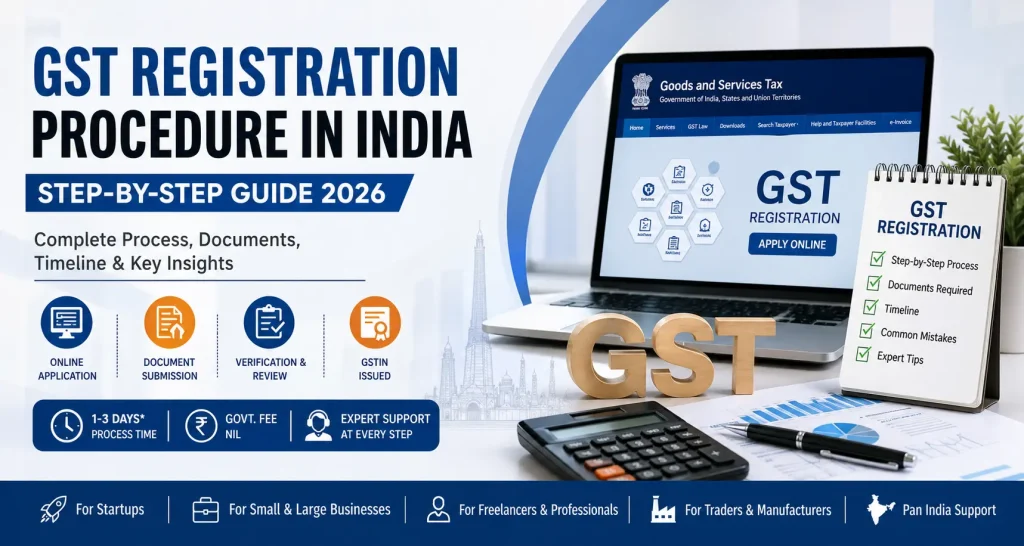
GST registration procedure in India is an online process where businesses apply through the GST portal, submit documents, and get approval to obtain GSTIN.
GST registration procedure in India is a fully online process where businesses apply through the GST portal by submitting Form GST REG-01, uploading required documents, and completing verification by the GST department to obtain a GSTIN.
With recent updates and ease-of-doing-business initiatives, the GST registration process has become faster and more streamlined. In many cases, Aadhaar-based verification allows quicker approval without physical interaction, making it easier for startups and businesses to get registered.
Businesses are required to obtain GST registration if they cross the prescribed turnover limits or engage in activities such as inter-state supply, e-commerce, or professional services. In practice, many businesses also opt for voluntary GST registration to work with corporates and expand operations.
This guide explains the step-by-step GST registration procedure, documents required, timeline, and practical insights to help you complete the process smoothly.
While the process is online, delays and rejections often happen due to incorrect application details, address proof issues, or non-response to GST notices. Proper guidance ensures faster approval and avoids compliance issues later.
Who Needs GST Registration in India?
GST registration is mandatory for businesses based on turnover limits and the nature of business activities. However, in practical business scenarios, GST registration is often required even before reaching these limits.
✔ ₹20 Lakhs – For service providers
✔ ₹40 Lakhs – For goods businesses
(Subject to conditions and category of business)
In addition to turnover-based registration, GST is mandatory in the following situations:
- Inter-state supply of goods or services
- Businesses selling through e-commerce platforms
- Input service distributors and agents
- Casual taxable persons and non-resident taxpayers
- Businesses required to deduct or collect TDS/TCS under GST
In cities like Bangalore, many corporates, startups, and vendors require a GSTIN as a basic condition for onboarding. Even if your turnover is below the threshold, businesses often go for voluntary GST registration to:
- Work with corporate clients and large companies
- Raise GST-compliant invoices
- Claim input tax credit (ITC)
- Expand business across states
- Build credibility and professional presence
GST registration is not just a legal requirement — it is also a business decision. Proper GST planning helps in selecting the right registration structure, tax rate applicability, and compliance model aligned with your business operations.
Choosing the right approach at the registration stage avoids future issues such as higher tax liability, incorrect GST classification, or compliance complications.
Documents Required for GST Registration
GST registration requires submission of business, identity, and address-related documents. Providing accurate and consistent documents is important to avoid rejection or delay in approval.
| Category | Documents Required |
|---|---|
| Business Details | PAN of business/entity, incorporation certificate (for companies/LLPs), partnership deed (if applicable) |
| Promoters / Directors | PAN card, Aadhaar card, photograph of proprietor/partners/directors |
| Business Address Proof | Rental agreement / ownership document + electricity bill or property tax receipt |
| Bank Details | Cancelled cheque or bank statement (can be updated after GST registration, generally within 30 days) |
| Authorized Signatory | Authorization letter / board resolution (for companies) |
In Bangalore, GST officers often ask for additional verification documents such as BBMP property tax paid receipt of the premises owner along with rental agreement and electricity bill. Proper documentation helps in avoiding delays or site verification issues.
All documents must match with PAN and Aadhaar details. Any mismatch in name, address, or spelling can lead to GST application rejection or clarification notice.
Incorrect address proof, unclear rental agreement, or non-submission of additional documents (like local tax proof) and failure to respond to GST officer queries are common reasons for delay or rejection.
Providing proper documentation at the initial stage ensures faster approval and avoids repeated follow-ups with the GST department.
Step-by-Step GST Registration Procedure (Simple Explanation)
The GST registration process is completely online. While the portal looks simple, each stage requires correct details and timely response to avoid delays or rejection.
You start by entering PAN, mobile number, email ID, and business location on the GST portal. Once verified, you receive a Temporary Reference Number (TRN) to continue the application.
Using the TRN, you log in and submit full business details including nature of business, address, bank details (optional initially), and promoter information.
All required documents such as address proof, identity proof, and business registration documents are uploaded. These documents must clearly match your application details.
The application is verified using Aadhaar OTP or Digital Signature (DSC). Aadhaar-based verification generally speeds up approval.
The GST officer reviews your application. If everything is clear, approval is granted. If not, a clarification notice is issued asking for additional details or documents.
Once approved, you receive your GSTIN and registration certificate. This allows you to issue GST invoices and start compliance.
Most delays occur at the verification stage where GST officers may ask for additional documents like address proof clarification, business activity details, or local verification support.
GST registration is not just about submitting the application. Proper follow-up, responding to notices, and handling verification queries are key to getting approval without delay.
With correct application and proper handling, GST registration can be completed quickly. However, errors or incomplete responses may lead to rejection or repeated queries.
Common Mistakes to Avoid in GST Registration
While GST registration is an online process, many applications get delayed, rejected, or stuck due to avoidable mistakes. Understanding these common issues can help you complete the process smoothly.
Entering wrong business activity, nature of supply, or registration type can lead to future compliance issues and even higher tax liability.
Differences in name spelling, address, or identity details between PAN, Aadhaar, and application form often result in rejection or clarification notices.
Submitting unclear rental agreement, missing ownership proof, or incorrect address documents is one of the most common reasons for GST rejection.
After application, GST officers may raise queries. Not responding within the timeline leads to rejection of the application.
Choosing incorrect category such as composition scheme or regular registration without proper understanding affects billing, tax rates, and compliance.
Many businesses focus only on getting GSTIN and ignore future compliance like return filing, invoicing, and reconciliation.
Most GST rejections are not due to system errors but due to incorrect application details or lack of proper response to verification queries.
A rejected GST application requires re-application, which delays business operations and affects onboarding with clients or vendors.
A well-prepared application with proper guidance ensures faster approval and avoids unnecessary delays or complications.
GST Registration Timeline & Cost
GST registration is designed as a quick online process. However, the actual time taken depends on document accuracy, verification process, and response to GST department queries.
✔ With proper documentation: 1–3 working days
✔ If clarification or verification required: 3–7 working days
In most cases, delay happens only when additional documents are requested or when there is no timely response to GST officer queries.
✔ Government Fees: NIL (No government charges for GST registration)
✔ Professional Fees: Reasonable and depends on service scope
Typical Professional Fees Range: ₹1,000 – ₹3,000 (basic registration support)
Value-Added Services (Included with Professional Firms like Prakasha & Co):
- ✔ Correct GST registration structure planning
- ✔ GST rate & billing guidance
- ✔ Application drafting & document verification
- ✔ Handling GST officer queries / notices
- ✔ Follow-up for faster approval
- ✔ Basic post-registration support
Choosing very low-cost or basic service providers may result in incorrect GST setup, delays, or lack of support in case of notices or verification issues.
GST registration is a one-time process, but correct setup at this stage ensures smooth business operations and avoids future compliance issues.
Why Professional Help Makes GST Registration Easy
While GST registration can be applied online, the real challenge lies in correct application, documentation, and handling GST department queries. Even small mistakes can lead to rejection or delay.
Working with an experienced GST consultant ensures your registration is done correctly from the beginning and aligned with your business needs.
- ✔ Correct GST structure based on your business model
- ✔ Accurate documentation to avoid rejection
- ✔ Handling GST officer queries and notices
- ✔ Faster approval through proper follow-up
- ✔ Guidance on billing, GST rates, and compliance
- ✔ Support for future GST filing and business expansion
At Prakasha & Co., we provide complete GST support for businesses in Bangalore and across India, ensuring smooth registration and compliance.
📧 Email: crp@prakashaandco.com
Get your GST registration done quickly with expert support.
Choosing the right GST consultant ensures not just registration, but long-term compliance, proper tax planning, and smooth business operations.
Frequently Asked Questions – GST Registration Procedure
How long does GST registration take?
GST registration usually takes 1–3 working days if all documents are correct. If additional verification or clarification is required, it may take 3–7 days.
Is GST registration completely online?
Yes, GST registration is an online process through the GST portal. However, GST officers may request additional documents or verification in certain cases.
What is the government fee for GST registration?
There is no government fee for GST registration. Only professional fees may apply if you take expert assistance.
Can I apply for GST without a bank account?
Yes, bank details can be updated after GST registration, typically within 30 days. However, providing bank details helps in smoother processing.
Is GST registration mandatory below ₹20 lakhs?
No, but many businesses opt for voluntary GST registration to work with corporate clients, claim input tax credit, and expand operations.
What happens if GST application is rejected?
If the application is rejected, you need to reapply with corrected details. This may delay your business operations and client onboarding.
Do I need professional help for GST registration?
While it is possible to apply online, professional assistance helps avoid mistakes, ensures faster approval, and provides guidance for future compliance.

Our GST & Business Compliance Services
- GST Registration Services
- GST Return Filing
- GST Notice & Legal Support
- Accounting & GST for Startups
- GST Cancellation & Re-registration
We provide complete GST support from registration to compliance under one roof.