Trademark Objection Reply in India – Protect Your Brand Before It’s Too Late
If your trademark status shows “Objected”, your brand has entered a critical legal stage — but it is still fully recoverable with the right action.
➤ A strong trademark objection reply can secure your brand. A weak reply can lead to permanent rejection.
A trademark objection is raised by the Trademark Examiner under the Trade Marks Act, 1999 to seek clarification on distinctiveness, similarity, or compliance. This stage requires a structured legal defence — not a basic or template response.
At Prakasha & Co., your case is handled by a Registered Trademark Attorney (Code: TM 25620) with 20+ years of experience, supported by a dedicated legal team that has successfully handled numerous trademark objections across industries.
What Makes Our Trademark Objection Handling Different
➤ Detailed analysis of examination report (Section 9 / 11 / procedural)
➤ Customized legal drafting — no copy-paste replies
➤ Use of case laws and precedents where applicable
➤ Strong representation in hearings (if required)
➤ Proven track record of successful objection clearances
➤ End-to-end handling until final registration
➤ We don’t just respond — we legally defend and position your brand for approval.
Why Many Trademark Applications Get Rejected
➤ Generic or copy-paste replies
➤ No legal reasoning or supporting arguments
➤ Missing the 30-day reply timeline
➤ Filing through unauthorized agents or online portals
⚠️ Important Legal Advisory – Avoid Unauthorized Trademark Consultants
As per CGPDTM Notice (07-01-2026), multiple online platforms are not authorized to represent clients before the Trademark Registry.
Unauthorized Entities Include:
onlinelegalindia.com, makenindia.com, lawpillars.in, indiafilings.com, e-startupindia.com, deenishlawchamber.com, corpbiz.io, companiesinn.com, cleartax.in, startupwala.com, uniqey.in, legalwiz.in, trademarkia.in, applytrademark.co.in, securetrademark.in, meraprofit.com, alonika.in, patntech.com
➤ Only registered trademark agents or advocates can legally handle objection replies.
➤ Always verify through official government portal:
👉
IP India Official Website
➤ If your trademark is objected, timely expert action can protect your brand, investment, and business future.
What is Trademark Objection in India?
A trademark objection is a formal observation raised by the Trademark Examiner during the examination stage of your application. It means that the examiner has found certain issues or requires clarification before allowing your trademark to proceed further.
It is important to understand that an objection does not mean rejection. Your application is still active, and you are given an opportunity to respond through a properly drafted trademark objection reply.
➤ The success of your trademark application at this stage depends on how professionally and legally the objection is handled.
Common Types of Trademark Objections
Trademark objections are generally raised under the following sections of the Trade Marks Act, 1999:
➤ Section 9 – Absolute Grounds for Refusal
➤ Mark is descriptive or generic
➤ Lacks distinctiveness
➤ Consists of common words or personal names
➤ Not capable of distinguishing your goods/services
➤ Section 11 – Relative Grounds for Refusal
➤ Similar or identical trademark already exists
➤ Likelihood of confusion among public
➤ Conflict with earlier registered marks
➤ Formality / Procedural Objections
➤ Missing Power of Attorney (TM-48)
➤ Incorrect trademark representation (logo mismatch)
➤ Classification or filing errors
➤ Incomplete or incorrect application details
In practice, many objections are a combination of legal (Section 9/11) and technical/formality issues. Each type requires a different legal approach while drafting the reply.
⚠️ Important: A generic or incorrect reply may lead to refusal of your trademark application. A properly structured legal reply with reasoning and supporting arguments is essential for success.
To understand how trademark registration works from filing to approval, you can refer to our detailed guide on trademark registration process in India.
Why Trademark Gets Objected? (Common Reasons Explained)
Even after conducting a proper trademark search and filing a unique brand name, it is common for the Trademark Office to raise objections. This happens because the examination process is based on strict legal provisions under the Trade Marks Act, 1999.
Understanding the exact reason for objection is the first step towards drafting a strong and successful trademark objection reply.
➤ Most objections are not about rejection — they are about clarification, justification, or compliance.
➤ Common Reasons for Trademark Objection
1. Similarity with Existing Trademark (Section 11 Objection)
➤ Your mark is similar to an already registered or applied trademark
➤ Likelihood of confusion among consumers
➤ Even phonetic or visual similarity can trigger objection
2. Lack of Distinctiveness (Section 9 Objection)
➤ Common or generic words
➤ Descriptive names related to product/service
➤ Personal names without uniqueness
➤ Marks not capable of distinguishing your brand
3. Descriptive or Generic Brand Name
➤ Names directly describing product features (e.g., “Best Quality Oil”)
➤ Industry common terms
➤ Lack of uniqueness in branding
4. Technical or Filing Errors
➤ Incorrect trademark class selection
➤ Incomplete application details
➤ Wrong or unclear trademark image/logo
➤ Mismatch between word mark and device mark
5. Missing or Incorrect Documents
➤ Power of Attorney (TM-48) not submitted
➤ Improper authorization
➤ Incomplete supporting documents
6. Formality Check Objection
➤ Differences in trademark representation
➤ Requirement to file correction (TM-M)
➤ Clerical or procedural issues in application
➤ Important Insight: Even a well-planned trademark can receive objection — what matters is how effectively the reply is handled.
A detailed trademark search and registration process reduces risk, but does not completely eliminate the possibility of objection.
⚠️ Key Point: Each objection requires a customized legal reply. Using generic templates or copy-paste replies can lead to rejection.
Most Common Trademark Objection: Power of Attorney (POA) Issue
Recently, one of the most common objections raised by the Trademark Office is:
“You are required to provide duly stamped Power of Attorney / Letter of Authorization.”
This is mainly due to the Karnataka Stamp Act amendment (Feb 2024), where:
➤ Stamp duty for Trademark POA increased from ₹100 to ₹500
➤ Applications filed with ₹100 stamp are now receiving objections
➤ Even valid trademarks are getting delayed due to this compliance issue
➤ This is not rejection — it is a correctable compliance requirement.
What You Should Do Immediately
➤ Check your trademark status here:
Check Trademark Status (Official Portal)
➤ Download examination report
➤ If POA objection is mentioned → act immediately
➤ Execute fresh POA with ₹500 e-stamp
➤ File reply within 30 days
➤ Download updated POA format:
Download TM-48 Format
⚠️ Important: If not corrected within 30 days, your application may be marked as abandoned.
Step-by-Step Process to Reply to Trademark Objection
Replying to a trademark objection is a structured legal process. Each step must be handled carefully to ensure your application moves toward acceptance.
➤ A well-drafted trademark objection reply is not just a response — it is a legal defence of your brand.
➤ Step-by-Step Trademark Objection Reply Process
Step 1: Analyse the Examination Report
➤ Identify whether objection is under Section 9, Section 11, or formality
➤ Understand the exact reason mentioned by the Trademark Examiner
➤ Check conflicting marks (if any)
Step 2: Legal Evaluation of the Trademark
➤ Evaluate distinctiveness of the mark
➤ Compare with cited trademarks
➤ Identify legal grounds to defend your application
Step 3: Drafting a Professional Reply
➤ Prepare a structured legal reply
➤ Include justification for uniqueness
➤ Add supporting arguments and case references (if applicable)
➤ Attach supporting documents (usage proof, brand details, etc.)
Step 4: Filing the Trademark Objection Reply
➤ Submit reply within prescribed timeline (generally 30 days)
➤ Ensure proper format and documentation
➤ Acknowledge submission on Trademark portal
Step 5: Handling Hearing (If Required)
➤ Attend hearing before Trademark Officer
➤ Present legal arguments and clarifications
➤ Address examiner’s concerns effectively
Step 6: Acceptance & Publication
➤ If reply is accepted, trademark proceeds to journal publication
➤ After publication → registration process continues
➤ Key Insight: Each objection requires a customized legal approach — there is no “one format” reply that works for all cases.
You can understand the complete filing journey here: trademark registration process in India.
⚠️ Important: Missing the reply deadline or submitting an incorrect reply may lead to abandonment or rejection of your trademark application.
Latest Trademark Power of Attorney (TM-48) Stamp Duty Value – State Wise (2026)
One of the most common trademark objections now issued by the Trademark Registry is:
“You are required to provide duly stamped (adequate stamp value) Power of Attorney”
This objection is mainly raised because many applicants file the TM-48 / Power of Attorney with incorrect stamp duty value.
⚠️ Stamp duty is governed by the respective State Stamp Act, and the value differs from state to state. Incorrect e-stamp value may lead to objection, delay, or abandonment of your trademark application.
➤ Important: The stamp duty depends on the state where the Power of Attorney is executed/signed.
State-wise TM-48 / Trademark POA Stamp Duty Value
| Stamp Duty Value | Applicable States |
|---|---|
| ₹100 | Andhra Pradesh, Arunachal Pradesh, Chhattisgarh, Delhi, Goa, Himachal Pradesh, Jharkhand, Manipur, Meghalaya, Mizoram, Uttar Pradesh, West Bengal |
| ₹200 | Uttarakhand |
| ₹300 | Gujarat |
| ₹500 | Assam, Karnataka, Madhya Pradesh, Maharashtra, Odisha, Rajasthan, Telangana |
| ₹600 | Kerala |
| ₹700 | Haryana |
| ₹1000 | Bihar, Punjab, Tamil Nadu |
➤ Recently, many trademark applications are receiving objections because old TM-48 documents were executed with lower stamp duty values such as ₹100, while revised state rules now require higher stamp duty.
➤ Before filing your trademark objection reply, always ensure the Power of Attorney is executed with the correct state-specific e-stamp value.
⚠️ If the correct stamp duty is not paid, the Trademark Registry may issue objection and your application can be delayed or marked as abandoned.
How Prakasha & Co. Handles Trademark Objection Reply (Expert Approach)
Handling a trademark objection is not a routine filing task — it is a legal process that requires experience, strategy, and deep understanding of trademark law.
At Prakasha & Co., your case is handled by a Registered Trademark Attorney (Code: TM 25620), supported by a team of legal professionals with practical experience in objection handling, hearings, and brand protection.
➤ We don’t use templates — every trademark objection reply is customized based on your brand, objection type, and legal position.
➤ Our Structured Approach to Trademark Objection Reply
➤ Detailed Objection Analysis
➤ Complete review of examination report
➤ Identification of legal grounds (Section 9 / 11 / Formality)
➤ Evaluation of risk and possible outcomes
➤ Legal Positioning of Your Brand
➤ Establish distinctiveness of the mark
➤ Differentiate from cited trademarks
➤ Prepare strong legal arguments based on facts
➤ Use of Case Laws & Precedents
➤ Reference relevant trademark judgments
➤ Apply accepted legal principles
➤ Strengthen reply with practical case-based reasoning
➤ Professional Drafting of Reply
➤ Clear, structured, and legally sound response
➤ Avoid generic or copy-paste formats
➤ Align reply with Trademark Office expectations
➤ Filing & Compliance Management
➤ Timely filing within deadline
➤ Proper documentation and submission
➤ Monitoring application status
➤ Hearing Representation (If Required)
➤ Appearance before Trademark Officer
➤ Presenting arguments clearly and effectively
➤ Handling complex objections professionally
➤ Result-Oriented Approach: Our focus is not just replying — but ensuring your trademark moves towards acceptance and registration.
➤ What Makes Us Different from Other Consultants?
➤ Registered Trademark Attorney (TM 25620) – legally authorized representation
➤ 20+ years of experience in legal and IP matters
➤ Real case handling (not theoretical or automated replies)
➤ Integrated legal + advisory approach
➤ No “guarantee” claims — only legally valid solutions
⚠️ Important Advisory: Avoid unauthorized agents or online platforms offering “guaranteed trademark approval”.
➤ As per IP India (2026 notice), several online service providers are not authorized to represent clients.
➤ Only registered trademark agents or advocates can legally handle objection replies.
➤ Incorrect handling may lead to rejection or loss of your brand.
➤ Your brand deserves proper legal defence — not generic replies.
Trademark Objection Cleared – Real Case Proof & Results
A trademark objection does not mean rejection. With proper legal handling, structured reply, and correct documentation, objections can be successfully cleared.
At Prakasha & Co., our Registered Trademark Attorney (TM 25620) and legal team have handled multiple objection cases and secured successful registrations.
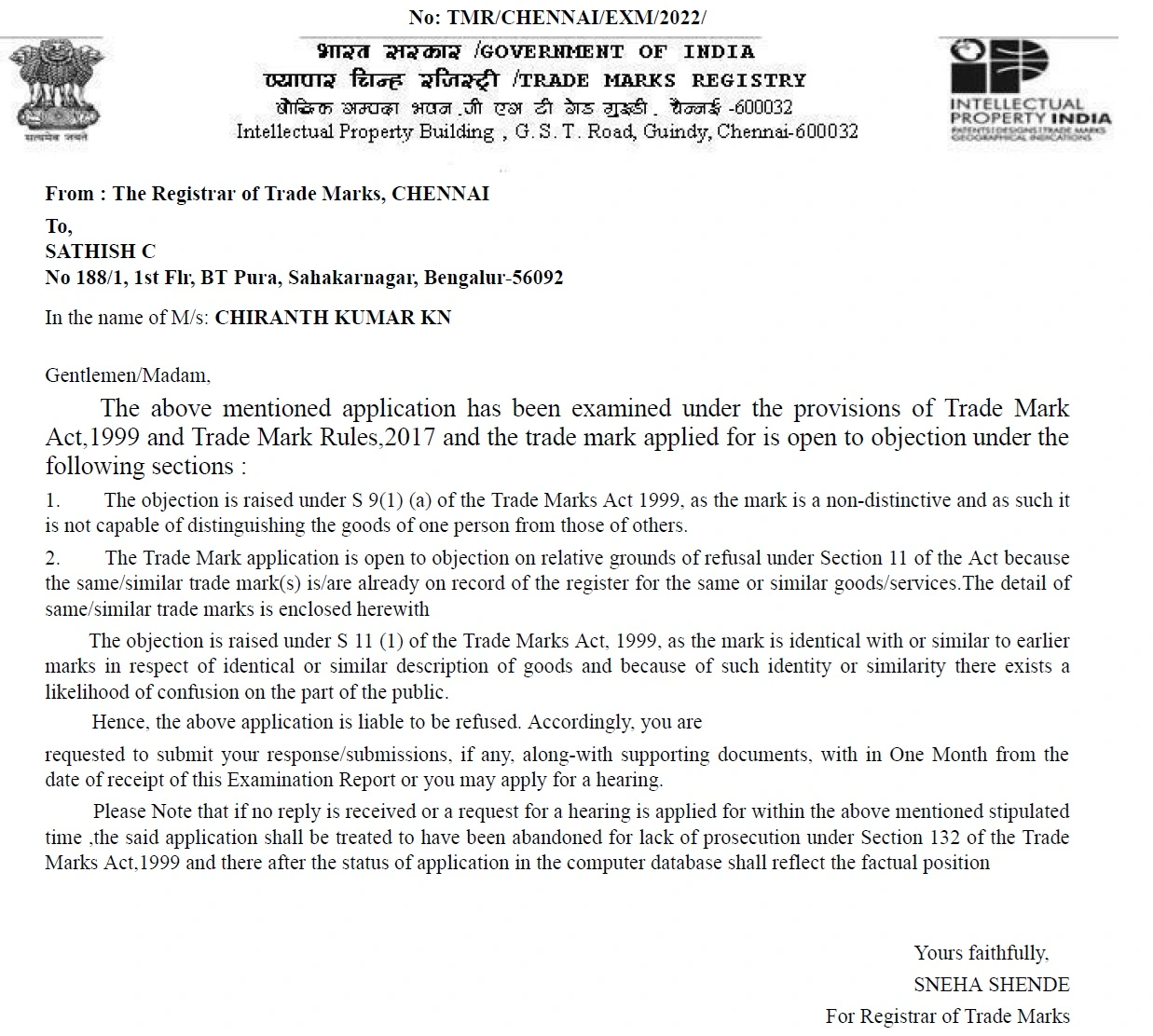
➤ Case 1: “KANNADI” – Objection Cleared & Registered
Issue: Trademark objection due to procedural mismatch
Action: TM-M correction + structured legal reply
Result: Trademark accepted and registration certificate issued
📄 Objection Notice
✅ Registration Certificate
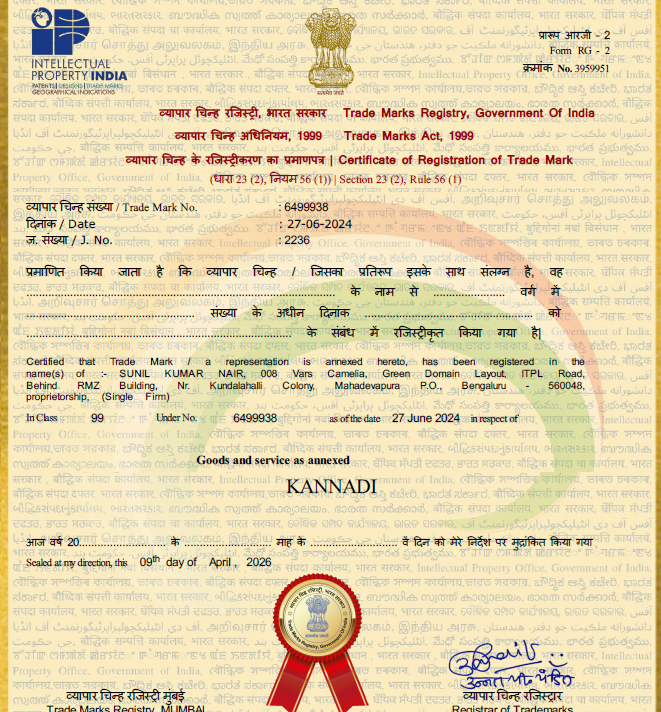
➤ Key Insight: Even technical objections can be cleared with proper compliance and legal correction.
➤ Case 2: “Sand Masters” – Section 11 Objection Cleared
Issue: Similarity with existing trademark
Challenge: Considered descriptive (“Sand”)
Action: Established brand distinctiveness + legal differentiation
Result: Objection cleared and mark accepted
➤ Key Insight: Even descriptive-looking names can be protected if positioned as a unique brand identity.
➤ Case 3: “Chiranth Kumar” – From Objection to Registration
Issue: Examination objection raised by Registry
Action: Detailed reply with supporting documents
Result: Trademark registered successfully
👉 View Objection Notice | View Registration Certificate
➤ Key Insight: Strong documentation and structured reply ensures successful approval.
Important: No One Can Guarantee Trademark Approval
➤ Trademark approval is governed by the Trade Marks Act, 1999
➤ Final decision lies with the Trademark Registry
➤ No consultant can legally guarantee registration
However, success depends on:
➤ Proper legal interpretation of objection
➤ Strong reply drafting
➤ Supporting evidence and compliance
➤ Timely submission and follow-up
➤ With expert handling, chances of clearing objection increase significantly.
➤ These real cases prove: Trademark objection is not the end — it is your opportunity to secure your brand legally.
Types of Trademark Objections in India (Section 9 & Section 11 Explained)
Trademark objections in India are generally raised under two major legal provisions of the Trade Marks Act, 1999 — Section 9 and Section 11.
Understanding which section your objection falls under is important, as the legal approach for reply differs in each case.
➤ Each type of objection requires a different legal strategy — there is no one-size-fits-all reply.
➤ Section 9 Objection – Absolute Grounds for Refusal
Section 9 objections are raised when the trademark lacks distinctiveness or is considered descriptive in nature.
Common Reasons:
➤ Trademark is descriptive of product or service
➤ Common or generic words used
➤ Personal or surname without uniqueness
➤ Mark not capable of distinguishing goods/services
Example:
➤ Names like “Best Quality Rice” or “Pure Oil” may face objection as they describe the product directly.
How We Handle Section 9:
➤ Establish brand distinctiveness
➤ Show unique combination or coined nature
➤ Provide usage proof (if available)
➤ Build strong legal justification
➤ Section 11 Objection – Relative Grounds for Refusal
Section 11 objections are raised when your trademark is considered similar to an existing or prior registered trademark.
Common Reasons:
➤ Similar sounding or spelling trademarks
➤ Visual resemblance with existing marks
➤ Likelihood of confusion in the market
➤ Same or related class of goods/services
Example:
➤ “SAND MASTER” vs “SAND MASTERS” may trigger objection if not differentiated properly.
How We Handle Section 11:
➤ Detailed comparison with cited marks
➤ Highlight visual, phonetic, and conceptual differences
➤ Establish distinct business identity
➤ Provide legal reasoning to remove confusion
➤ Formality / Procedural Objections
These objections are not related to the brand itself but arise due to technical or documentation issues.
Common Issues:
➤ Missing Power of Attorney (TM-48)
➤ Incorrect trademark image or logo mismatch
➤ Wrong classification
➤ Clerical errors in application
➤ Need for amendment (TM-M filing)
How We Handle:
➤ Correct filing errors immediately
➤ Submit proper amendment requests
➤ Ensure compliance with Trademark Registry requirements
⚠️ Important: Identifying the correct type of objection is the key to drafting a successful trademark objection reply.
If you are unsure about your objection type, refer to your examination report or consult experts before filing a reply.
Documents Required, Timeline & Fees for Trademark Objection Reply
Once a trademark objection is raised, timely action with proper documentation is essential to avoid rejection or abandonment of your application.
➤ A complete and properly drafted trademark objection reply increases the chances of successful approval.
➤ Documents Required for Trademark Objection Reply
➤ Examination Report (issued by Trademark Office)
➤ Authorization Letter / Power of Attorney (TM-48)
➤ Trademark Application Details
➤ Brand usage proof (if available – invoice, website, packaging, etc.)
➤ Supporting documents (if required based on objection)
➤ Note: Not all cases require usage proof — it depends on the nature of objection (especially Section 9 cases).
➤ Timeline for Trademark Objection Reply
➤ Reply must be filed within 30 days from the date of examination report
➤ Delay in reply may lead to abandonment of application
➤ After reply submission, the Trademark Office may:
➤ Accept the application directly
➤ Raise further clarification
➤ Schedule hearing (if required)
⚠️ Important: Missing the 30-day deadline can result in losing your trademark application completely.
➤ Trademark Objection Reply Fees (2026)
➤ Professional Fees: ₹3,000 – ₹7,000 (depending on complexity)
➤ Government Fees: NIL (for objection reply submission)
➤ Hearing Fees (if applicable): Additional charges based on representation
➤ The cost may vary depending on:
➤ Type of objection (Section 9 / Section 11)
➤ Number of objections raised
➤ Requirement of legal research or hearing
➤ At Prakasha & Co., we provide clear and transparent pricing with complete support from reply drafting to final outcome.
You can also explore our full trademark registration services for complete end-to-end assistance.
Complete Trademark Process – Step-by-Step Visual Guide
To make it simple for business owners, we have explained the complete trademark process in 3 clear stages. This will help you understand where objections arise and how your trademark moves towards registration.
➤ Stage 1: Application & Examination (Critical Stage)
This is the most important stage where the Trademark Officer reviews your application. Objections are generally raised at this stage.

➤ Includes filing, examination, objection, reply, and hearing (if required)
➤ A proper trademark objection reply at this stage is crucial for success
➤ Stage 2: Publication & Opposition (Public Review Stage)
Once your trademark is accepted, it is published in the Trademark Journal for public review.

➤ Any third party can oppose within 4 months
➤ If opposed, legal proceedings begin (counter statement, evidence, hearing)
➤ Final Stage: Registration & Legal Protection
After clearing all stages, your trademark is registered and you receive legal ownership rights.

➤ Registration certificate issued
➤ Valid for 10 years (renewable)
➤ Legal protection against misuse or infringement
➤ Need Help with Trademark Objection or Hearing?
If your trademark is objected or opposed, proper legal handling is required at each stage including reply drafting, hearings, and dispute resolution.
👉 Consult Legal Experts for Trademark Objection & Hearing Support
FAQs – Trademark Objection Reply in India
➤ What should I do if my trademark is objected?
You should review the examination report and file a proper trademark objection reply within the prescribed time. A professional legal reply increases the chances of approval.
➤ How to reply to trademark objection in India?
A reply must be drafted with legal reasoning, addressing each objection raised under Section 9 or Section 11, along with supporting arguments and documents.
➤ What is Section 9 objection in trademark?
Section 9 objection is raised when the trademark is considered descriptive, generic, or lacks distinctiveness.
➤ What is Section 11 objection in trademark?
Section 11 objection is raised when your trademark is similar to an existing registered or applied trademark, leading to possible confusion.
➤ Can a trademark objection be cleared?
Yes, most objections can be successfully cleared with a properly drafted legal reply and correct representation.
➤ What happens if I don’t reply to trademark objection?
Failure to respond within the deadline may lead to abandonment of your trademark application.
➤ How long does it take to clear trademark objection?
The timeline depends on the case. Some objections are cleared after reply, while others may require a hearing before approval.
➤ Is trademark objection same as rejection?
No, objection is not rejection. It is an opportunity to clarify and defend your application.
➤ Your Trademark is Objected? Take Action Now
A trademark objection does not mean the end of your brand — it is a stage where your brand needs proper legal defence.
With the right approach, legal drafting, and expert handling, your trademark can still be successfully registered.
➤ Get expert assistance from Registered Trademark Attorney (Code: TM 25620)
➤ Complete objection analysis
➤ Professional reply drafting
➤ Legal representation (if hearing required)
➤ End-to-end support until resolution
👉 Consult trademark experts and protect your brand today

Author – Satheesh S (Trademark Attorney)
Satheesh S is a Registered Trademark Attorney (Agent Code: TM 25620) with over 20+ years of experience in handling trademark registration, objection replies, and legal representation before the Trademark Registry.
He specializes in:
➤ Trademark objection reply drafting (Section 9 & 11)
➤ Representation in trademark hearings
➤ Brand protection strategy and legal advisory
➤ Handling complex objection and refusal cases
➤ End-to-end trademark registration support
With a strong legal background and practical case handling, he has successfully assisted businesses in securing their trademarks even after objections were raised by the Trademark Office.
➤ His approach focuses on legal accuracy, structured argument, and protecting client’s brand interest at every stage.
Recent Trademark Case Successfully Registered After Objection Clearance
Below is one of the recent trademark registration certificates issued after successful objection handling:
👉 View Trademark Registration Certificate (KANNADI Case)
➤ This case demonstrates how proper legal handling and structured reply can convert an objection into successful registration.
Last Updated: April 2026
Explore Our Trademark Services
➤ Trademark Registration in Bangalore
➤ Trademark Search & Registration Guide
➤ Trademark Registration Process in India
➤ Trademark Rights in India
➤ Trademark Legal Protection & Injunction
➤ At Prakasha & Co., we provide complete trademark support — from filing to objection handling and final registration — ensuring your brand is legally protected at every stage.