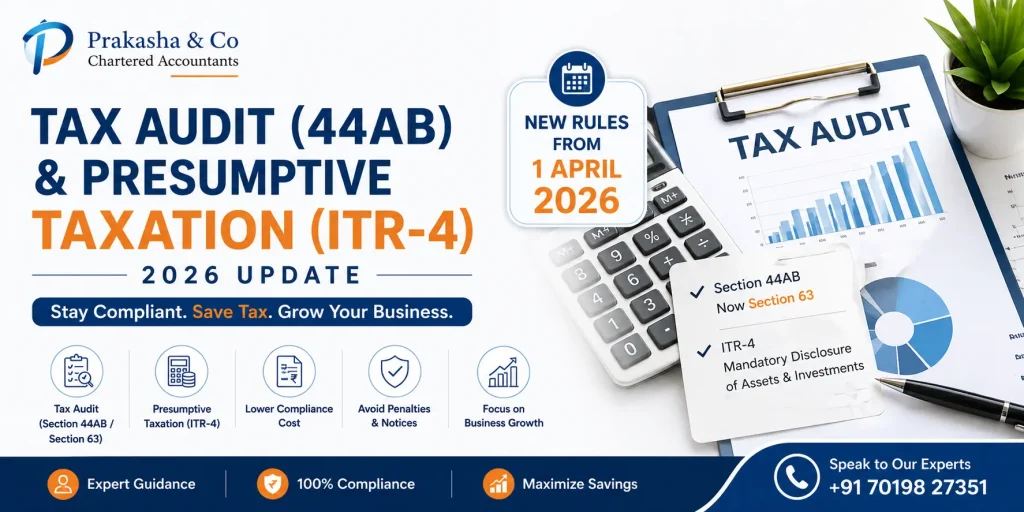
Tax Audit 44AB is a key compliance requirement for businesses and professionals under the Income Tax Act. With the 2026 updates, taxpayers must also evaluate presumptive taxation (ITR-4) and new disclosure requirements carefully.
Income Tax Audit & Presumptive Taxation (ITR-4) – Updated Rules from April 2026
From April 1, 2026, significant changes have been introduced under the new Income Tax Act, 2025. Businesses and professionals must now clearly understand whether to opt for tax audit (Section 44AB / Section 63) or presumptive taxation (ITR-4).
Choosing the right method impacts your compliance cost, tax liability, and risk of notices. Proper planning helps avoid unnecessary audit burden while staying fully compliant.
Tax Audit Requirement – Section 44AB (Now Transitioning to Section 63)
Under the new Income Tax Act, 2025, Section 44AB is being restructured into Section 63 to simplify audit compliance and reporting.
- Ensures correctness of income and deductions
- Verifies compliance with tax provisions
- Reduces chances of scrutiny
- Improves financial credibility
Applicability of Tax Audit (FY 2025-26 / AY 2026-27)
| Category | Threshold |
|---|---|
| Business | ₹1 Crore (₹10 Crore if 95% digital) |
| Profession | ₹50 Lakhs |
| Presumptive Cases | If profit declared below limits |
Presumptive Taxation – Simplified Tax Filing (ITR-4)
Presumptive taxation allows small businesses and professionals to avoid detailed books and audit requirements by declaring fixed percentage income.
- Business (44AD): Turnover up to ₹2–3 Crore
- Profession (44ADA): Receipts up to ₹75 Lakhs
- Profit: 6% / 8% (business), 50% (profession)
New Rule from April 2026 – Mandatory Disclosure in ITR-4
- Assets (property, investments, etc.)
- Bank balances
- Capital details
- Financial position summary
Earlier, presumptive scheme avoided detailed reporting. Now, transparency is increased to reduce misuse and mismatch with AIS.
Audit vs Presumptive Taxation – Which is Better?
| Particular | Presumptive | Audit |
|---|---|---|
| Compliance | Low | High |
| Books Required | No | Yes |
| Flexibility | Limited | High |
| Best For | Small taxpayers | Growing businesses |
Practical Tax Planning Strategy (2026)
- Use presumptive scheme to reduce compliance cost
- Maintain digital transactions to increase threshold
- Switch to audit if actual profit is lower
- Reconcile GST, TDS & books regularly
- Choose correct tax regime (old vs new)
Documents Required for Tax Audit / Presumptive Filing
The documentation requirement depends on your business type, turnover, and whether you opt for audit or presumptive taxation. Below are the commonly required details.
All bank account statements (business & personal if used for business transactions).
Sales invoices, receipts, and turnover details (including digital and cash).
Purchase bills, expense vouchers, and payment records.
GST login access, GSTR-1, GSTR-3B, and reconciliation details.
PAN, Income Tax login, previous ITR copies, Form 26AS / AIS.
TDS returns, challans, and deduction details (if applicable).
Property, fixed assets, bank balances, investments (mandatory for ITR-4 disclosure).
Business loans, EMI schedules, creditors and outstanding balances.
Cash book, ledger, profit & loss, balance sheet.
Payroll details, stock records, agreements (if applicable).
Common Mistakes to Avoid
- Wrong selection of presumptive scheme
- Ignoring asset disclosure in ITR-4
- Mismatch between GST & ITR
- Late audit filing
How Prakasha & Co Helps
- Audit & presumptive tax planning
- ITR filing with correct compliance
- Notice handling support
- GST, TDS & accounting alignment
Frequently Asked Questions – Tax Audit & Presumptive Taxation
What is the fees for Income Tax Audit?
Tax audit fees generally start from ₹10,000 to ₹25,000 for small businesses. The cost may increase based on turnover, number of transactions, GST reconciliation, and complexity of accounts.
What is the cost for presumptive taxation (ITR-4 filing)?
Presumptive taxation filing (ITR-4) is more cost-effective and typically ranges from ₹3,000 to ₹7,500 depending on business details, disclosures, and asset reporting requirements.
Which is better – Tax Audit or Presumptive Taxation?
Presumptive taxation is suitable for small businesses to reduce compliance cost. However, if your actual profit is lower than prescribed limits, tax audit may be beneficial to reduce tax liability legally.
What are the new changes in ITR-4 from April 2026?
Under the new rules, taxpayers opting for presumptive taxation must disclose asset details, investments, bank balances, and financial position in ITR-4. This increases transparency and reduces mismatch with AIS data.
Is audit mandatory if turnover is below ₹2 crore?
Not necessarily. If you opt for presumptive taxation and declare required profit percentage, audit is not required. However, if profit is declared lower, audit becomes mandatory.
What happens if tax audit is not done?
Non-compliance may attract penalty of 0.5% of turnover (maximum ₹1,50,000) along with possible notices and disallowance of certain claims.
Can you help in handling income tax notices?
Yes, we assist in responding to notices, correcting filings, and representing your case before the Income Tax Department wherever required.
Do I need to maintain books if I choose presumptive taxation?
Detailed books are not mandatory, but basic records like bank statements and income details should be maintained, especially due to new disclosure requirements in ITR-4.
Can I switch from presumptive taxation to audit or vice versa?
Yes, but certain conditions apply. Frequent switching may lead to restrictions, so it should be planned carefully based on your business situation.
Do you handle complete compliance including GST, TDS, and accounting?
Yes, we provide end-to-end support including accounting, GST filing, TDS compliance, tax audit, and income tax return filing.
How early should I start tax audit preparation?
It is advisable to start early to avoid last-minute issues. Proper planning helps in reconciliation, correct reporting, and avoiding penalties.