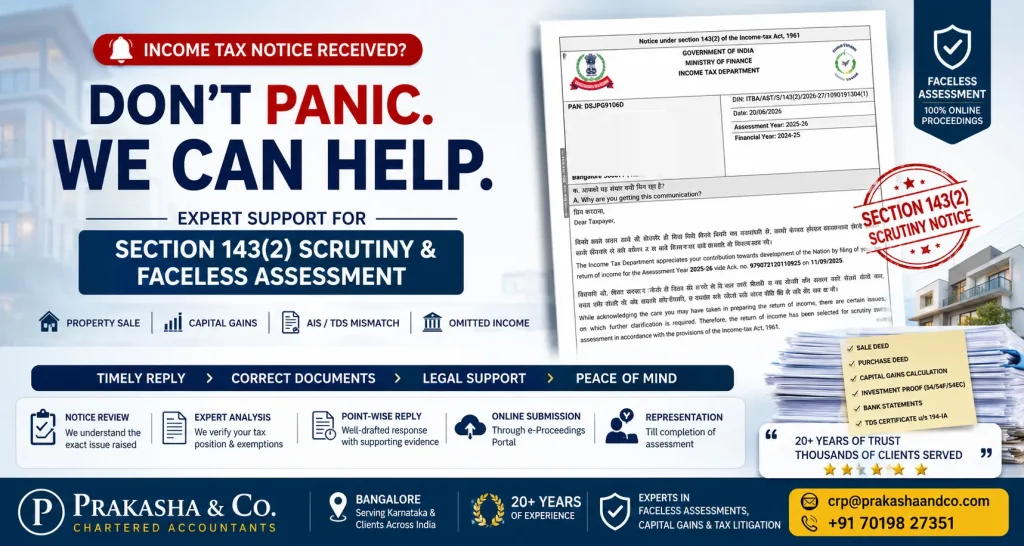
Income Tax Notice for Property Sale? Our Help for Section 143(2) Scrutiny; Faceless Assessment
Received an Income Tax Notice after selling your property? Don’t panic. In many cases, the notice is issued because the Income Tax Department requires clarification regarding your property transaction, capital gains calculation, exemption claimed under Section 54 or 54F, mismatch in AIS or Form 26AS, or other financial information. Receiving a notice does not automatically mean that additional tax is payable.
At Prakasha and Co., CA’s office, we have been assisting taxpayers Income Tax Notice for Property Sale in Bangalore and Karnataka for over 20 years in handling Faceless Assessment, Section 143(2) Scrutiny Notices, Property Sale Cases, Capital Gain Assessments, and Income Tax e-Proceedings. Our objective is simple—understand the reason behind the notice, prepare the correct documentary evidence, and submit a professional response that protects your legitimate tax position.
Received Any of These Notices?
- ✔ Notice under Section 143(2)
- ✔ Income Tax Scrutiny Notice
- ✔ Faceless Assessment Notice
- ✔ Property Sale Verification Notice
- ✔ Capital Gain Mismatch Notice
- ✔ Omitted Income Notice
- ✔ AIS / Form 26AS Mismatch
- ✔ High Value Transaction Notice
- ✔ Bank Transaction Verification Notice
Our CA team can review your notice, explain the actual issue, prepare your reply and represent you before the Income Tax Department through the Faceless Assessment Portal.
Why Did I Receive an Income Tax Notice Under Section 143(2)?
Receiving an Income Tax Notice under Section 143(2) does not automatically mean you have done something wrong. In most cases, the Income Tax Department wants additional clarification before accepting the income declared in your Income Tax Return. The scrutiny process is now completely digital under the Faceless Assessment Scheme, where all replies are submitted online through the Income Tax e-Proceedings Portal.
Property transactions are one of the most closely monitored financial activities in India. Today, the Income Tax Department receives transaction data automatically from multiple government departments and financial institutions. Even a genuine mismatch, missing document or difference in reporting can trigger a scrutiny assessment.
How Does the Income Tax Department Track Property Transactions?
Many taxpayers are surprised to receive a scrutiny notice because they assume the Income Tax Department only verifies the figures mentioned in the Income Tax Return. In reality, the Department compares your return with information received from several independent sources before selecting cases for scrutiny.
Information commonly verified by the Income Tax Department includes:
- ✔ Property Registration details received from the Sub-Registrar Office
- ✔ TDS deducted by the purchaser under Section 194-IA
- ✔ Annual Information Statement (AIS)
- ✔ Form 26AS
- ✔ Statement of Financial Transactions (SFT)
- ✔ PAN-linked property purchases and sales
- ✔ Bank account credits received from the buyer
- ✔ Stamp Duty valuation reported by the Registration Department
- ✔ Capital gains reported in the Income Tax Return
- ✔ Investments claimed under Sections 54, 54F and 54EC
- ✔ High-value deposits and other linked financial transactions
When these records do not match the Income Tax Return filed by the taxpayer, the case may be selected for Scrutiny Assessment under Section 143(2) to verify the correctness of the income reported.
Common Reasons for Receiving a Section 143(2) Scrutiny Notice
Every scrutiny notice is different. However, based on our experience of handling income tax assessments, the following are some of the most common reasons for selection under scrutiny.
Property Sale Related
- Sale consideration differs from registration records
- Incorrect capital gain computation
- Section 54 or 54F exemption claimed
- Improvement expenses not supported
- Joint ownership mismatch
- Difference in Stamp Duty value
Income Related
- Income omitted from the Income Tax Return
- Mismatch in AIS or Form 26AS
- TDS reflected but income not reported
- Interest income omitted
- Rental income mismatch
- Business receipts mismatch
Financial Transactions
- Large bank deposits
- High-value cash transactions
- Mutual fund investments
- Share transactions
- Foreign remittances
- Credit card spending pattern
Most of these issues can be satisfactorily explained by submitting proper documentary evidence and a well-drafted reply through the Income Tax e-Proceedings Portal.
Our Practical Experience in Property Sale Scrutiny Cases
Recently, our office represented a Bangalore family that received a Section 143(2) Scrutiny Notice after reporting capital gains from the sale of their ancestral property. Although the capital gains had been correctly disclosed in the Income Tax Return, the Department sought clarification regarding the exemption claimed and supporting documents.
Our team reviewed the complete transaction, verified the sale deed, purchase records, indexed cost calculation, exemption eligibility and supporting bank transactions. After preparing a comprehensive point-wise reply with documentary evidence through the Faceless Assessment Portal, the assessment proceedings progressed smoothly without unnecessary litigation.
Every scrutiny case is different. Understanding the exact issue raised by the Department and submitting the right evidence at the right stage often makes a significant difference in the outcome.
Limited Scrutiny vs Complete Scrutiny – What’s the Difference?
One of the first questions taxpayers ask after receiving an Income Tax Notice is whether the scrutiny is Limited Scrutiny or Complete Scrutiny. The answer determines the scope of verification and the documents that may be required during the assessment proceedings.
Limited Scrutiny
Under Limited Scrutiny, the Income Tax Department examines only the specific issue mentioned in the notice or subsequent questionnaire. For example, the verification may be restricted to:
- ✔ Capital gain on property sale
- ✔ Section 54 or 54F exemption claimed
- ✔ Bank transaction verification
- ✔ Difference in AIS or Form 26AS
- ✔ High-value financial transaction
If satisfactory evidence is submitted, the assessment is generally completed without examining other unrelated matters.
Complete Scrutiny
In Complete Scrutiny, the Assessing Officer may examine the entire Income Tax Return, including all sources of income, deductions, exemptions, investments and financial transactions for the relevant assessment year.
This generally requires a much more comprehensive review of the taxpayer’s financial records and supporting documents.
Before preparing any reply, it is important to identify the exact scope of scrutiny. Submitting unnecessary documents or overlooking the actual issue can unnecessarily complicate the assessment.
Documents Required for Replying to a Section 143(2) Scrutiny Notice
The documents required depend upon the issue raised by the Department. However, for most property sale and capital gain scrutiny cases, the following documents are commonly required.
- ✔ Copy of Income Tax Notice
- ✔ Income Tax Return filed
- ✔ PAN & Aadhaar
- ✔ Sale Deed
- ✔ Purchase Deed
- ✔ Khata / Revenue Records (where applicable)
- ✔ Encumbrance Certificate
- ✔ Capital Gain Working
- ✔ Indexed Cost Calculation
- ✔ Cost Improvement Bills
- ✔ Brokerage & Legal Expense Bills
- ✔ Bank Statements reflecting sale consideration
- ✔ Form 26AS
- ✔ AIS (Annual Information Statement)
- ✔ TDS Certificate under Section 194-IA (if applicable)
- ✔ Investment proof under Section 54, 54F or 54EC
- ✔ Builder Agreement / Possession Letter (where applicable)
- ✔ Any earlier correspondence with the Income Tax Department
Providing complete documentation at the initial stage often helps avoid repeated notices and unnecessary delays during the assessment process.
Why Professional Representation Makes a Difference
Many taxpayers believe that simply uploading the requested documents is sufficient. However, scrutiny assessments are not decided only on documents—they are decided on how the facts are explained and supported under the Income Tax Act.
In our experience, successful scrutiny responses combine three important elements:
- Accurate documentary evidence supporting every financial transaction.
- Proper legal explanation linking the facts with the applicable provisions of the Income Tax Act.
- Relevant judicial precedents, wherever required, to support the taxpayer’s claim.
Whether the issue relates to property sale, inherited property, Section 54 exemption, Section 54F investment, omitted income or AIS mismatch, presenting the facts correctly is often as important as the documents themselves.
Recent Tax Relief for Property Sellers – ITAT Decision (June 2026)
Every scrutiny notice does not result in additional tax. Courts and Tribunals have repeatedly held that genuine taxpayers should not lose tax benefits merely because of procedural delays.
In a recent ITAT decision (June 2026), the Tribunal allowed the taxpayer’s claim for exemption under Section 54 even though the transfer documentation was completed later due to circumstances beyond the taxpayer’s control. The Tribunal observed that genuine compliance should prevail over procedural delays where the conditions of the law are substantially satisfied.
If your scrutiny notice relates to property sale, capital gains or exemption under Sections 54, 54F or 54EC, the availability of judicial precedents can significantly strengthen your reply.
Common Mistakes to Avoid
- ❌ Ignoring the notice or missing the due date.
- ❌ Uploading incomplete documents.
- ❌ Incorrect capital gain calculation.
- ❌ Not explaining AIS or Form 26AS mismatch.
- ❌ Claiming exemption without proper evidence.
- ❌ Replying without professional review.
A well-prepared reply at the first stage often avoids unnecessary additions and repeated notices.
Why Choose Prakasha & Co.?
- ✔ 20+ Years of Income Tax Practice
- ✔ Experts in Faceless Assessments
- ✔ Capital Gain & Property Sale Specialists
- ✔ Online Representation across India
- ✔ Complete Reply through e-Proceedings Portal
- ✔ Assistance till Assessment Completion
We have represented salaried employees, NRIs, business owners and families in scrutiny cases involving property sales, inherited properties, capital gains, AIS mismatches and omitted income.
Received an Income Tax Notice?
Don’t wait until the last date. A timely and properly drafted reply can make a significant difference in the outcome of your scrutiny assessment.
Our Chartered Accountants will review your notice, verify your tax computation, prepare a point-wise reply and represent you before the Income Tax Department through the Faceless Assessment Portal.
📧 crp@prakashaandco.com
📞 +91 7019827351
🌐 Prakasha & Co., Bangalore
Our Practical Experience
Recently, we assisted a Bangalore family that received a Section 143(2) Scrutiny Notice after selling their ancestral property. Although the capital gains had been correctly reported, the Income Tax Department sought additional clarification regarding the exemption claimed. Our team prepared the capital gains computation, supporting documents and a detailed online reply through the Faceless Assessment Portal, enabling the client to complete the scrutiny process smoothly.
Who Can Benefit From Our Income Tax Scrutiny Support?
Our services are suitable for individuals, families, NRIs and business owners who have received an Income Tax Notice relating to property transactions or other financial matters.
- ✔ Sold a site, flat, house or commercial property
- ✔ Sold inherited (ancestral) property
- ✔ Claimed exemption under Sections 54, 54F or 54EC
- ✔ Received a Section 143(2) Scrutiny Notice
- ✔ Received a notice for omitted income or AIS mismatch
- ✔ Received a notice after high-value bank transactions
- ✔ Need professional representation before the Income Tax Department
Frequently Asked Questions (FAQs)
I have received a Section 143(2) notice. Should I be worried?
No. It only means the Income Tax Department requires clarification regarding your Income Tax Return. A proper reply with supporting documents usually resolves the issue.
I sold my property, but it was in my wife’s name. Is that a problem?
Not necessarily. The important point is who is the legal owner and how the sale and capital gains have been reported. We review the ownership documents and advise the correct tax position.
My wife inherited the property from her father and has never filed an Income Tax Return. Can she still receive a notice?
Yes. Property transactions are reported to the Income Tax Department through the Sub-Registrar and PAN-based reporting. Even if she has not filed earlier returns, the sale may require compliance depending on the facts.
I recently sold a site and earned about ₹20 lakh profit. Can my capital gains tax be reduced legally?
Possibly. Relief may be available under Sections 54, 54F, 54EC or by correctly computing indexed cost and eligible deductions. Every case should be reviewed before paying tax.
I have already paid tax. Why did I still receive a notice?
Many notices are issued to verify documents, exemptions claimed or differences found in AIS, Form 26AS or property transaction records.
Will the Income Tax Department know that I sold my property?
Yes. Property registrations, TDS under Section 194-IA, AIS, Form 26AS, bank transactions and other reporting systems enable the Department to verify property transactions electronically.
I forgot to report my property sale in my Income Tax Return. What should I do?
Do not ignore the issue. Depending on the stage of proceedings, corrective action may still be available. Early professional advice is recommended.
Can I reply to the scrutiny notice myself?
Yes, but your reply should be complete, supported by evidence and legally correct. Many taxpayers prefer professional assistance to avoid mistakes.
What happens if I ignore the Income Tax Notice?
The Department may complete the assessment based on available information, which could result in additional tax demand, interest or penalties.
How many days do I get to reply?
The response time is mentioned in the notice or subsequent communication. Always submit your reply before the due date.
Can you help taxpayers outside Bangalore?
Yes. Since scrutiny proceedings are conducted online through the Faceless Assessment Portal, we assist clients across Karnataka and throughout India.
How much do you charge for handling a scrutiny notice?
Our professional fee depends on the complexity of the case. After reviewing the notice, we provide a transparent quotation before starting the assignment.