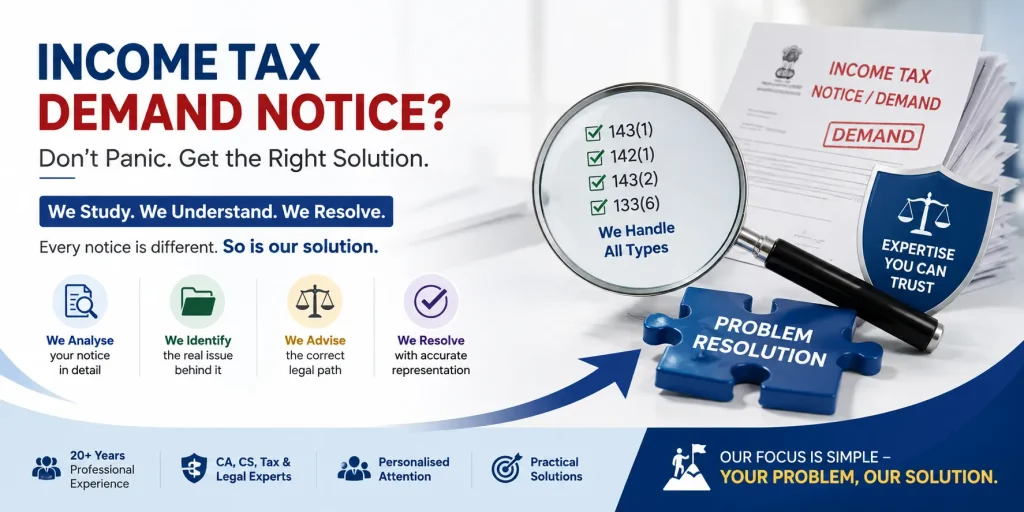
Received an Income Tax demand notice or SMS after filing your ITR? Don’t panic.
First check the actual notice or intimation before paying anything or replying. In many cases, the issue may be a tax calculation difference, wrong tax regime, exemption claim, TDS mismatch or a simple mistake in the ITR.
Income Tax Demand Notice After ITR Filing – What Should I Do?
You filed your Income Tax Return (ITR) and thought the tax work was completed. Then you suddenly receive an email or mobile SMS saying that an Income Tax demand is pending or that you need to respond to a notice.
If this is the first time you have received an Income Tax notice, it is natural to feel worried. But do not panic and do not ignore it.
First verify that the communication is genuine and check the actual notice or intimation. The reason may be as simple as a wrong tax regime, excess exemption, TDS difference, incorrect tax calculation or a clerical error in the return.
Prakasha & Co, Bangalore helps individuals review Income Tax demand notices, 143(1) intimations and 142(1) notices. We explain what has happened and advise the appropriate solution before you take further action.
Simple first step:
Send us the actual Income Tax notice or intimation. After reviewing it, we explain the issue, the available solution and whether any additional work is required.
Income Tax Demand Notice After ITR Filing – What to Do?
An Income Tax demand notice means that an amount is showing as payable against your PAN for a particular Assessment Year. But receiving a demand does not automatically mean that you have intentionally made a wrong claim.
Sometimes the demand is caused by a wrong tax regime, difference in tax calculation, excess exemption, TDS mismatch or a simple mistake in the ITR.
Common Reasons for Income Tax Demand
- Wrong tax regime selected while filing the ITR
- Difference between Form 16 calculation and the final ITR
- Excess HRA or travel-related exemption claimed
- Incorrect deduction or exemption claimed
- TDS or tax-payment mismatch
- Income or deduction figure entered incorrectly
- Simple clerical or data-entry mistake in the return
Therefore, do not pay an Income Tax demand blindly just because you received an SMS or email. First understand why the demand has been raised.
Our simple approach:
ITR filed → Tax calculation → Tax regime → Exemption/Deduction → Tax credit → Department’s calculation
We compare the relevant details and identify the actual reason for the demand before advising you whether it should be paid, corrected or responded to.
If you have received an Income Tax demand notice after ITR processing, you can send us the notice and a short explanation of what happened. We will first review the issue and explain the available course of action.
Income Tax Notice – Why Did I Receive It?
Many taxpayers ask, “I have already filed my ITR and paid my tax. Why have I now received an Income Tax notice?”
After your ITR is filed, the Income Tax Department processes the return and compares the information with the data available with it. A difference may result in an Income Tax demand, refund adjustment or a request for further information.
The notice may relate to something as simple as a tax regime difference, TDS mismatch, exemption claim or incorrect figure in the return. It does not necessarily mean that there is a serious tax problem.
Common Income Tax Notice Problems We Handle
- Wrong tax regime selected while filing the ITR
- HRA or travel exemption questioned by the department
- TDS mismatch or difference in tax credit
- Income or deduction mismatch in the ITR
- Cash deposit or cash transaction requiring clarification
- Property sale or high-value transaction requiring explanation
- Foreign investment or foreign asset reporting issue
Received a notice? The first step is simple:
Don’t panic. Don’t ignore it. Check the actual notice and understand the reason.
If you are unsure about the reason or what reply is required, you do not need to prepare everything yourself. Send us the notice and the supporting documents relating to the issue. We will review it and explain the next step in simple language.
Income Tax Notice Under Section 143(1) – What Does It Mean?
An Income Tax notice under Section 143(1) is generally an intimation issued after the Income Tax Department processes your ITR. It may show a refund, nil demand or tax payable.
If your 143(1) intimation shows an Income Tax demand, don’t assume that the amount is automatically correct. First check why the department’s calculation is different from the return you filed.
Why Can a 143(1) Demand Arise?
- Different tax regime used in the ITR and the original tax calculation
- HRA or other exemption claimed differently
- Travel or LTA exemption requiring clarification
- TDS or tax-payment difference
- Deduction or exemption entered incorrectly
- Income or tax figure entered incorrectly in the ITR
- Other processing differences identified by the department
Received a 143(1) demand?
Don’t blindly pay the demand. First compare the reason for the adjustment with your ITR and the documents supporting the claim.
What We Check in a 143(1) Demand
At Prakasha & Co, Bangalore, we review the actual intimation and identify where the difference has arisen. Depending on the case, we check the tax regime, exemption or deduction claimed, tax calculation and tax credits relevant to the demand.
After the review, we explain whether the demand appears payable or whether a rectification, response or other appropriate corrective action should be considered.
Income Tax Demand Notice 143(1) – Why this Arise?
If your 143(1) intimation shows a tax demand, the next question is usually, “Why has the Income Tax Department calculated this amount when I already filed my return?”
In many cases, the difference comes from a mismatch between the information reported in your ITR and the information or calculation considered while processing the return. A careful comparison can often identify the reason.
Common Reasons for an Income Tax Demand After ITR Processing
The ITR was filed under a different regime from the one expected by the taxpayer.
HRA, travel or another exemption was claimed incorrectly or requires support.
The tax credit considered during processing differs from the amount claimed.
Income, deduction or tax figures may have been entered incorrectly.
What Should You Do With the Demand?
Do not decide only from the demand amount. First identify the exact adjustment mentioned in the 143(1) intimation and compare it with the return and the supporting documents for that particular claim.
If the demand is genuinely payable, we will tell you so. If there appears to be an error or an issue that can be corrected, we will advise the appropriate route, such as rectification or another legally available response.
Our objective is simple
Find the reason for the demand first. Then take the correct action. We do not advise clients to make unsupported claims simply to remove a tax demand.
I Filed My ITR Under the Wrong Regime and Received Tax Demand
One common reason for an Income Tax demand after ITR filing is that the return was filed under a tax regime different from the one the taxpayer expected to use.
This can happen when the tax calculation prepared earlier and the final ITR filing are not checked carefully before submission. The result may be an unexpected tax demand under 143(1).
We Have Handled Such a Tax Regime Issue
In one matter handled by Prakasha & Co, the taxpayer had filed the ITR under a tax regime that did not provide the expected tax benefit. After receiving the demand, the taxpayer was unsure whether the amount had to be paid.
We reviewed the ITR, tax calculation, regime selected and relevant supporting information and identified the reason for the difference.
Our approach
Review the ITR → Identify the regime difference → Check the available corrective option → Take the appropriate action.
Whether a correction is possible depends on the Assessment Year, filing status, timing and applicable tax provisions. We therefore check the actual return before advising the taxpayer.
Received a demand because you selected the wrong tax regime? Send us the 143(1) intimation. We will first review the issue and explain what can be done.
Income Tax Notice for HRA, Travel or Wrong Exemption Claim
Some taxpayers receive an Income Tax notice questioning an exemption or deduction claimed in the ITR. Common examples include HRA, travel-related exemption, LTA and other tax benefits.
If you have received such a notice, don’t panic and don’t immediately admit that the claim was wrong. First check exactly what was claimed and what documents are available to support it.
Income Tax Notice for Travel-Related Exemption
We have handled a matter where the Income Tax Department questioned a travel-related exemption/reimbursement claimed by the taxpayer.
We reviewed the actual claim, the nature of the travel, the supporting documents and the question raised in the notice before preparing the appropriate response.
How we handle an exemption notice
Check the claim → Review supporting documents → Check the applicable conditions → Prepare the explanation → Submit the appropriate response.
The important point is that an exemption should not be defended simply because it was entered in the ITR. The claim and the supporting facts should match. If the claim cannot be supported, we explain the position honestly and advise the appropriate corrective action.
Received a Wrong Exemption Claim Notice?
If the department has questioned your HRA, LTA, travel exemption or another deduction, send us the notice and the documents relating to that claim.
After reviewing the notice, we will explain the issue and tell you whether further handling is required. Additional professional fees, if any, depend on the complexity of the matter.

Sample Income Tax notice relating to an exemption claim.
Income Tax Notice U/S 142(1) – What Should I Do?
If you receive an Income Tax notice under Section 142(1), the department is generally asking you to provide information, documents or an explanation relating to your Income Tax Return or financial transactions.
This can be worrying when you receive such a notice for the first time. However, do not ignore it and do not send a casual reply. First understand exactly what information the notice is asking for.
What Can an Income Tax 142(1) Notice Ask About?
- HRA or rental details
- Travel or LTA claims
- Investment details
- Property sale or purchase
- Foreign travel
- Cash deposits or cash transactions
- Source of income or funds
- Foreign investments or assets
- Other information specifically mentioned in the notice
Received a 142(1) notice?
Don’t guess the reply. Read each question in the notice and prepare the response based on the actual facts and supporting documents.
How Prakasha & Co Handles a 142(1) Income Tax Notice
We first review the notice and identify exactly what the Income Tax Department is asking. We then check the relevant supporting documents and prepare the response based on the facts available with the taxpayer.
Our approach is simple: Read the notice → Understand the questions → Check supporting documents → Prepare the explanation → Submit the appropriate response.
If the matter requires detailed documentation, extensive response preparation or further representation, the additional professional fee will depend on the complexity and will be explained before proceeding.

Sample Income Tax notice under Section 142(1).
Income Tax Notice for Cash Deposit, Cash Transaction or Bank Transaction
Have you received an Income Tax notice for a cash deposit, cash transaction or bank transaction? Do not panic. The department may ask you to explain the source or nature of a particular transaction.
The important thing is to check the exact transaction mentioned in the notice and prepare the explanation based on the actual source of the money and available supporting records.
What We Check in a Cash Deposit or Bank Transaction Notice
- The transaction or cash deposit referred to in the notice
- The actual source of the funds
- Bank statements and relevant transaction records
- Whether the transaction was already reported in the ITR
- Documents supporting the explanation
Our approach is simple
Identify the transaction → Understand the source → Check supporting documents → Prepare the explanation → Submit the appropriate response.
We do not recommend giving a general explanation or submitting documents that do not relate to the actual transaction. The response should match the facts and supporting records.
Income Tax Notice for High-Value Transaction or Property Sale
Similar questions can arise for high-value transactions, property sales, investments or other financial transactions reported to the department.
If you have received such a notice, send us the actual notice and the documents relating to the transaction. We will first review what information has been requested and advise you on the appropriate response.
Income Tax Notice Under Section 133(6) – What Should You Do?
If you receive an Income Tax notice under Section 133(6), the department may be asking for specific information or documents relating to your income, transactions or financial records.
The notice may look serious, but do not panic or ignore it. First understand exactly what information has been requested and the Assessment Year to which it relates.
How We Handle a Section 133(6) Income Tax Notice
We review the notice, identify each information point and check the relevant records before preparing the response.
Simple process
Review notice → Identify information required → Check supporting documents → Prepare response → Submit through the appropriate Income Tax channel.
If the notice relates to a particular bank transaction, investment, property transaction, cash transaction or source of income, we focus on that specific issue rather than asking you to prepare unnecessary documents.
Any further handling depends on the complexity of the notice and will be discussed with you before proceeding.
Income Tax Scrutiny Notice – Is It the Same as a 143(1) Demand?
No. A routine 143(1) intimation after ITR processing should not be treated as the same as an Income Tax scrutiny notice.
If you have received a notice relating to scrutiny or Section 143(2), the matter needs closer examination. The issues mentioned in the notice, the Assessment Year and the documents available with you will determine how the response should be handled.
Received an Income Tax scrutiny notice?
Send us the actual notice first. We will review what the department is examining and tell you whether it is a straightforward response or requires detailed professional handling.
Income Tax Demand – How to Check and Respond
If your Income Tax account shows an outstanding demand, first check the Assessment Year, demand amount and reason for the demand. Do not assume that every outstanding demand has to be paid immediately.
Sometimes the demand may be genuine. In other cases, it may relate to a tax calculation difference, TDS mismatch, earlier payment, exemption issue or an error in processing.
How We Check an Income Tax Outstanding Demand
We first examine the demand and the relevant ITR information. We then identify whether the amount appears payable or whether there is a reason to consider a response, rectification or another appropriate corrective action.
Simple process
Check demand → Find the reason → Verify the facts → Decide the correct response → File the appropriate request or advise payment.
Income Tax Demand Already Paid but Still Showing Outstanding?
This is another common problem. If you have already paid the tax demand but it is still appearing as outstanding, do not make the payment again without first checking the payment and demand records.
Share the payment details and the outstanding-demand information with us. We will review the issue and advise the appropriate correction or response.
Income Tax Demand Notice Payment – Should You Pay Immediately?
If the demand is correct and payable, payment may be required. If you believe the demand is incorrect, the appropriate response or correction should be considered before making a decision.
If further handling is required, the professional fee depends on the complexity of the demand and will be explained before proceeding.
How Prakasha and Co Handles Tax Notices and Tax Demands
You do not need to understand the technical wording of the notice before contacting us. Send us the actual Income Tax notice or demand intimation.
We first understand the issue, explain it in simple language and then advise the appropriate action.
Send us the actual notice or intimation.
We identify what the department is asking or demanding.
We explain the issue and available options.
We prepare the appropriate response, rectification or other corrective action.
Depending on the matter, the work may involve rectification, notice response, supporting-document submission, correction of an ITR issue or appropriate departmental representation.
What Documents Do We Need for Income Tax Notice Review?
For the initial review, you do not need to collect all your tax records. Send us the actual notice or intimation first.
Also provide a short explanation of what happened and the supporting documents relating to the particular claim or transaction mentioned in the notice.
Depending on the issue, this could include rent documents, travel records, investment proof, property documents, foreign investment records, bank or transaction documents or other relevant evidence.
You don’t need to prepare everything before contacting us.
Send the notice first. After reviewing it, we will tell you what additional information or documents are actually required.
Income Tax Notice Review Fee and Time
Our initial professional review fee is ₹5,000. This covers the initial review of the Income Tax notice or intimation and advice on the appropriate course of action.
If the matter requires detailed reply preparation, rectification, extensive document review, foreign-asset correction or representation, the additional professional fee will depend on the complexity of the matter. We explain the additional work and fee before proceeding.
How Quickly Can You Review My Income Tax Notice?
The initial review is generally completed within 1–2 working days after receiving the notice and necessary basic information.
For straightforward matters, further filing or response preparation can normally proceed within the next few working days after receiving the required documents and client approval.
The final disposal or processing by the Income Tax Department depends on the department and cannot be guaranteed by us.
Received an Income Tax Notice? Remember These 5 Things
- Don’t panic. A notice does not automatically mean serious wrongdoing.
- Don’t ignore it. Check the notice and the response date.
- Don’t blindly pay. First understand why the demand was raised.
- Don’t share OTP, PIN or passwords. Verify suspicious emails and SMS first.
- Get the notice reviewed. The correct solution depends on the actual facts.
Frequently Asked Questions About Income Tax Notices and Demands
These are some of the common questions taxpayers search for after receiving an Income Tax notice, demand or SMS.
Received an Income Tax Notice? Send It to Us.
Don’t panic. Don’t ignore it. Don’t blindly pay it.
Send us the actual Income Tax notice or demand intimation and a short explanation of what happened. We will explain what the problem is, why it happened, what can be done and what the next step should be.
Prakasha & Co – CA, CS, Tax & Legal Advisors, Bangalore
Sahakar Nagar, Bangalore
crp@prakashaandco.com
|
7019827351
Can I Respond to an Income Tax Notice Myself?
Yes. If you understand the Income Tax provisions and are comfortable preparing your own response, you can respond directly through your Income Tax e-Filing account.
The Income Tax Department provides an e-Proceedings facility through which taxpayers can view eligible notices and submit their response with supporting documents. :contentReference[oaicite:1]{index=1}
How to Submit Your Income Tax Notice Response Online
- Log in to the official Income Tax e-Filing portal using your credentials.
- Go to Dashboard → Pending Actions → e-Proceedings.
- Select Self and identify the relevant notice or proceeding.
- Open the notice and carefully read what information or documents have been requested.
- Click Submit Response and follow the instructions shown on the portal.
- Enter your written response and upload the relevant supporting documents.
- Complete the declaration and submit the response.
- Save the Transaction ID and Acknowledgment Number, wherever provided, for future reference. :contentReference[oaicite:2]{index=2}
Be Careful Before You Submit Your Response
A response submitted through the Income Tax portal is not something you should prepare casually.
- Read the notice and each question carefully.
- Upload documents that actually support your explanation.
- Do not upload unrelated or unsupported documents.
- Make sure your written explanation matches the documents submitted.
- Check the response carefully before clicking submit.
- Keep the submission acknowledgment and transaction details.
The Income Tax Department’s current e-Proceedings guidance states that, for applicable notices, the taxpayer can provide written remarks and upload documents against the relevant categories. A single attachment is generally subject to the portal’s permitted size limit, currently stated as 10 MB in the Department’s guidance.
One important point: the Department’s FAQ states that a response submitted on the e-Filing portal cannot be edited after submission. Therefore, review the explanation and attachments carefully before submitting.
When Should You Take Professional Help for an Income Tax Notice?
If the notice involves a simple information request and you are confident about the facts and documents, you may be able to respond yourself.
Professional review becomes more useful when the notice involves a large tax demand, disputed exemption, property transaction, cash transaction, foreign investment, scrutiny proceedings or an issue from an earlier Assessment Year.
In such matters, the wording of the response and the documents submitted should be considered carefully because the response becomes part of the tax proceedings.
What If the Income Tax Demand Is Correct?
Not every Income Tax demand is an error. Sometimes our review may show that the tax demand is genuinely payable.
In that situation, we will tell you clearly instead of recommending an unnecessary dispute. You can then make the required payment through the official Income Tax portal and retain the payment record.
Our objective is to find out whether the demand is correct and what is the safest appropriate action based on the facts.
What If the Income Tax Demand Is Wrong?
If the demand appears incorrect, the appropriate solution depends on the reason for the difference and the Assessment Year.
Depending on the facts, the matter may involve rectification, response to outstanding demand, correction of tax-credit information or another legally available corrective process.
We first identify the error and then advise the appropriate route instead of filing a standard reply without checking the facts.

About the Author
Damodharaa R is a CA and Legal Advisor with 20+ years of professional experience, advising individuals and businesses on taxation, Income Tax notices, compliance and related legal matters.
This article is based on practical Income Tax notice and demand-handling experience and is intended to help taxpayers understand their immediate options in simple language.
Last Updated: 14 August 2026 | Reviewed for: Income Tax notices, e-Proceedings and outstanding-demand process
Tax procedures and Income Tax portal facilities may change from time to time. The actual notice, Assessment Year, applicable provisions and portal instructions should be checked before taking action.
Received an Income Tax Notice? Don’t Panic.
Send us the actual notice or demand intimation.
We will review the issue, explain what has happened and tell you the appropriate next step before you decide how to proceed.
Prakasha & Co – CA, CS, Tax & Legal Advisors, Bangalore
Sahakar Nagar, Bangalore
crp@prakashaandco.com
|
7019827351