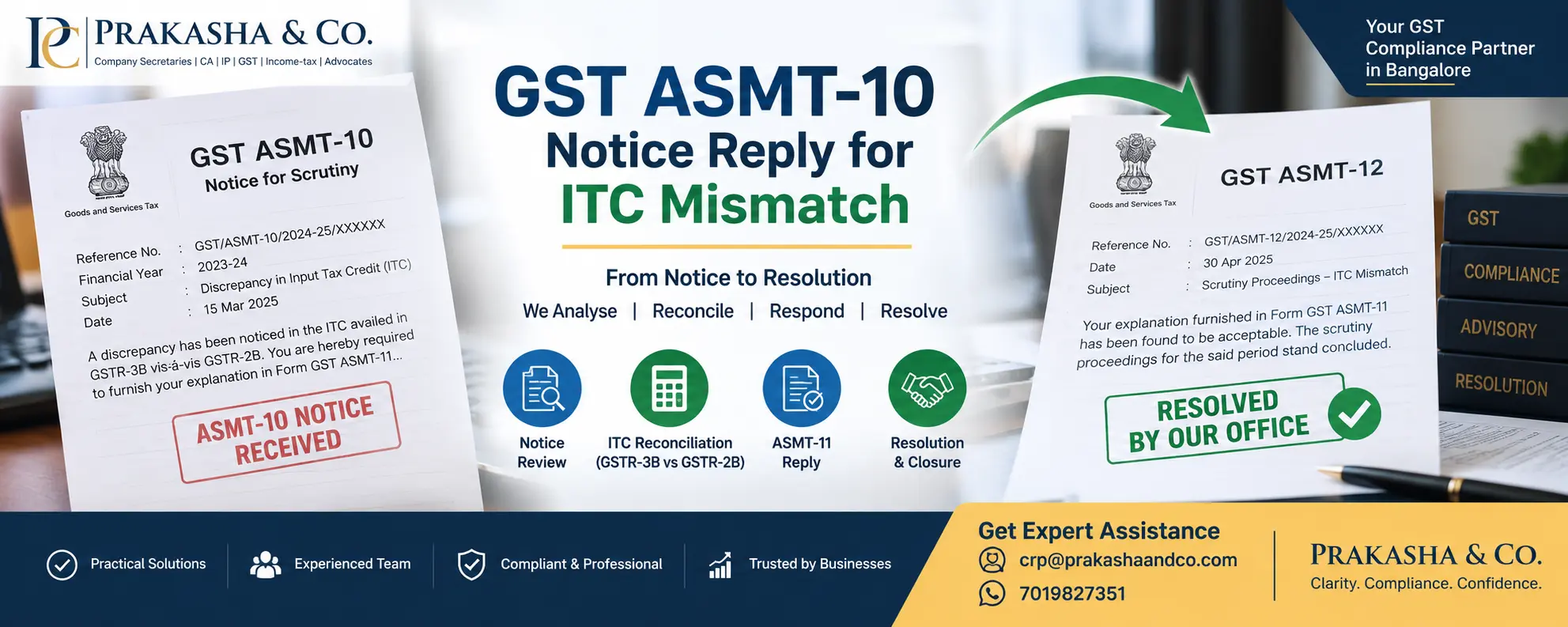
GST ASMT-10 Notice for ITC Mismatch? Resolve It Before It Escalates
Received a GST ASMT-10 notice for a difference between GSTR-3B and GSTR-2B? Do not assume that the entire difference is automatically payable. First identify the reason for the mismatch, reconcile the records and check whether the disputed ITC was actually utilised.
Prakasha & Co., Bengaluru handles the complete process — ITC reconciliation, Electronic Credit Ledger review, ASMT-11 reply, DRC-03 compliance where required and GST departmental follow-up. Our focus is to resolve the scrutiny issue properly before it progresses into further demand proceedings.
What We Check First
- GSTR-3B vs GSTR-2B — identify the actual difference.
- Purchase Register & Invoices — verify the underlying transactions.
- Supplier reporting — check late filing, amendments and GSTIN errors.
- Electronic Credit Ledger — examine the utilisation position.
- Legal position — determine the correct reply, reversal and interest treatment.
A strong GST scrutiny reply must explain the difference with supporting records. A simple statement such as “the mismatch is due to vendor filing” is not enough.
Recent Bengaluru Case — ₹21.15 Lakh ITC Difference
We recently handled an ASMT-10 notice for a Bengaluru private limited company where the department identified an ITC difference of ₹21,15,814 for FY 2022-23. The matter was addressed through reconciliation, voluntary reversal through Form GST DRC-03 and a detailed response covering the applicable interest provisions. :contentReference[oaicite:1]{index=1}
The GST department subsequently issued Form GST ASMT-12, recording that the taxpayer’s reply was satisfactory and that no further action was required in the matter.

If your business has received an ITC mismatch notice, send us the ASMT-10 first. We can review the notice, trace the difference and guide your accounts team on the appropriate response.
Prakasha & Co. — GST Scrutiny Consultant in Bangalore
GST Notice Reply | ITC Reconciliation | GST Lawyer | Departmental Representation
What Is a GST ASMT-10 Notice Under Section 61?
Form GST ASMT-10 is a GST scrutiny notice issued when the department identifies a discrepancy in a return. In ITC cases, one common issue is excess ITC reported in GSTR-3B compared with GSTR-2A/2B.

Actual ASMT-10 scrutiny notice issued by the Bengaluru West Central Tax authorities in an ITC mismatch matter.
ASMT-10 is a scrutiny notice, not automatically a final demand order. The taxpayer is given an opportunity to explain the discrepancy or address the amount payable. The reply is generally furnished through Form GST ASMT-11. If the explanation is found satisfactory, the officer can conclude the scrutiny by issuing Form GST ASMT-12.
Do Not Miss the Reply Deadline
The notice specifies the time allowed for submitting the explanation. Under Rule 99, the period prescribed for the ASMT-10 response is subject to the period stated in the notice and the applicable rules. Ignoring the notice or allowing the response period to expire can take the matter into further departmental proceedings. It does not, however, mean that an ASMT-10 automatically converts into a demand notice.
This is why we recommend acting as soon as the notice is received — check the department’s calculation, reconcile the ITC and prepare the ASMT-11 response before the matter escalates.
ASMT-10 → Discrepancy identified
↓
ASMT-11 → Explanation / compliance submitted
↓
ASMT-12 → Reply accepted where found satisfactory
In our recent Bengaluru matter, the taxpayer’s reply to ASMT-10 was accepted and the Superintendent of Central Tax issued Form GST ASMT-12, recording that the reply was satisfactory and that no further action was required.

ASMT-12 acceptance order issued after the GST scrutiny reply was found satisfactory.
GSTR-3B vs GSTR-2B Discrepancy Notice: Why Does the ITC Mismatch Happen?
A GSTR-3B vs GSTR-2B discrepancy notice does not always mean that the business claimed ineligible ITC. The difference must first be traced to the underlying invoices, supplier reporting and period-wise reconciliation.
In our GST scrutiny consultant Bangalore practice, we commonly find that an apparent ITC mismatch is caused by differences between what the purchaser recorded and what the supplier reported on the GST portal.
Common Reasons for GSTR-3B and GSTR-2B ITC Difference
- Supplier filed GSTR-1 late: The invoice may appear in a later GSTR-2B even though the underlying purchase belongs to an earlier period.
- Invoice reported in a different period: Month-wise comparison can show a difference that disappears when the records are reconciled across periods.
- Wrong GSTIN or B2B reporting: An invoice may not appear in the recipient’s 2B because the supplier reported the transaction incorrectly.
- Supplier amendment: Changes to invoice details in a subsequent return can create a temporary or apparent mismatch.
- Genuine excess or ineligible ITC: Reconciliation may also establish that part of the difference is actually required to be reversed. That portion should be addressed correctly rather than defended without evidence.
Why We Do Not Reconcile 3B and 2B by Numbers Alone
The department’s figure is only the starting point. We trace the difference to the purchase register, invoice, supplier GSTIN, GSTR-2B, GSTR-3B and Electronic Credit Ledger. This helps separate a genuine ITC issue from a reporting or timing difference.
Department’s ITC figure → GSTR-3B → GSTR-2B → Purchase Register → Invoice & Supplier Verification → Electronic Credit Ledger → Final Legal Position
This transaction-level exercise forms the foundation of a strong GST ASMT-10 notice reply for ITC mismatch. It also tells us whether the appropriate response is an explanation, reconciliation, voluntary ITC reversal through Form GST DRC-03, or further legal representation before the GST department.
ITC Mismatch Reconciliation Before GST ASMT-11 Reply
A good GST ASMT-10 notice reply for ITC mismatch starts with reconciliation, not with drafting. We first establish how the department arrived at the disputed figure and then trace that amount through the company’s GST records.
Our GSTR-3B vs GSTR-2B Reconciliation Process
- Check the ASMT-10 calculation — identify the exact ITC difference and period questioned by the officer.
- Match GSTR-3B with GSTR-2B — identify invoice-wise and period-wise differences.
- Verify the Purchase Register — confirm that the disputed invoices relate to genuine business purchases.
- Check supplier reporting — identify late filing, amendments, incorrect GSTIN or other reporting differences.
- Review the Electronic Credit Ledger — determine the actual utilisation position where interest under Section 50(3) is relevant.
- Prepare the final reconciliation — separate explainable differences from any ITC that genuinely requires reversal.
Once the reconciliation is complete, we determine whether the matter requires a Section 61 scrutiny reply, supporting documents, voluntary ITC reversal through Form GST DRC-03, or further representation before the jurisdictional GST officer.
Is Interest Payable on Wrong ITC? Section 50(3) and Rule 88B Explained
One of the most important questions in a GSTR-3B vs GSTR-2B discrepancy notice is whether the disputed ITC was actually utilised. A difference in ITC figures should not, by itself, be treated as proof that interest is payable on the entire amount.
Section 50(3): Wrongly Availed ITC and Actual Utilisation
Section 50(3) of the CGST Act deals with interest on wrongly availed and utilised Input Tax Credit. Therefore, the utilisation position has to be examined rather than calculating interest merely on the ITC difference shown in the notice.
Rule 88B: Why the Electronic Credit Ledger Matters
Under Rule 88B, the Electronic Credit Ledger becomes important when determining whether wrongly availed ITC was actually utilised. We therefore review the ledger for the relevant period before accepting any interest calculation proposed in the notice.
ITC identified in ASMT-10 → Ledger balance → Actual utilisation → Applicable interest, if any
In our Bengaluru ASMT-10 matter, the reply specifically addressed the Section 50(3) and Rule 88B position after examining the ITC issue and the company’s records. The response requested that interest not be levied where the statutory conditions for interest were not satisfied.
This is why a GST scrutiny consultant in Bangalore should examine the Electronic Credit Ledger before advising a client to pay interest on an ITC mismatch.
ITC Reversal Through Form GST DRC-03: When Should You Pay?
If reconciliation confirms that a portion of the ITC was genuinely availed in excess, the correct approach is to quantify that amount and address it through the appropriate GST procedure. Form GST DRC-03 may be used for voluntary payment or reversal where applicable.
Do Not Use DRC-03 Without First Reconciling the ITC
A business should not automatically reverse the entire difference appearing in an ASMT-10 notice. Timing differences, supplier reporting issues and other explainable discrepancies should first be separated from genuine excess ITC.
What About Penalty Under Section 73?
Where the matter falls within the applicable Section 73 framework, voluntary payment within the prescribed statutory stage can have consequences for the penalty position. The exact treatment depends on the nature of the liability and the stage of the proceedings.
In our recent Bengaluru matter, the taxpayer voluntarily addressed the identified ITC amount through DRC-03 and the ASMT-11 response separately explained the applicable interest and penalty position. The reply requested acceptance of the compliance and closure of the scrutiny proceedings.
CBIC Circular 183 & 193: How ITC Mismatch Cases Are Examined
Not every difference between GSTR-3B and GSTR-2A/2B has the same cause. CBIC issued specific guidance for certain historical ITC mismatch situations, including Circular No. 183/15/2022-GST and Circular No. 193/05/2023-GST.
Circular 183 GST ITC Reconciliation
The circular provides a framework for dealing with specified discrepancies between ITC claimed by the recipient and the credit appearing from supplier-reported data, subject to the conditions and verification prescribed for the relevant period.
Circular 193/05/2023-GST
Circular 193 further addresses the treatment of specified ITC differences and the verification approach for the periods covered by the departmental instructions. These circulars should be applied according to the financial year, nature of mismatch and facts of the particular case.
For a GST ASMT-10 notice reply for ITC mismatch, our team therefore combines the applicable circular guidance with the taxpayer’s invoices, purchase register, GST returns and other supporting records before preparing the final ASMT-11 reply.
₹21.15 Lakh GST ITC Mismatch: How We Resolved a Bengaluru ASMT-10 Notice
A Bengaluru private limited company received an ASMT-10 notice for FY 2022-23 questioning an ITC difference of ₹21,15,814 between its GST returns. For the accounts team, the immediate concern was not just the mismatch but the possibility of the matter progressing into further tax proceedings.
What Prakasha & Co. Did
- Reviewed the ASMT-10 and identified how the department had calculated the disputed ITC.
- Reconciled the ITC with GSTR-3B, GSTR-2B, purchase records and supporting documents.
- Reviewed the Electronic Credit Ledger for the interest position.
- Where the identified excess ITC required adjustment, the taxpayer addressed the amount through Form GST DRC-03.
- Prepared the ASMT-11 scrutiny reply explaining the reconciliation and applicable legal position.
The Result: Form GST ASMT-12 Acceptance
The department accepted the explanation and issued Form GST ASMT-12. The order recorded that the reply was satisfactory and that no further action was required in the matter.
This is why an ITC mismatch notice should be reconciled before simply accepting the department’s figure. The right response may involve accounting verification, GST reconciliation, legal analysis and direct departmental coordination.
Documents Required for GST ASMT-10 Notice Reply for ITC Mismatch
A strong Section 61 scrutiny reply depends on records that allow the department to verify the difference. You do not need to send every accounting document; we identify the records relevant to the disputed ITC.
Keep These Documents Ready
- Form GST ASMT-10 with notice reference and annexures.
- GSTR-3B for the relevant financial year and tax periods.
- GSTR-2B / GSTR-2A for the corresponding periods.
- Purchase Register with supplier GSTIN, invoice number, date and tax amount.
- Tax Invoices relating to the disputed ITC.
- Electronic Credit Ledger covering the relevant period.
- Vendor reconciliation or supporting confirmation, wherever required.
- DRC-03 acknowledgement, if any reversal or payment has already been made.
After reviewing these records, our GST scrutiny consultant in Bangalore prepares the reconciliation and identifies what should be explained, reversed or legally contested before the final ASMT-11 reply is submitted.
Missed the GST ASMT-10 Reply Due Date? Act Before Further Proceedings
If your business has missed the response period mentioned in the GST ASMT-10 notice, do not assume that the matter is automatically closed or that the notice itself has become a demand order.
Under Rule 99, the taxpayer is given an opportunity to explain the discrepancy through Form GST ASMT-11. If no satisfactory explanation is furnished, or an accepted liability is not paid, the department may take further statutory action, including proceedings under the applicable demand provisions.
What Should You Do If the Deadline Has Passed?
- Check the GST portal for the present status of the scrutiny proceeding.
- Review the original ASMT-10 and the discrepancy raised by the officer.
- Prepare the ITC reconciliation without delaying further.
- Check whether any subsequent communication or demand proceeding has been issued.
- Take professional advice on the appropriate response at the current stage.
Prakasha & Co. can review an expired ASMT-10 matter, examine the discrepancy and advise whether the appropriate next step is an ASMT-11 response, departmental representation or response to subsequent proceedings.
GST Notice Lawyer in Bangalore for ASMT-10 Departmental Representation
A GST ASMT-10 notice should not be answered with a generic letter. The response must address the exact discrepancy identified by the GST department and support the explanation with reconciliation, invoices, return data and other relevant records.
Under Section 61 and Rule 99, the proper officer scrutinises the return using information available to the department and may issue Form GST ASMT-10 where a discrepancy is identified. The taxpayer can accept the discrepancy and pay the applicable amount or submit an explanation through Form GST ASMT-11. If the explanation is found acceptable, Form GST ASMT-12 is issued. :contentReference[oaicite:0]{index=0}
When Professional GST Representation Becomes Important
- Large ITC mismatch: The notice involves a substantial difference between GSTR-3B and GSTR-2B.
- Multiple financial years: The discrepancy requires period-wise reconciliation.
- Supplier-side issues: ITC relates to invoices reported late, amended by suppliers or reported under incorrect details.
- Interest question: The department has proposed interest and the Electronic Credit Ledger needs examination.
- DRC-03 payment: The taxpayer is considering voluntary reversal or payment and needs to determine the correct amount.
- Further departmental communication: The scrutiny matter requires clarification, additional documents or representation before the officer.
What We Handle for the Taxpayer
- Review the ASMT-10 notice and departmental calculation.
- Prepare the GSTR-3B vs GSTR-2B reconciliation.
- Verify the purchase register, tax invoices and supplier reporting.
- Examine the Electronic Credit Ledger and utilisation position where relevant.
- Determine the appropriate treatment of disputed ITC and interest.
- Draft and submit the ASMT-11 scrutiny reply with supporting annexures.
- Coordinate further communication with the GST department and assist with departmental representation where required.
Our Objective Is Resolution, Not Just Reply Filing
The purpose of professional assistance is not merely to upload an ASMT-11 response. The objective is to present the taxpayer’s position clearly, support the reconciliation with records and, where the explanation is accepted, obtain the appropriate ASMT-12 closure.
CBIC’s scrutiny instructions also contemplate further statutory action where no satisfactory explanation is furnished or an accepted liability remains unpaid. This is why the response should be prepared after understanding the complete factual and statutory position.
Prakasha & Co., Bangalore provides GST scrutiny assistance, ITC reconciliation, ASMT-10 notice reply, ASMT-11 drafting, DRC-03 compliance and GST departmental representation for businesses facing GST scrutiny.
GST Demand Notice After ASMT-10: When Can Scrutiny Escalate?
A GST ASMT-10 notice is a scrutiny notice, not itself a final GST demand order. However, if the discrepancy is not satisfactorily explained, or an accepted liability is not paid, the department may take further statutory action, including proceedings under the applicable demand provisions.
ASMT-10 Does Not Automatically Become a Demand Notice
Receiving an ASMT-10 does not mean that a demand has already been finally determined. The taxpayer gets an opportunity to explain the discrepancy through Form GST ASMT-11 and provide supporting records.
If the explanation is accepted, the scrutiny can be concluded through Form GST ASMT-12. If the discrepancy remains unresolved, the department can consider further action under the GST law. :contentReference[oaicite:1]{index=1}
Typical Escalation Path
ASMT-10 → Reconciliation → ASMT-11 → Department Examination → ASMT-12 / Further Proceedings
Where further proceedings are initiated, the applicable statutory notice and procedure should be examined separately. A taxpayer should not treat an ASMT-10 itself as though it were already a final adjudication.
When Can Section 73 or Section 74 Become Relevant?
Section 73 covers determination of tax not paid or short paid, erroneous refunds, or ITC wrongly availed or utilised for reasons other than fraud, wilful misstatement or suppression of facts. Section 74 applies where the department alleges fraud, wilful misstatement or suppression of facts to evade tax. :
Therefore, if an ITC mismatch remains unresolved after scrutiny, the next communication must be examined carefully to identify the section invoked, financial year, disputed ITC, tax, interest, penalty and the basis of the department’s allegation.
Do Not Wait Until a Demand Notice to Start Reconciliation
- Reconcile the GSTR-3B vs GSTR-2B difference immediately.
- Verify the purchase register and underlying tax invoices.
- Check supplier reporting and amendments.
- Review the Electronic Credit Ledger where interest on utilisation is relevant.
- Identify genuinely excess or ineligible ITC separately from timing or reporting differences.
- Determine whether any payment or reversal is actually required.
- Prepare the ASMT-11 reply with a proper reconciliation rather than a generic explanation.
CBIC’s scrutiny instructions specifically contemplate further action where no satisfactory explanation is furnished or an accepted liability remains unpaid. :contentReference[oaicite:3]{index=3}
Received ASMT-10 or a Subsequent GST Demand Notice?
Do not respond only by copying figures from the GST portal. First determine what the department has identified, why the difference arose, whether the ITC was actually eligible, whether it was utilised and what stage the proceedings have reached.
Prakasha & Co., Bangalore assists businesses with GST scrutiny, ITC mismatch reconciliation, ASMT-10/ASMT-11 replies, DRC-03 compliance and representation in subsequent GST proceedings.
GST ASMT-10 Notice Resolution: Our End-to-End Process
Every ITC mismatch is different. Our approach is to first establish the facts and reconciliation, then determine the appropriate GST treatment before preparing the response.
Our GST ASMT-10 Resolution Process
-
ASMT-10 Notice Review
We examine the financial year, discrepancy identified, ITC amount, interest calculation and the records referred to by the department. -
GSTR-3B vs GSTR-2B Reconciliation
The departmental figure is reconciled with GSTR-3B, GSTR-2B/2A and the purchase register to identify the actual reason for the difference. -
Invoice & Supplier Verification
Relevant purchase invoices and supplier reporting are checked to distinguish timing differences, amendments, reporting errors and potentially ineligible ITC. -
Electronic Credit Ledger Review
Where interest is relevant, the Electronic Credit Ledger and utilisation position are examined along with the applicable provisions. -
Legal Position & ITC Treatment
We determine whether the difference requires explanation, reconciliation, reversal, payment or further representation based on the facts and applicable GST provisions. -
ASMT-11 Reply & Supporting Annexures
A structured Section 61 scrutiny reply is prepared with reconciliation statements and supporting documents. -
DRC-03 Compliance Where Applicable
Where a liability is accepted after verification, the appropriate payment or reversal process is considered and documented. -
Departmental Follow-up
We assist with further clarification, supporting documents and departmental communication where required. -
Closure or Further Proceedings
Where the explanation is accepted, the matter may conclude with Form GST ASMT-12. If the discrepancy remains unresolved, the subsequent statutory communication and proceedings are examined separately.
Under Rule 99, a taxpayer may accept the discrepancy and pay the applicable amount or furnish an explanation in Form GST ASMT-11. Where the explanation or information is found acceptable, the proper officer informs the taxpayer through Form GST ASMT-12.
GST ASMT-10 Notice – Frequently Asked Questions
1. Why did I receive an ASMT-10 notice for ITC mismatch?
An ASMT-10 may be issued when scrutiny of your GST return identifies a discrepancy. In ITC cases, the difference may arise between figures reported in GSTR-3B and information available through GSTR-2B or other GST records. The exact reason should be established through proper reconciliation.
2. Is GST ASMT-10 a demand notice?
No. ASMT-10 is a scrutiny notice under Section 61. It gives the taxpayer an opportunity to explain the discrepancy through ASMT-11. If the explanation is found acceptable, the proper officer may issue ASMT-12. Further statutory proceedings, if required, are a separate stage.
3. How do I reply to GST ASMT-10 online?
The taxpayer may furnish the explanation or information in Form GST ASMT-11. The response should be supported by the relevant reconciliation, invoices, return data and other documents required to explain the discrepancy.
4. Is interest payable if excess ITC was not utilised?
Interest treatment depends on the applicable statutory provisions and whether the wrongly availed ITC was also utilised. The Electronic Credit Ledger and relevant transaction history should therefore be examined before calculating or accepting an interest liability.
5. Can ITC mismatch be reversed through DRC-03?
Where an actual liability or reversal is established, payment or reversal through the prescribed mechanism, including DRC-03 where applicable, may be considered. The amount should be determined only after proper reconciliation rather than simply reversing the entire ASMT-10 figure.
6. What happens if I miss the ASMT-10 reply deadline?
Do not assume that the ASMT-10 automatically becomes a final demand. Check the GST portal, determine the current status of the scrutiny and examine whether any subsequent communication or statutory proceeding has been issued.
7. How can I get Form GST ASMT-12?
ASMT-12 is issued by the proper officer where the explanation or information submitted in response to the scrutiny is found acceptable. A well-supported ASMT-11 reply and complete reconciliation can assist the officer in evaluating the discrepancy on the available records.
8. How much does GST ASMT-10 notice reply assistance cost?
GST scrutiny and ASMT-10 reply assistance starts from ₹5,000 onwards. The final professional fee depends on the amount involved, number of financial years, reconciliation volume, complexity of the ITC issue, documentation required and whether departmental representation or further proceedings are involved.
9. Can a GST consultant or lawyer represent me before the department?
Professional assistance can include notice analysis, reconciliation, drafting the response, preparing supporting documents and coordinating the matter with the GST department. The exact form of representation depends on the nature and stage of the proceedings.
10. What documents should I send for an ASMT-10 review?
Start with the ASMT-10 notice, GSTR-3B, GSTR-2B/2A, purchase register, relevant invoices and Electronic Credit Ledger. If DRC-03 has already been filed, provide the acknowledgement and payment details as well.
Received a GST ASMT-10 Notice for ITC Mismatch?
Do not respond by simply accepting the difference shown in the notice. First determine why the mismatch occurred, whether the ITC is actually eligible, whether it was utilised and what amount, if any, needs to be reversed or paid.
Prakasha & Co., Bangalore assists businesses with GST ASMT-10 scrutiny notices, GSTR-3B vs GSTR-2B reconciliation, Section 61 scrutiny replies, ASMT-11 drafting, DRC-03 compliance and GST departmental representation.
Send Us Your GST Notice for Review
Prakasha & Co.
Company Secretaries | CA | IP | GST | Income-tax | Advocates
Email: crp@prakashaandco.com
Phone / WhatsApp: 7019827351
GST Scrutiny Consultant in Bangalore | GST Notice Reply | ITC Reconciliation | GST Lawyer

CA | GST & Taxation Professional | 20+ Years of Professional Experience
Resolve the GST Scrutiny — Do Not Ignore the Notice
Whether the difference is due to supplier reporting, timing differences, reconciliation issues or genuinely excess ITC, the correct response starts with facts, records and proper reconciliation.
Prakasha & Co. provides professional assistance for GST scrutiny and ITC mismatch matters across Bangalore and for businesses requiring GST departmental support.
GST ASMT-10 Notice Reply | Section 61 Scrutiny | ITC Reconciliation | ASMT-11 | DRC-03 | ASMT-12
Don’t worry about the GST notice; we handle it. You can just relax and carry on your business; we manage it through our contact with the GST office. As we have good contact with GST officials, we easily resolve the notice demand and other things out of the box.