How to get income tax refund is one of the most common questions for taxpayers who want to recover their hard-earned money from excess TDS deducted on salary, bank interest, or property transactions. However, refund is not automatic — it depends on accurate tax planning, correct disclosure, and proper application of eligible exemptions and deductions under the Income Tax Act, 1961.
In many cases, taxpayers miss out on refunds or face delays due to incorrect reporting, mismatch in Form 26AS or AIS, or improper claim of deductions. With the current system of strict validation, even small errors can lead to refund reduction, delay, or notices.
With over 20+ years of experience in Bangalore, our CA-assisted team has handled a wide range of income tax refund cases with a strong success track record. More than 99% of refund cases are processed smoothly when returns are filed with proper reconciliation, correct claims, and complete compliance.
In certain situations, refunds may be adjusted or delayed due to existing tax demands, prior year mismatches, or business-related tax issues. These require proper review, correction, and follow-up with the department to ensure resolution.
Our approach focuses on legally maximising your refund by applying the correct provisions, verifying all disclosures, and ensuring compliance with sections relating to income reporting, deductions, and TDS credit. This helps in avoiding notices and ensures smooth refund processing.
This guide will help you understand the complete process, check refund status, identify delay reasons, and take the right steps to receive your eligible income tax refund without complications.
Understanding how to get income tax refund starts with knowing when you are eligible…
What is Income Tax Refund?
Income tax refund is the amount returned to you when the total tax paid during the year is more than your actual tax liability. This excess tax may be in the form of TDS deducted from salary, bank interest, property transactions, or advance tax paid.
As per Section 237 of the Income Tax Act, 1961, a taxpayer is eligible to claim a refund when such excess payment is correctly reported and claimed in the Income Tax Return (ITR). However, the refund is not automatic — it is processed only after the Income Tax Department verifies your return with the data available in Form 26AS, AIS (Annual Information Statement), and other records.
In practical terms, refund eligibility depends on three key factors:
- Correct Reporting of Income: All income sources such as salary, interest, capital gains, and rental income must be properly disclosed.
- Accurate Claim of TDS: The tax deducted must be reflected in Form 26AS/AIS and correctly claimed in the return.
- Proper Compliance & Verification: The return must be verified and free from mismatches or incorrect claims.
Based on our experience, most refund issues arise not because tax was not deducted, but because the return was filed without proper reconciliation of TDS, income, or disclosures. When these aspects are handled correctly, the refund process becomes smooth and predictable.
Step-by-Step Process to Get Income Tax Refund
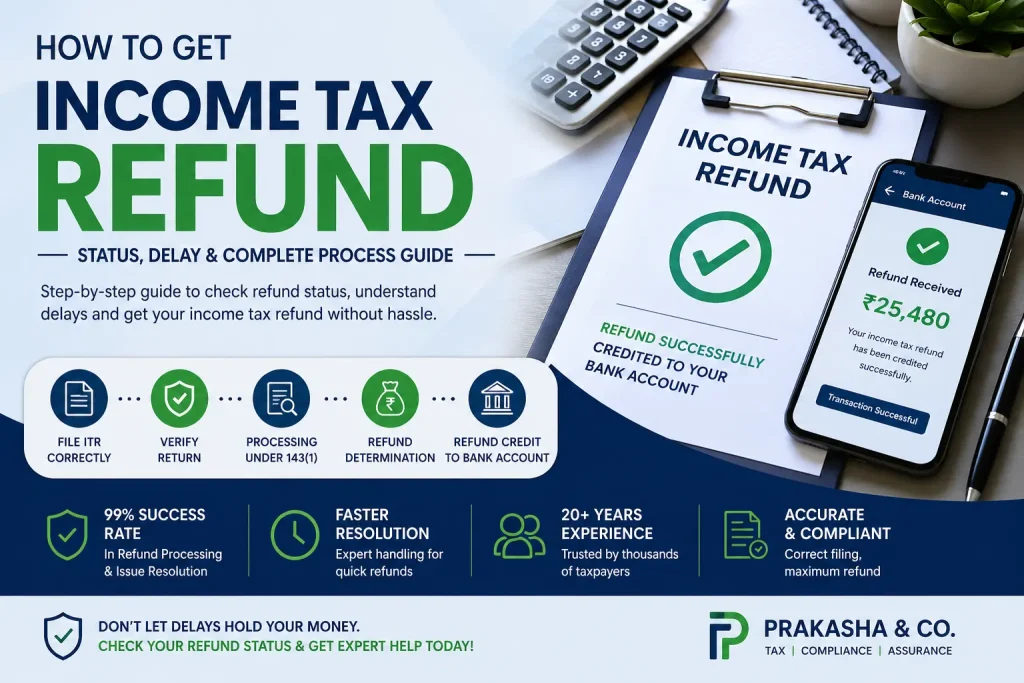
To receive your income tax refund smoothly, it is important to follow the correct process with accurate reporting and verification. Below is the practical step-by-step flow followed by the Income Tax Department:
- Prepare and File Your ITR Correctly: Ensure that all income sources, TDS details, and deductions are properly reported. The refund is calculated based on the accuracy of the return filed.
- Verify Your Return: After filing, the ITR must be verified through Aadhaar OTP, net banking, or other available methods. Without verification, the return will not be processed.
- Processing Under Section 143(1): The Income Tax Department processes your return by matching the data with Form 26AS, AIS, and other available records. Any mismatch may result in adjustment or delay.
- Refund Determination: If excess tax has been paid and all details are correctly matched, the refund amount is computed and approved by the department.
- Refund Credit to Bank Account: The approved refund is credited to your pre-validated bank account. If the account is not validated or incorrect, the refund may fail.
In most straightforward cases, refunds are processed once the above steps are completed without any mismatch. However, if there are differences in TDS, income reporting, or claims, the process may require correction or follow-up before the refund is issued.
How to Check Income Tax Refund Status
After filing and verifying your Income Tax Return (ITR), you can easily track the status of your refund online. The Income Tax Department provides real-time updates on whether your return is processed, refund is issued, or any action is pending.
Follow these simple steps to check your refund status:
- Login to the Income Tax e-filing portal using your PAN and password
- Go to the “View Filed Returns” section
- Select the relevant Assessment Year
- Click on “View Details” to check the status
The refund status may show one of the following:
- Return Filed: Return submitted but not yet processed
- Return Verified: Successfully verified and awaiting processing
- Processed: Return processed under Section 143(1)
- Refund Issued: Refund approved and sent to your bank account
- Refund Failed: Bank details issue – revalidation required
If your refund status shows “processed” but the amount is not credited, it is advisable to check your bank account validation status and review the intimation received from the Income Tax Department.
Income Tax Refund Timeline – What to Expect
Many taxpayers expect their refund to be credited immediately after filing the return. However, the actual timeline depends on multiple factors such as accuracy of filing, verification status, and the level of validation required by the Income Tax Department.
Based on our practical experience in handling refund cases, the processing time generally varies depending on the refund amount and complexity:
- Refund up to ₹10,000: In many cases, these are processed faster and may be credited within 7 to 15 days after processing, where there are no mismatches.
- Refund between ₹10,000 to ₹50,000: Typically takes around 1 to 3 months, depending on validation checks and workload at the department level.
- Refund above ₹1,00,000: May take a few months or longer, as higher refund amounts are usually subject to detailed verification and scrutiny.
It is important to understand that higher refund claims often undergo deeper validation, including cross-checking of income, TDS, and deductions reported in the return.
In some cases, the Income Tax Department may also send alerts or intimations if the refund is claimed based on entries not fully supported by Form 16, AIS, or other available data. Taxpayers may be given an option to revise the return or provide clarification before final processing.
Therefore, accurate filing, proper disclosure, and correct reconciliation of TDS and income play a key role in ensuring faster refund processing.
Common Reasons for Income Tax Refund Delay
If your income tax refund is delayed or not received, it is usually due to specific issues in filing, verification, or data mismatch. Understanding these reasons can help you identify the problem and take corrective action.
Based on our experience, the following are the most common reasons for refund delay:
- ITR Not Verified: If the return is not verified after filing, the Income Tax Department will not process it, and the refund will remain pending.
- Mismatch in Form 26AS or AIS: Differences between your reported income/TDS and the data available with the department can lead to delay or adjustment in refund.
- TDS Not Reflected Properly: Even if tax is deducted, if it is not correctly filed by the deductor, the credit may not be available for refund.
- Incorrect Bank Account Details: Refunds are credited only to pre-validated bank accounts. Errors can lead to refund failure.
- Defective Return (Section 139(9)): Returns filed with missing or incorrect details may be marked defective and require correction before refund is processed.
- Adjustment Against Previous Demand (Section 245): If there are any outstanding tax dues, the refund may be adjusted against such demand.
- Incorrect Claims or Missing Disclosures: Claims such as deductions or HRA without proper disclosure (like landlord PAN where required) can trigger validation issues.
- Return Processed with Adjustments (Section 143(1)): The department may reduce the refund if discrepancies are found during processing.
In most cases, refund delays are not due to system errors but due to mismatch or incomplete compliance. Identifying the exact issue and correcting it at the right time helps in faster resolution.
What to Do If Income Tax Refund is Not Received
If your income tax refund is delayed or not credited even after processing, it is important to identify the issue and take the right corrective steps. In most cases, the problem can be resolved by reviewing the return and updating the required details.
You can follow the below steps to resolve refund-related issues:
- Check Refund Status: Verify whether your return is processed and refund is issued through the Income Tax portal.
- Verify Bank Account Details: Ensure your bank account is pre-validated and linked correctly. If refund has failed, request for reissue after correction.
- Review Intimation Under Section 143(1): Check if any adjustments have been made to your refund due to mismatch or incorrect claims.
- Check for Notices or Defective Return: If your return is marked under Section 139(9), you need to correct and re-submit within the specified time.
- Reconcile Form 26AS and AIS: Ensure all TDS and income details are properly matched and reported in your return.
- File Revised Return or Rectification: If any error is identified, you can revise your return under Section 139(5) or file rectification under Section 154.
- Respond to Department Communication: If any clarification is sought by the department, timely response is important to avoid further delay.
In cases where refund is stuck due to mismatch, incorrect filing, or complex transactions such as property or capital gains, a detailed review and correction may be required to resolve the issue effectively.
For complete assistance in resolving refund delays or mismatch issues, you can visit our Income Tax Refund Services in Bangalore page for detailed support.
Frequently Asked Questions on Income Tax Refund
How long does it take to get income tax refund in India?
The refund timeline depends on accuracy of filing and verification. Smaller refunds may be processed within a few weeks, while higher refund amounts can take a few months due to detailed validation by the Income Tax Department.
Why is my income tax refund delayed?
Refund delay usually happens due to mismatch in Form 26AS or AIS, unverified ITR, incorrect bank details, defective return, or adjustment against previous tax demand.
How can I check my income tax refund status?
You can check your refund status by logging into the Income Tax e-filing portal and viewing your filed returns for the relevant assessment year.
Refund issued but not credited – what should I do?
This usually happens when bank account details are incorrect or not validated. You need to update your bank details and request reissue of refund through the portal.
Can I revise my return if I made a mistake?
Yes, you can file a revised return under Section 139(5) if you have made an error in your original return, subject to the applicable time limits.
Is TDS automatically refunded after filing ITR?
No. TDS will be refunded only if it is correctly reflected in Form 26AS/AIS and properly claimed in the return. Any mismatch may lead to reduced or no refund.
What happens if my refund is reduced?
The Income Tax Department may reduce your refund after processing under Section 143(1) if discrepancies or incorrect claims are found. You will receive an intimation explaining the adjustment.
If you are facing refund delay, mismatch, or reduced refund, you can refer to our Income Tax Refund Services in Bangalore page for detailed assistance.
About the Author