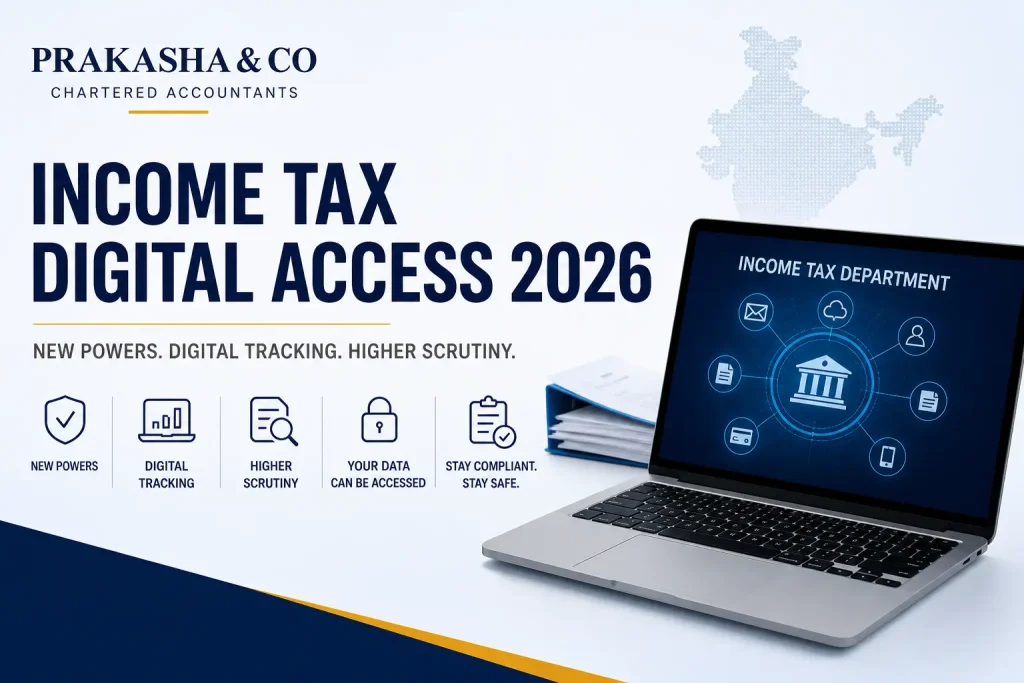
From April 1, 2026, the Income Tax Department can access digital data, including emails, Facebook, bank accounts, UPI transactions, and investment platforms, during investigations under Section 247 of the Income Tax Act, 2025.
Income Tax Digital Access 2026 introduces a major shift in how the Income Tax Department looks at financial transactions. Under the new rules, tax officers can access digital data easily.
Income Tax Digital Access 2026 – Your Financial & Digital Data Can Be Reviewed
New powers under the Income Tax Act, 2025 (effective from 1 April 2026) allow authorities to access your digital footprint during investigations. This is a critical compliance alert for individuals and businesses.
📌 What This Means for You
- Your digital transactions (UPI, bank, investments) are fully traceable
- Social media lifestyle can be compared with your declared income
- AI systems track mismatches between income, spending, and assets
- Failure to respond to notices can escalate into digital investigation
This is a shift from traditional tax assessment to digital-first enforcement. Proper reporting, reconciliation, and tax planning are now essential.
Read Full New Income Tax Law 2026 →🔍 Income Tax Digital Access 2026: New Powers Under Section 247 (Section 247 – Digital Access)
The Income Tax Act, 2025 introduces a major enforcement shift by allowing officers to access “Virtual Digital Spaces” during search and investigation proceedings.
📊 What Can Be Accessed by Income Tax Authorities?
| Category | Digital Access Scope | Risk to Taxpayer |
|---|---|---|
| Emails & Communication | Gmail, Outlook, business communication records | Unreported income discussions, hidden transactions |
| Social Media | Instagram, LinkedIn, X, Facebook | Lifestyle vs income mismatch detection |
| Cloud Storage | Google Drive, iCloud, Dropbox | Hidden agreements, invoices, asset details |
| Bank & UPI Transactions | All bank accounts, GPay, PhonePe, Paytm | Undisclosed income, cash flow mismatch |
| Investment & Trading | Demat, Zerodha, Groww, mutual funds | Capital gains not reported |
| Cryptocurrency & Digital Assets | Crypto wallets, exchanges | High-risk non-disclosure category |
| Devices & Systems | Laptops, mobiles, business systems | Complete financial trail extraction |
✔ This is not routine surveillance. These powers apply only in investigation or search cases. However, once triggered, the scope of access is extensive and legally enforceable.
👉 To understand full legal changes and implications, refer: Income Tax Act 2025 Explained
🚨 Income Tax Digital Access 2026: When Can Authorities Access Your Data?
The new powers are not used in routine cases. However, once triggered, the department can initiate deep digital investigation.
🔍 Common Triggers for Investigation
- Declared income is low but expenses are high (UPI, travel, lifestyle)
- Frequent large UPI or bank transactions without proper reporting
- Mismatch between Income Tax Return (ITR) and AIS data
- GST turnover not matching income declared in ITR
- Unreported crypto, trading, or foreign income
- Ignoring income tax notices or compliance requirements
- Using third-party accounts (staff/family) to route expenses
📊 Real Case Handled by Our Team (Bangalore Rural – Devanahalli)
A business operating in Devanahalli (Bangalore Rural) had significant turnover through UPI transactions. However, proper reporting and reconciliation were not maintained.
- High UPI receipts flagged by system
- Mismatch between GST and Income Tax filings
- Notice issued for both Income Tax and GST review
Our team handled the matter with proper documentation and reconciliation. The case was resolved with relief as part of initial-level leniency, but strict compliance was mandated going forward.
⚠️ Key Learning: UPI-based businesses and proprietorships are now under strong monitoring. Future cases may not get such relaxation.
🤖 AI-Based Monitoring – The Real Game Changer
The Income Tax Department uses advanced analytics (AIS + AI systems) to track:
- Your spending pattern (UPI, bank, cards)
- Your lifestyle (social media, travel, assets)
- Your declared income in tax return
👉 To correct missed income or previous filing errors, refer: File Previous Year / Missed ITR Safely
📞 Avoid Notices – Maintain Proper Books & Tax Compliance
With digital monitoring and AI-based scrutiny, even small mistakes can trigger notices. Proper bookkeeping, accounting, and reconciliation are now essential to ensure your income, GST, and financial data are fully aligned.
Our expert team ensures:
- Accurate bookkeeping & accounting records
- GST and Income Tax data reconciliation
- Proper tax filing and compliance
- Legal tax planning to minimize tax liability
⚠️ Final Warning: Your Digital Footprint is Now Tax Evidence
From April 2026, the Income Tax Department will no longer rely only on your filed returns. Your digital transactions, lifestyle, and financial behavior will be used as evidence during assessment and investigation.
⚖️ Possible Legal Consequences of Non-Compliance
- Income Tax Notices and reassessment proceedings
- Heavy penalties and additional tax liability
- Search and seizure (including digital access)
- Attachment of bank accounts or assets
- Prosecution in serious cases of tax evasion
📌 What You Should Do Immediately
- Review your past ITR filings and correct errors
- Reconcile AIS, GST, and financial records
- Disclose any missed income through updated return
- Implement proper accounting and compliance system
- Take professional advice before any notice arises
👉 Fix missed returns or past errors here: File Previous Year ITR →
🚀 Don’t Wait for a Notice – Get Compliant Today
Our CA, CS, and Legal experts help you handle tax filing, compliance, notices, and planning with complete accuracy and peace of mind.
Consult Expert Tax Advisor →⚠️ Final Warning: Your Digital Footprint is Now Tax Evidence
From April 2026, the Income Tax Department will no longer rely only on your filed returns. Your digital transactions, lifestyle, and financial behavior will be used as evidence during assessment and investigation.
⚖️ Possible Legal Consequences of Non-Compliance
- Income Tax Notices and reassessment proceedings
- Heavy penalties and additional tax liability
- Search and seizure (including digital access)
- Attachment of bank accounts or assets
- Prosecution in serious cases of tax evasion
📌 What You Should Do Immediately
- Review your past ITR filings and correct errors
- Reconcile AIS, GST, and financial records
- Disclose any missed income through updated return
- Implement proper accounting and compliance system
- Take professional advice before any notice arises
👉 Fix missed returns or past errors here: File Previous Year ITR →
🚀 Don’t Wait for a Notice – Get Compliant Today
Our CA, CS, and Legal experts help you handle tax filing, compliance, notices, and planning with complete accuracy and peace of mind.
Consult Expert Tax Advisor →❓ Frequently Asked Questions – Income Tax Digital Access & Compliance 2026
1. I have not disclosed RSU / foreign stock income (USA company). What should I do?
RSU and foreign stock income must be disclosed under Indian Income Tax provisions, including Schedule FA and capital gains reporting. Non-disclosure is a high-risk trigger under digital monitoring. You should immediately correct this by filing an updated return. 👉 File missed / previous ITR safely
2. I am receiving rental income but not reporting fully. Is it risky?
Yes. Rental income is easily traceable through bank transactions and tenant records. Under-reporting can lead to notice and reassessment. Proper reporting with deduction planning is recommended to reduce tax legally.
3. I already paid my tax demand earlier, but I am still getting notices. Why?
This usually happens due to mismatch in records, non-updated compliance, or pending proceedings. Payment alone does not close the case unless properly reconciled and updated in records. Professional handling is required to close such notices permanently.
4. My business has high UPI transactions. Will it trigger income tax notice?
Yes. High UPI turnover without proper reporting or mismatch with GST/ITR is a common trigger. The department tracks digital transactions closely, and reconciliation is mandatory.
5. Can income tax officers access my emails and social media?
Under the new law effective April 2026, digital access is permitted during investigation if there is “reason to believe” tax evasion exists. This includes emails, cloud data, and social media.
6. What if I missed filing my ITR for previous years?
You can still file an updated return within the allowed time by paying additional tax. This helps avoid penalties and legal action. 👉 File previous year ITR here
7. My family has ancestral property income. How to plan tax efficiently?
Family income can be structured through a Hindu Undivided Family (HUF) to optimize tax liability legally. Proper planning is required to avoid future disputes and tax issues. 👉 Learn HUF tax planning
8. Can I correct my tax return after filing?
Yes. You can revise or update your return depending on the situation. Updated return (ITR-U) allows correction of missed income within 48 months.
9. How do I avoid income tax notices under new digital rules?
Maintain proper records, match your income with spending, reconcile AIS, and file accurate returns. Professional tax planning is the safest approach.
10. Do I need a CA for tax compliance now?
With increased scrutiny and digital tracking, expert guidance helps avoid costly mistakes, notices, and penalties. Proper compliance and planning ensure peace of mind.

Previous Year ITR Filing in India (Missed Return & Late Filing Solution)