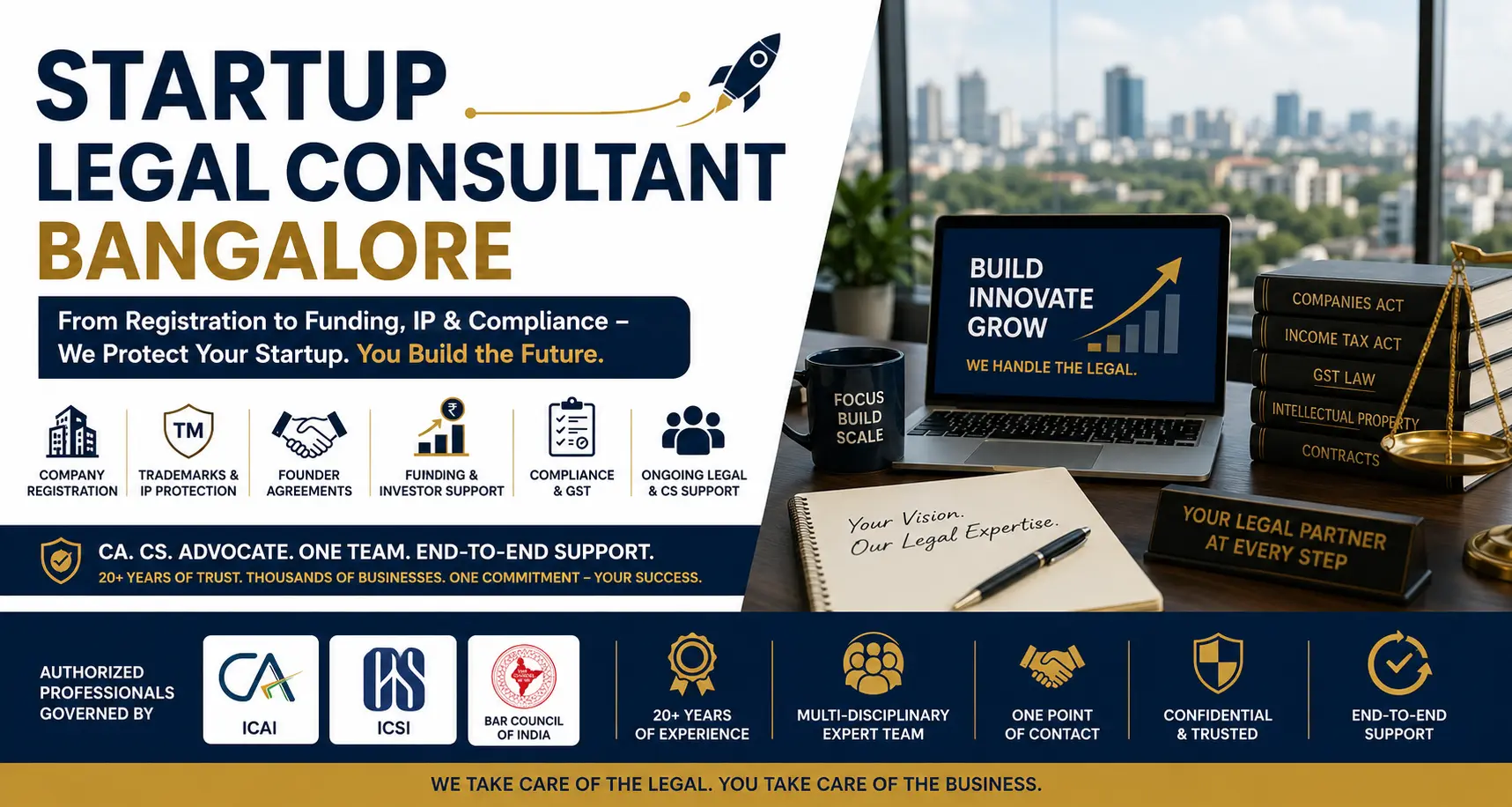
Startup Legal Consultant services have become increasingly important for founders building SaaS, AI, technology, fintech, robotics, and high-growth startups. Most founders need more than company registration—they need practical guidance covering IP, founder agreements, fundraising, taxation, and long-term business growth.
Why Startup Founders Need a Startup Legal Consultant
⚠ Most startups do not face their challenge during registration. The real challenges start when investors, co-founders, tax office begin asking difficult questions.
Every year, hundreds of Bangalore startups successfully register their business, launch products, acquire customers, and start generating revenue. However, many founders discover later that registration alone does not protect a startup from legal, compliance, intellectual property, or ownership risks.
Questions such as “Who owns the software?”, “Is the trademark protected?”, “Can a co-founder leave with equity?”, “Will investors accept my business structure?”, “Are my MCA and GST compliances complete?” usually arise much later—often when fixing them becomes expensive.
This is why modern startups increasingly look for a Startup Legal Consultant and Company Secretary who understands not only registrations, but also IP protection, founder structuring, investor readiness, corporate governance, and long-term business growth.
Why Many Bangalore Startups Struggle After Registration
The traditional approach forces founders to coordinate between multiple office.
- A CA handles GST and tax matters.
- An Advocate drafts Legal agreements.
- A Trademark Consultant files IP applications.
- A Company Secretary manages MCA compliance.
- A separate consultant handles funding documentation.
While each consultant may be experienced in their own area, startup-related risks often arise between these disconnected functions.
For example, a trademark may be filed correctly but software ownership may not be assigned to the company. A founders’ agreement may exist but investor protection clauses may be missing. GST registrations may be completed but export compliance for SaaS products may not be planned.
As startups grow, these small gaps become major business risks.
Startups rarely fail because they missed a form. They fail because critical legal, tax, ownership, and compliance issues were never connected together.
A Real Bengaluru Startup Lesson: When Cheap Registration Became Costly Later
One technology startup, Metaxperia LLP, initially selected the LLP structure because incorporation and annual compliance costs were comparatively lower. At that stage, the primary focus was product development and market expansion.
As the business matured and investor discussions progressed, potential investors preferred a Pvt Ltd Company structure. By then, branding activities, operational contracts, IP filings, and business processes had already been built around the LLP.
The founders eventually had to spend additional time, professional fees, restructuring costs, documentation efforts, and intellectual property review expenses to align the business with investor expectations.
The issue was not that the LLP structure was wrong. The issue was that future funding requirements had not been considered at the incorporation stage.
This situation is far more common in startup ecosystem than many founders realise.
Before You Raise Funding, Answer These 7 Questions
- Is your current business structure suitable for future investors?
- Does your company legally own all software and source code?
- Have all founders signed proper ownership and exit agreements?
- Is your startup name protected through trademark registration?
- Have you secured protection in the correct trademark classes?
- Are MCA, GST, and tax compliances up to date?
- Can your startup pass investor due diligence today?
If the answer to even two of these questions is uncertain, your startup may already have hidden legal or compliance risks that deserve immediate attention.
Building a Startup Requires More Than Registration
A scalable technology business requires a strong legal and compliance foundation from day one. The right business structure, intellectual property strategy, founder agreements, governance framework, compliance systems, and tax planning decisions made today can significantly reduce future disputes, investor objections, and regulatory issues.
The following guide explains how Bangalore startups can build an investor-ready legal and compliance framework covering entity structuring, intellectual property protection, founder management, GST planning, corporate governance, and ongoing compliance requirements.
How Startups Can Raise Funds Before Valuation Without Losing Control
One of the biggest challenges for early-stage startups is raising capital before the business has sufficient revenue, assets, or market traction to justify a formal valuation. Many founders assume they must wait until the company reaches a certain size before approaching investors.
In reality, several startups successfully raise growth capital through future equity-linked investment structures that allow investors to participate in future growth without forcing founders to negotiate a valuation too early.
Smart founders focus on building the product first and negotiating valuation later.
Properly structured instruments such as CCDs (Compulsorily Convertible Debentures) and SAFE-style future equity arrangements can help startups secure funding while preserving cash flow and reducing the pressure of early-stage valuation discussions.
These structures allow investors to participate in future equity at a later funding round, often with pre-agreed benefits or conversion mechanisms linked to the company’s future growth and fundraising milestones.
Why This Approach Helps Early-Stage Startups
- No immediate valuation negotiations during the early stage.
- Faster fundraising discussions with angel investors and strategic partners.
- Reduced legal and transaction costs compared to complex investment rounds.
- Allows founders to focus on product development and market validation.
- Provides investors with future upside participation.
- Preserves working capital during the startup growth phase.
For many technology startups, obtaining the first strategic investor is often more important than obtaining the highest valuation. The right investor can provide industry access, credibility, mentoring, partnerships, and future fundraising opportunities.
Retaining Key Talent Without Heavy Salary Commitments
Limited cash flow should not prevent a startup from attracting talented professionals. Many successful startups combine modest salaries with carefully structured future ownership incentives linked to performance, milestones, or long-term contribution.
Rather than creating large fixed salary obligations, founders can reward key contributors based on the future success of the business while maintaining financial stability during the growth stage.
- Founder vesting arrangements.
- Performance-linked equity participation.
- ESOP structures for employees.
- Advisor equity programmes.
- Milestone-based ownership allocation.
- Long-term retention incentives.
Ownership should be earned over time, not granted entirely on day one.
Proper vesting mechanisms help ensure that founders, employees, advisors, and strategic contributors remain committed to the business while protecting the company if someone leaves prematurely.
The objective is simple: attract great talent, preserve cash, retain key contributors, and build a structure that remains attractive to future investors.
Why Startup Founders Prefer a Single Advisory office Instead of many
Most founders initially engage different consultants for different requirements. A CA handles GST and Incometax. A Company Secretary manages MCA filings, Labor compliance. An Advocate drafts agreements. A trademark consultant files intellectual property applications. As the business grows, founders spend increasing amounts of time coordinating between multiple advisors.
Unfortunately, business risks often arise in the gaps between these professionals. An agreement may not align with company records. Intellectual property may not be assigned correctly. Investor documents may conflict with regulatory filings. Compliance deadlines may be missed because nobody has complete visibility of the overall structure.
Startups need coordination, not just compliance.
A properly structured startup requires tax planning, legal documentation, intellectual property protection, corporate governance, regulatory filings, investor readiness, employment structuring, and dispute prevention to work together as a single ecosystem.
How a Startup Legal Consultant Helps Protect Software, and Funding
LLP vs Pvt Ltd Co for Tech Startups: The Decision That Can Impact Future Funding
One of the first legal decisions a startup founder makes is selecting the business structure. Unfortunately, many founders focus only on registration cost and annual compliance expenses without considering future investment, ownership transfers, ESOPs, acquisitions, or expansion plans.
The right structure should support where the startup wants to be three to five years from now—not just where it is today.
The cheapest structure today may become the most expensive restructuring project tomorrow.
When an LLP May Be Suitable
An LLP can be a practical choice where the founders intend to operate as a professional practice, consulting business, service firm, or closely held venture with no immediate plans for external investment.
- Lower compliance burden.
- Flexible internal management.
- Lower annual maintenance costs.
- Suitable for small founder-controlled businesses.
- Useful for consulting and service-based operations.
However, as the business grows, certain limitations may become visible, especially when investors, strategic partners, or ESOP structures are required.
Why Most Fundable Startups Prefer Private Limited Companies
Technology startups planning to raise angel funding, venture capital, strategic investments, or future acquisitions generally prefer a Private Limited Company structure because it offers greater flexibility for ownership management and investor participation.
- Investor-friendly shareholding structure.
- ESOP implementation.
- Easy onboarding of new shareholders.
- Share transfers and equity restructuring.
- Convertible investment instruments.
- Higher acceptance during due diligence.
- Better scalability for future funding rounds.
A Real Bengaluru Startup Experience
We advised Metaxperia LLP, a technology startup that initially selected the LLP route because of lower setup and compliance costs. During the early stage, the decision appeared commercially sensible.
As the company matured and discussions with investors progressed, the founders discovered that potential investors preferred a Private Limited Company structure. By that stage, the business had already invested in branding, documentation, intellectual property filings, contracts, and operational processes under the LLP framework.
The founders eventually had to spend additional time and professional resources restructuring the business to align with future investment requirements.
The lesson was not that LLPs are unsuitable. The lesson was that the chosen structure should align with the startup’s future growth strategy from day one.
If your long-term goal includes fundraising, ESOPs, strategic investors, acquisitions, or scaling across multiple markets, the initial business structure deserves careful planning.
Another Common Mistake: Copy-Paste Founders’ Documents
Many startups download generic LLP Agreements, Shareholders Agreements, or Founders Agreements from the internet. While these templates may appear sufficient initially, they rarely address the issues that technology startups face later.
- Software ownership rights.
- Source code assignment.
- Founder vesting.
- Investor entry rights.
- Founder exit mechanisms.
- Deadlock resolution.
- Future fundraising provisions.
- ESOP implementation flexibility.
Strong startup documentation should not only protect today’s business but also support tomorrow’s growth, investment, and expansion plans.
Protecting Your Startup’s Most Valuable Asset: Software, and Brand Ownership
Most technology startups believe their biggest asset is the product they are building. Legally speaking, the real asset is ownership of the IP behind that product. Investors, acquirers, and strategic partners do not merely evaluate software functionality—they evaluate who legally owns it.
A startup can lose years of development effort if intellectual property ownership is not documented correctly from the beginning.
Who Actually Owns the Software Developed for Your Startup?
This is one of the most misunderstood questions in the startup ecosystem. Many founders assume that paying a developer, freelancer, agency, or consultant automatically transfers ownership of the software to the company.
In reality, payment alone does not always transfer intellectual property rights. If ownership documentation is missing, disputes may arise regarding source code, software architecture, mobile applications, databases, algorithms, designs, APIs, AI models, and proprietary business systems.
Every startup should ensure that all IP created for the business is formally assigned to the company through appropriate agreements.
- Employment Agreements.
- Developer Contracts.
- Consultant Agreements.
- Freelancer Engagement Letters.
- Intellectual Property Assignment Agreements.
- Confidentiality and NDA Clauses.
What Happens When a Developer Leaves?
Many startups depend heavily on one developer, technical architect, or co-founder during the initial stages. Problems often arise when that individual leaves the business after building core software systems.
Without proper agreements, the startup may face disputes involving access rights, ownership claims, repositories, source code modifications, customer databases, or future software development.
Good documentation protects both the individual contributor and the company by clearly defining ownership, responsibilities, and post-exit obligations.
Investors frequently review software ownership documents during due diligence before investing significant capital.
Trademark Protection: Why Most Tech Startups Start With the Wrong Filing Strategy
Many founders spend considerable resources designing logos while overlooking protection of the actual business name. In practice, logos can evolve over time, but brand names often remain the foundation of customer recognition and business value.
For this reason, technology startups generally prioritise protection of the brand name through wordmark registration before expanding into logo protection.
The objective is to secure exclusive rights over the name that customers search for, remember, recommend, and associate with the business.
The Software Trademark Class Mistake That Many Startups Discover Too Late
Technology businesses often operate across multiple activities simultaneously. A SaaS company may provide downloadable applications, cloud-based services, educational content, AI tools, consulting services, and digital platforms under a single brand.
Filing under only one trademark class can leave important parts of the business exposed.
- Class 9 – Downloadable software, mobile applications, digital products.
- Class 42 – SaaS platforms, cloud solutions, software development services, AI platforms.
- Class 41 – Online education, digital learning platforms, training programmes, publishing activities.
The appropriate filing strategy depends on the startup’s current operations as well as planned future expansion.
Artificial Intelligence, SaaS and Emerging Technology Businesses Require Additional Planning
Modern startups increasingly operate in sectors such as Artificial Intelligence, Machine Learning, Robotics, FinTech, Defence Technology, DeepTech, Cloud Computing, and Data Analytics.
These businesses often create proprietary algorithms, automation systems, datasets, models, and software frameworks that become significant assets over time.
Establishing clear ownership, confidentiality obligations, licensing rights, and commercial usage rights at an early stage helps prevent disputes and improves investor confidence.
Investors invest in intellectual property ownership, not merely product demonstrations.
Startup Intellectual Property Checklist
- Is the software owned by the company?
- Have all developers signed IP assignment documents?
- Are NDA and confidentiality clauses in place?
- Is the startup name protected through trademark registration?
- Have the correct trademark classes been identified?
- Can investors verify ownership of key business assets?
- Are founders protected if a key team member leaves?
If any of the above questions remain unanswered, intellectual property protection should become a priority before scaling operations, onboarding investors, or entering new markets.
Founder, Employee and Investor Protection Framework: Avoiding Disputes Before They Happen
Most startup disputes do not begin in courtrooms. They begin when expectations are not documented clearly. A startup may start with trust and enthusiasm, but as the business grows, questions regarding ownership, responsibilities, compensation, decision-making authority, and future exits become increasingly important.
The objective of good legal documentation is not to prepare for conflict. The objective is to prevent conflict from arising in the first place.
The best startup agreements are the ones that never need to be enforced because expectations were clearly defined from day one.
Founder Vesting: Protecting the Business From Early Exits
Many startups divide ownership equally at incorporation. However, business realities change. Sometimes one founder becomes inactive, joins another venture, relocates, or loses interest while retaining significant ownership in the company.
Founder vesting mechanisms help ensure that ownership is earned through continued contribution rather than being permanently granted on day one.
- Performance-linked ownership.
- Time-based vesting schedules.
- Milestone-driven equity allocation.
- Founder exit protection.
- Business continuity safeguards.
Good Leaver and Bad Leaver Protection
Not every founder or employee leaves under the same circumstances. Some departures occur due to personal reasons, health concerns, family commitments, or mutually agreed transitions. Others may involve misconduct, breaches of confidentiality, or direct competition with the business.
Clearly drafted Good Leaver and Bad Leaver provisions help determine how ownership, incentives, and exit rights will be handled in each situation.
Retaining Key Employees Without Increasing Salary Costs
Early-stage startups often operate with limited capital. Hiring experienced professionals at large salaries may not always be practical. Instead, many startups use carefully structured ESOPs, advisory equity arrangements, and milestone-based incentives to attract and retain high-quality talent.
This approach helps conserve cash while aligning long-term interests between the company and key contributors.
Great startups often grow because talented people believe in future value creation, not just current salaries.
SAFE, CCD and Future Equity Structures for Startup Funding
Many founders believe fundraising can only happen after obtaining a formal valuation. In reality, early-stage investments are frequently structured through future equity-linked arrangements that postpone valuation discussions until the business achieves greater traction.
Depending on the business model and funding objectives, startups may consider structures such as SAFE-style arrangements, CCD investments, or other convertible instruments that enable fundraising without immediate dilution negotiations.
These structures can provide flexibility for both founders and investors while reducing the complexity of early-stage fundraising.
- Reduced pressure on early-stage valuation.
- Faster investor onboarding.
- Preservation of founder control.
- Lower transaction complexity.
- Investor participation in future growth.
Several startups have successfully raised early-stage capital through convertible investment structures before reaching formal institutional funding rounds. Similar approaches are increasingly being adopted across the Bangalore startup ecosystem. Based on the Bodh Robotics transaction structure, convertible CCD-based funding enabled investment participation linked to future financing events rather than requiring immediate valuation negotiations. :contentReference[oaicite:0]{index=0} :contentReference[oaicite:1]{index=1}
Investor Rights Without Losing Operational Freedom
Investors generally seek transparency, governance, and protection of their investment. Founders seek operational freedom to build and scale the business. A balanced investment structure should protect both objectives.
Well-drafted investment documentation may address:
- Information rights.
- Board observer rights.
- Future fundraising participation.
- Exit mechanisms.
- Founder protection provisions.
- Investor protection safeguards.
- Decision-making thresholds.
Resolving Disputes Without Disrupting the Business
Lengthy litigation can consume management time, business resources, and investor confidence. For this reason, many startups establish dispute resolution mechanisms at the documentation stage itself.
A well-drafted founders’ agreement, shareholders’ agreement, or investment agreement can provide structured mechanisms for resolving disagreements before they escalate into major business disruptions.
- Deadlock resolution procedures.
- Mediation provisions.
- Arbitration mechanisms.
- Founder buyout options.
- Exit planning frameworks.
For Bangalore-based startups, clearly defining Bengaluru as the arbitration seat and governing jurisdiction often provides greater certainty and reduces procedural complications.
The goal is not to prepare for failure. The goal is to ensure the business remains stable regardless of future changes in founders, employees, investors, or market conditions.
Startup Compliance Roadmap: What Founders Must Complete After Registration
Obtaining the incorporation certificate is only the starting point. Many startups unknowingly miss important filings and registrations during the first year, creating avoidable penalties, compliance notices, and investor concerns later.
Investors rarely ask whether your company is registered. They ask whether your company is compliant.
The First 30 Days After Registration
- Opening the business bank account.
- Capital contribution and documentation.
- INC-20A filing for Private Limited Companies.
- LLP Agreement execution and Form 3 filing for LLPs.
- Accounting system setup.
- Founder and employment documentation.
- Trademark filing strategy.
The First 90 Days
- MSME (Udyam) Registration.
- GST applicability review.
- Vendor and customer agreements.
- Privacy Policy and Website Terms.
- Intellectual Property review.
- Investor readiness documentation.
Why MSME Registration Matters
- MSME (Udyam) Registration.
- GST applicability review.
- Vendor and customer agreements.
- Privacy Policy and Website Terms.
- Intellectual Property review.
- Investor readiness documentation.
Why MSME Registration Matters
Many startups overlook MSME registration despite the benefits available. Apart from improving access to government schemes, startups can also avail reduced government fees for trademark applications, improving cost efficiency during the initial growth phase.
GST Planning for SaaS, AI and Technology Startups
Technology businesses frequently operate across multiple states and international markets from day one. Proper GST planning becomes important when selling software subscriptions, cloud services, digital products, consulting services, and exports.
- GST Registration applicability.
- Software and SaaS taxation.
- Cross-border service exports.
- LUT (Letter of Undertaking).
- Export without payment of GST.
- Foreign remittance compliance.
Many SaaS startups pay unnecessary taxes simply because export structures were not planned correctly from the beginning.
What Investors Actually Check Before Investing
Founders often spend months preparing pitch decks while investors focus on something entirely different—risk assessment.
Before investing, investors typically review:
- Company structure.
- Founder agreements.
- Trademark ownership.
- Software ownership records.
- Cap table and shareholding records.
- MCA compliance history.
- GST and tax compliance.
- Employment and consultant agreements.
- Existing investor rights.
Well-maintained legal and compliance records often accelerate fundraising discussions and reduce due diligence concerns.
Quick Startup Legal Health Check
Answer the following questions honestly.
- Does the company own all software and source code?
- Have all founders signed proper agreements?
- Is the startup name trademark protected?
- Have the correct trademark classes been identified?
- Can a founder exit without creating disputes?
- Are employee and consultant agreements in place?
- Are MCA filings fully updated?
- Is GST structured correctly?
- Can investors review clean compliance records today?
If the answer to several questions is “No” or “Not Sure”, the startup may already have legal, intellectual property, compliance, or governance gaps that should be addressed before scaling further.
Building a Startup Is Difficult. Legal Mistakes Should Not Make It Harder.
Technology founders should spend their time building products, acquiring customers, raising funds, and growing teams—not struggling with registrations, intellectual property disputes, compliance deadlines, investor documentation, or legal restructuring.
A strong startup foundation combines company registration, founder structuring, intellectual property protection, funding readiness, employee retention planning, tax compliance, and long-term governance into a single coordinated framework.
Whether you are launching a SaaS platform, AI startup, fintech solution, robotics company, marketplace, cloud application, consulting venture, or technology business, the objective is the same—build a scalable and investor-ready organisation from day one.
Your focus should be building the product. Our focus is helping protect the structure behind it.
Documents Typically Required To Get Started
- PAN and Aadhaar of founders.
- Business concept or project summary.
- Proposed startup names.
- Office address proof.
- Shareholding or ownership plan.
- Existing agreements, if any.
- Trademark or intellectual property details.
With proper planning from the beginning, startups can avoid expensive restructuring exercises, ownership disputes, compliance gaps, and investor objections while creating a stronger foundation for future growth.
One Startup. One Advisory Team. Complete Lifecycle Support.
Startups rarely require a single service. A founder who starts with company registration often needs trademark protection, founders’ agreements, employee documentation, GST registration, funding support, ESOP planning, annual compliance management, investor documentation, contract review, and intellectual property protection within the next few years.
Working with separate advisors for every stage often results in duplicated effort, inconsistent advice, and unnecessary costs.
Our role is not limited to registrations. We assist startups throughout their business lifecycle—from idea validation and entity formation to intellectual property protection, fundraising preparation, compliance management, expansion planning, strategic transactions, and long-term governance.
Essential Legal Documents Every Startup Should Have
Many startup disputes arise because important relationships were never documented properly. The right agreements help prevent misunderstandings and create clarity for founders, employees, investors, customers, and vendors.
- Founders Agreement.
- Shareholders Agreement.
- Employment Agreements.
- Consultant Agreements.
- NDA and Confidentiality Agreements.
- SaaS Service Agreements.
- Software Development Agreements.
- Investor Agreements.
- Vendor Agreements.
- Privacy Policy and Terms of Use.
Can Your Startup Pass Due Diligence Today?
Fundraising often slows down because founders begin organising documents only after investors request them. A due diligence-ready startup can respond faster and inspire greater investor confidence.
- Corporate records.
- Shareholding records.
- Trademark ownership.
- Software ownership records.
- Tax and GST filings.
- Founder documentation.
- Investment records.
- Employment contracts.
Data Privacy, AI Governance and Digital Compliance
Modern startups frequently collect customer information, behavioural data, payment information, analytics data, and AI-generated outputs. Regulatory expectations around data governance continue to evolve.
Technology businesses should establish clear privacy practices, customer consent mechanisms, internal access controls, confidentiality procedures, and data handling frameworks from an early stage.
Building Long-Term Wealth Through ESOPs and Equity Participation
Many successful startups attract and retain exceptional talent by allowing employees to participate in future growth through structured ESOP programmes.
Well-designed ESOP structures can help startups conserve cash, improve retention, align interests, and build a stronger ownership culture.
Planning for Acquisition, Strategic Investment and Founder Exit
Every startup is created with a future objective—growth, acquisition, strategic partnership, succession, or public listing. Decisions made during incorporation often influence these future opportunities.
Proper structuring helps founders prepare for investment rounds, mergers, acquisitions, strategic exits, and business succession without unnecessary legal complications.
10 Startup Legal Mistakes We Frequently See in Bangalore
- Registering an LLP when investor funding is planned.
- No founders agreement.
- No IP assignment from developers.
- Trademark filed in only one class.
- No vesting mechanism for founders.
- Using internet templates for critical agreements.
- Ignoring GST on software exports.
- Missing INC-20A or LLP compliance filings.
- Giving equity without documentation.
- Preparing for due diligence only after investors ask.
Choosing the Right Startup Legal Consultant for Long-Term Growth
Professional Expertise Backed by Statutory Practice Licences
Startups frequently seek advice on legal, taxation, compliance, corporate governance, intellectual property, and regulatory matters simultaneously. These areas are governed by different professional and regulatory frameworks.
Our multidisciplinary practice combines expertise from Chartered Accountancy, Company Secretarial Practice, Corporate Law, Taxation, Intellectual Property, Regulatory Compliance, and Business Advisory services.
- Corporate and Startup Advisory.
- Company Secretarial and MCA Compliance.
- Direct and Indirect Taxation.
- GST Advisory and Litigation Support.
- Trademark and Intellectual Property Protection.
- Corporate Documentation and Agreements.
- Fundraising and Investor Documentation.
- Business Structuring and Governance.
This integrated approach helps founders obtain practical solutions instead of fragmented advice from multiple service providers.
What Founders Really Want Is Peace of Mind
Most startup founders do not wake up thinking about MCA filings, GST returns, shareholder resolutions, trademark classes, founder vesting schedules, CCD documentation, or investor rights.
They think about product development, customer acquisition, hiring, revenue growth, and fundraising.
The purpose of engaging an experienced Corporate Legal Consultant and Company Secretary is not simply filing forms. It is ensuring that someone is continuously monitoring the legal, regulatory, compliance, governance, taxation, and intellectual property framework supporting the business.
Your startup deserves more than registrations. It deserves a long-term advisory partner who understands the entire journey from incorporation to investment, expansion, and eventual exit.
Frequently Asked Questions (FAQs)
Why should I hire a Startup Legal Consultant in Bangalore?
A startup legal consultant helps founders manage registration, agreements, intellectual property, funding documentation, compliance, taxation, and investor readiness under one coordinated framework.
Can you help with startup funding and investor documentation?
Yes. We assist with SAFE-style arrangements, CCD investments, shareholder agreements, founder documentation, due diligence preparation, and investor compliance support.
Should my startup register as an LLP or a Private Limited Company?
The answer depends on your business model, future funding plans, ESOP requirements, and growth strategy. Many investor-backed startups prefer the Private Limited structure.
Can you help protect our software, brand, and intellectual property?
Yes. We assist with trademark registration, IP assignment agreements, software ownership documentation, NDAs, and startup IP protection strategies.
Do startups need GST registration?
It depends on turnover, business activities, interstate supplies, exports, and platform-based operations. A startup-specific GST review helps determine the correct approach.
Can you manage ongoing startup compliance after registration?
Yes. We support MCA filings, GST compliance, annual returns, board documentation, investor compliance, tax filings, and corporate governance requirements.
What documents are required to get started?
Typically, PAN, Aadhaar, proposed business details, address proof, ownership structure, and any existing agreements or intellectual property information.
Need guidance from a Startup Legal Consultant Bangalore? Connect with our multidisciplinary team of Company Secretaries, Chartered Accountants, Advocates, and Trademark Professionals for end-to-end startup registration, IP protection, funding support, compliance management, and business growth advisory.
Virtual CFO Service in Bangalore
Property Verification Lawyer in Bangalore: 1–2 Day Legal Due Diligence & Title Search
ISO Certification in Bangalore to Win Tenders, Clients & Global Business