Business Data Theft, How Businesses Can Protect
Your customer database is one of the most valuable assets in your business.
For investment advisors, stock market advisory firms, insurance companies, mutual fund distributors, wealth managers, healthcare businesses, technology companies and professional service firms, years of effort are invested in building customer relationships, trust, goodwill and recurring revenue.
Unfortunately, many business owners discover the true value of their customer database only after it has been copied, misused, leaked, sold, or utilised for somebody else’s personal gain.
In today’s business environment, the threat does not always come from hackers sitting in another country.
Very often, the risk comes from people who already have access to your business information.
- An employee starts a parallel business.
- An ex-staff member approaches existing customers.
- A business partner leaves and takes customer contacts.
- A consultant copies confidential business information.
- A vendor gains access to sensitive client records.
- A competitor receives internal business information.
- A trusted person secretly monetises customer data for personal benefit.
The result is often devastating.
- Loss of customers.
- Reduction in subscription income.
- Decline in insurance renewals.
- Loss of recurring revenue.
- Reputational damage.
- Confidential information exposure.
- Loss of market position.
- Business valuation reduction.
- Costly legal disputes.
At Prakasha & Co., Bangalore, we are increasingly handling matters involving customer database theft, client poaching, confidential information misuse, business data leakage, insider fraud, cyber crime complaints, employment disputes and damage recovery actions.
What surprises most business owners is that the financial damage is often discovered several months after the misuse has already started.
By that stage, valuable customers may have already shifted their business elsewhere.
The Biggest Mistake Business Owners Make
Most business owners focus only on preventing data theft through software, access controls, passwords and monitoring tools.
While these measures are important, they do not address the bigger problem.
The real protection comes from having a strong legal framework before a breach occurs.
Without proper legal protection, a business owner may discover that:
- The employment agreement is weak.
- The confidentiality clause is unenforceable.
- The partner exit terms are unclear.
- The customer database ownership is not properly documented.
- No evidence collection procedure exists.
- No damage recovery mechanism exists.
- No emergency legal response plan exists.
In many cases, businesses only realise these gaps after losing customers, revenue and market goodwill.
Real Bangalore Case: Revenue Reduced by Nearly 20%
A successful stock market advisory business operating from Rajajinagar, Bangalore approached our team after noticing a continuous reduction in subscription income.
Initially, management believed the issue was related to market conditions and competition.
However, after reviewing management information reports, customer behaviour patterns and business records, it became apparent that customer relationships were being influenced outside the authorised business structure.
The impact was substantial.
Recurring revenue reduced, customer retention weakened and years of business development efforts were affected.
This situation highlights a growing challenge faced by many businesses today:
Business data theft is no longer just an IT issue. It is a legal, financial and business continuity issue.
Immediate Questions Owner Asks After Discovering Data Theft
- Can I file a police complaint for customer data theft?
- Can I initiate cyber crime action?
- Can I recover business losses from the responsible person?
- Can I stop my customers from being approached?
- Can I obtain an injunction from court?
- Can I take legal action against an ex-employee or partner?
- Can I claim compensation for loss of business?
- Can I prevent further misuse immediately?
- What evidence is required to prove the theft?
- How quickly should legal action be taken?
The answer depends largely on how quickly the issue is identified and whether the business has maintained proper documentation, contractual protections, digital evidence and compliance controls.
In many situations, immediate action within the first few days can significantly improve the chances of protecting customers, preserving evidence and recovering damages.
How We Help Businesses Respond Immediately
When a business suspects customer database theft, client poaching, confidential information misuse or insider fraud, our Corporate Legal Team assists with:
- Emergency legal review.
- Evidence preservation strategy.
- Cyber crime complaint support.
- Police complaint assistance.
- Legal notices and cease-and-desist actions.
- Employee and partner dispute management.
- Damage recovery strategy.
- Confidentiality enforcement.
- Business protection measures.
- Long-term risk reduction planning.
The objective is simple.
Stop further damage, secure evidence, protect customers, recover losses wherever possible, and strengthen the business against future incidents.
7 Common Ways Data Gets Misused Without the Owner Knowing
Many business owners assume customer data theft happens only when somebody downloads database before resigning.
In reality, most business information is leaked slowly over weeks or months without attracting attention.
The most dangerous situations are often the ones that remain unnoticed until customers start moving away.
Below are some of the common patterns we regularly discuss with business owners across Bangalore.
1. The “Slow Customer Migration” Method
This is one of the most common situations.
A person with access to customer information gradually builds direct relationships with clients. Over time, customers start communicating directly with that individual rather than the company.
When the person leaves, many customers follow them without the business owner immediately realising what happened.
By the time the revenue drop becomes visible, substantial damage may have already occurred.
2. Running a Parallel Business Using Company Customers
Some individuals quietly start a side business while continuing to work within the organisation.
Instead of acquiring customers independently, they use existing company relationships, business contacts and market credibility to generate personal income.
Many business owners discover this only after customers mention receiving direct offers outside the company.
3. Customer Information Shared with Competitors
Sometimes the objective is not to build a personal business.
The information itself has value.
Customer lists, renewal dates, investment preferences, premium amounts, contact details and business records can become valuable assets for competitors looking to expand quickly.
In highly competitive sectors, this information can significantly impact revenue and customer retention.
4. WhatsApp, Mobile Phone and Personal Email Misuse
Modern data theft does not always involve sophisticated hacking.
Simple screenshots, WhatsApp exports, personal emails, photographs of computer screens and cloud storage uploads can transfer large amounts of business information within minutes.
This is one reason why many businesses struggle to detect information leakage early.
5. Ex-Staff Contacting Existing Customers
Many businesses experience this issue shortly after a resignation.
Customers suddenly receive calls, messages or emails from former staff members introducing alternative services, competing products or new business ventures.
Some customers may not even realise they are no longer dealing with the original company.
6. Partner Disputes and Business Information Misuse
Not every risk comes from employees.
Business partners, consultants, distributors, franchise operators and external associates may also have access to valuable information.
When relationships deteriorate, customer databases, pricing structures and business strategies sometimes become points of conflict.
Without proper agreements, businesses often struggle to protect their interests.
7. Customer Database Theft Discovered Too Late
The biggest challenge is that most business owners only discover the problem after revenue begins falling.
At that stage, valuable customers may have already moved elsewhere and important evidence may no longer be easily available.
The earlier a business identifies unusual activity, the better its chances of limiting losses and protecting customer relationships.
What We Commonly Hear From Business Owners
- “Our customers suddenly stopped renewing.”
- “An ex-staff member is contacting our clients.”
- “Someone copied our customer database.”
- “Our sales have reduced but we don’t know why.”
- “A former employee joined a competitor and our customers followed.”
- “Our business information is being used elsewhere.”
- “We suspect confidential data has been shared.”
- “Can we take legal action and recover the damage?”
If any of these situations sound familiar, it is important to act quickly.
The first few days after discovering a potential data misuse issue are often critical for preserving evidence, protecting customers and reducing further losses.
Business Situations We Have Seen in Bangalore
One of the biggest mistakes business owners make is believing that these incidents only happen to big companies.
In reality, small and medium businesses are often more vulnerable because customer relationships are concentrated within a small team and business controls are still evolving.
Over the years, our Corporate Legal and Compliance Team has worked with business owners who discovered serious issues only after significant revenue, customers or goodwill had already been affected.
While every case is unique, the following examples reflect common situations that many businesses may relate to.
Case 1: Subscription Revenue Reduced Without Any Clear Reason
A successful stock market advisory business in RT Nagar, Bangalore approached us after noticing a steady reduction in subscription collections.
Initially, management believed the market was responsible.
The assumption was that customers were reducing spending due to changing market conditions.
However, when business reports, customer movements and internal activities were reviewed, a different picture started emerging.
Certain customer relationships had gradually shifted away from the company’s formal business channels.
The financial impact was significant because the business relied heavily on recurring subscription income.
The biggest lesson from this situation was simple:
Revenue leakage is not always caused by market conditions. Sometimes it originates from within the business itself.
Case 2: Insurance Customers Started Renewing Elsewhere
An insurance business owner contacted us after noticing several premium clients had not renewed their policies through the company.
Further enquiries revealed that customers had been approached by a person who already understood their policy history, renewal cycle and premium structure.
The customers were offered alternative options and gradually moved away.
The business owner’s biggest concern was not merely the lost revenue.
The real concern was understanding how confidential customer information had become available outside the organisation.
For service-based businesses, losing a customer is painful.
Losing a long-term customer relationship built over many years is far more damaging.
Case 3: Business Information Followed the Person Who Left
In another matter, a business owner discovered that after a key individual exited the organisation, a noticeable portion of customer enquiries and business opportunities also started moving elsewhere.
The issue was not simply about one person leaving.
The issue was that valuable business information, customer relationships and years of goodwill appeared to move together.
This is a common risk when businesses rely heavily on individuals rather than documented systems, structured controls and legal safeguards.
Case 4: The Business Owner Knew Something Was Wrong But Had No Proof
This is probably the most common situation we encounter.
The business owner feels something is not right.
- Customers stop responding.
- Revenue starts falling.
- Sales conversions decline.
- Key accounts become inactive.
- Competitors suddenly know too much.
However, there is one major problem.
The owner has suspicion but no usable evidence.
Without proper evidence preservation, digital records and legal strategy, taking action later becomes significantly more difficult.
This is why early intervention is often critical.
What These Cases Have In Common
Although the industries were different, the underlying problem was remarkably similar.
- Customer information had significant commercial value.
- Access to that information was not adequately controlled.
- Warning signs were overlooked.
- The issue was discovered after financial damage had already begun.
- Business owners were unsure about the immediate legal steps to take.
Most importantly, every business owner asked the same question:
“What should we do now to stop further damage and protect our business?”
The answer usually depends on how quickly action is taken, how much evidence is available and whether proper legal protections already exist within the business.
10 Warning Signs Your Customer Database May Already Be Misused
Most business owners do not discover data misuse immediately.
The warning signs usually appear much earlier.
Unfortunately, many businesses ignore these indicators until the financial impact becomes visible.
If you notice multiple signs below, it may be time to review your business controls and legal protections.
1. Customers Suddenly Stop Renewing
Your service quality remains the same.
Your team remains unchanged.
Yet long-term customers quietly stop renewing.
This should never be ignored.
Sometimes customers are already being approached by someone who has access to their information.
2. Sales or Revenue Starts Falling Without Any Clear Business Reason
Many business owners initially blame market conditions.
However, when revenue reduces while demand remains stable, deeper investigation is often necessary.
A declining revenue trend may indicate customer diversion or information misuse.
3. Customers Say “Someone Already Contacted Us”
This is one of the biggest red flags.
Your team calls a customer.
The customer responds:
“Someone already spoke to us about this.”
Immediately investigate how that information became available.
4. Former Staff Suddenly Become Competitors
People are free to pursue new opportunities.
However, concern arises when a new business immediately gains access to customers, industry information and business opportunities that normally take years to develop.
This is often where businesses begin asking important legal questions.
5. Important Customers Become Less Responsive
Customers who were once actively engaged suddenly stop answering calls.
Emails remain unanswered.
Meetings become difficult to arrange.
Sometimes this happens naturally.
Sometimes there is another reason behind the change.
6. Competitors Know Too Much About Your Business
Competitors somehow know:
- Your pricing.
- Your customers.
- Your renewal dates.
- Your business strategy.
- Your upcoming plans.
Business owners often ask:
“How did they know this?”
That question should never be ignored.
7. Customer Complaints Increase Unexpectedly
Sometimes customers receive conflicting messages.
They may be contacted by multiple people claiming to represent similar services.
This creates confusion and damages trust.
The reputational impact can be substantial.
8. Employees Refuse to Follow Reporting Processes
Some individuals prefer operating independently.
They avoid CRM updates.
They resist supervision.
They keep customer communication outside official systems.
This creates significant risk for the business.
9. Customer Information Exists Outside Company Systems
Business information should remain within authorised systems.
When customer records appear in personal phones, personal email accounts, spreadsheets or external devices, the risk level increases dramatically.
This is often where future disputes begin.
10. You Have Suspicion But No Evidence
This is the most common situation.
The business owner feels something is wrong.
The numbers do not make sense.
The customer behaviour has changed.
Yet there is no direct proof available.
At this stage, proper evidence preservation becomes extremely important.
Most Business Owners Wait Too Long
One common pattern we see repeatedly is delay.
The owner notices something unusual.
The issue is discussed internally.
Several weeks pass.
Then several months pass.
By the time action is taken:
- Customers may already have moved.
- Important evidence may be lost.
- Revenue damage may have increased.
- Recovery becomes more difficult.
The earlier a business responds, the greater the chance of protecting customers, preserving evidence and reducing losses.
Ask Yourself These Questions
- Who has access to your customer database today?
- Can customer information be copied easily?
- Do you have legally enforceable confidentiality protection?
- Do your agreements prevent customer solicitation?
- Do you have an emergency response plan if data is stolen?
- Can you quickly gather evidence if misuse occurs?
- Do you know what legal action can be taken immediately?
If the answer to any of these questions is uncertain, your business may be carrying more risk than you realise.
What Should You Do If You Suspect Customer Data Theft or Client Misuse?
Many business owners make one serious mistake.
The moment they suspect misuse, they immediately confront the person.
Unfortunately, this can destroy valuable evidence.
The first few days are extremely important.
Don’t Panic. Act Smart.
Stay calm.
Avoid emotional reactions.
Avoid threatening messages or public allegations.
Focus on facts, records and evidence.
Secure Evidence Immediately
Preserve emails, WhatsApp messages, CRM records, access logs, reports and communication history.
Do not allow important information to be deleted or altered.
In many cases, evidence becomes the strongest protection for the business.
Protect Your Customers Quickly
Identify important customers.
Review customer movement patterns.
Communicate professionally where necessary.
The objective is to prevent further business loss.
Restrict Further Access
Review system access immediately.
Change passwords where required.
Secure customer databases and confidential business information.
Many businesses delay this step and suffer additional losses.
Assess the Damage
Understand the business impact.
Which customers are affected?
What revenue is at risk?
Can future losses still be prevented?
Early assessment helps build a stronger recovery strategy.
Take Legal Advice Early
Most business owners wait too long.
By the time legal action starts, valuable customers may already be lost.
Evidence may become difficult to recover.
Immediate legal review often helps businesses take faster and more effective action.
Important Reality
Business data misuse is not always caused by an employee.
The issue may involve:
- Existing staff
- Ex-staff members
- Business partners
- Consultants
- Vendors
- Franchise operators
- Distributors
- Third parties with access to business information
Every situation requires a different legal strategy.
How Prakasha & Co. Corporate Legal Team Helps Businesses
Our team assists businesses in protecting customer databases, business goodwill, confidential information and long-term customer relationships.
We support businesses with:
- Business data theft review
- Customer database protection
- Cyber crime complaint support
- Police complaint assistance
- Legal notices
- Evidence preservation strategy
- Damage recovery planning
- Partner and employee dispute management
- Confidentiality protection systems
- Business risk reduction frameworks
Businesses looking for structured corporate legal protection may explore our Corporate Legal Advisory Services:
Corporate Legal Protection & Business Advisory Services
For wider legal support, dispute management and business legal solutions:
Business Legal Services & Compliance Support
Our experienced legal professionals regularly assist businesses facing operational, contractual, compliance and business protection challenges:
Expert Legal Team Support for Businesses
Our objective is simple.
Stop further damage.
Protect customers.
Preserve evidence.
Reduce future risks.
Recover losses wherever legally possible.
Need Immediate Legal Guidance?
If you suspect customer database theft, client poaching, confidential information misuse, insider fraud, business data leakage or unauthorised use of your customer information, early action can make a significant difference.
Our Corporate Legal Team assists businesses across Bangalore in reviewing risks, protecting evidence, initiating legal action and strengthening long-term business protection systems.
Call: 7019827351
Email: crp@prakashaandco.com
Office: Sahakar Nagar, Bangalore
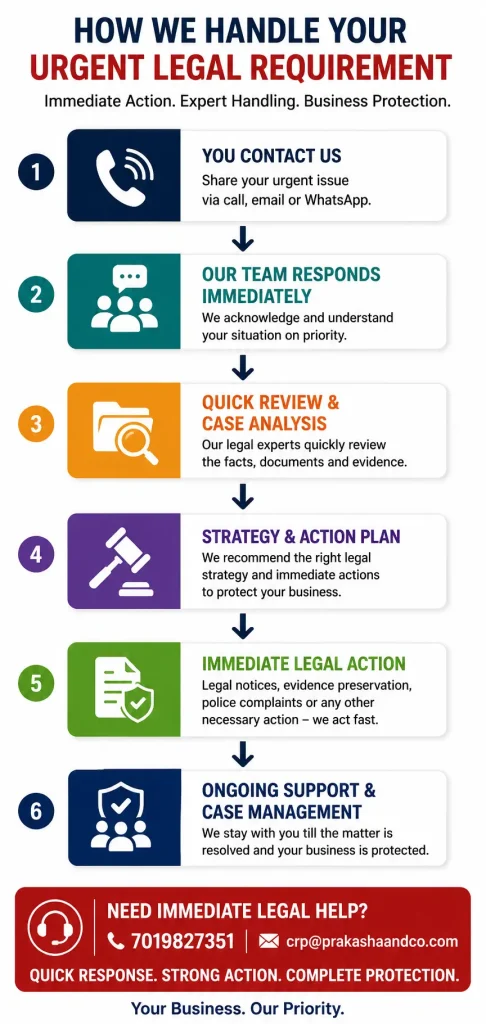
Need Immediate Help? Here’s How Our Legal Team Responds
When customer data theft, client poaching, confidential information misuse or business disputes arise, speed matters.
Our Legal team follows a structured response process to protect evidence, reduce further damage and help businesses take appropriate action quickly.
How Smart Businesses Protect Their Customer Database Before Problems Start
Most business owners invest in business growth.
Very few invest in business protection.
Unfortunately, protection becomes important only after a problem occurs.
By then, valuable customers, revenue and goodwill may already be affected.
The businesses that suffer the least damage are usually the ones that build protection systems before issues arise.
Customer Data Is a Business Asset
Many businesses treat customer information as ordinary data.
In reality, it is one of the most valuable assets of the organisation.
Your customer database may contain years of effort, marketing investment and relationship building.
Protecting this asset requires more than passwords and software.
It requires legal protection.
Strong Employment Agreements Matter
Many businesses still use generic appointment letters downloaded from the internet.
These documents often provide little protection when disputes arise.
A properly drafted employment agreement should clearly address:
- Confidential information.
- Customer ownership.
- Data protection responsibilities.
- Conflict of interest.
- Misuse consequences.
- Exit obligations.
Clear documentation reduces confusion later.
Non-Disclosure Agreements (NDA)
A business cannot assume confidential information will remain confidential.
It should be documented.
Well-drafted NDA provisions help establish accountability and strengthen legal remedies if misuse occurs.
They also create awareness within the organisation.
Non-Solicitation Protection
One of the biggest concerns for business owners is customer poaching.
Customers often follow relationships.
That is why customer protection clauses are important.
Properly structured non-solicitation provisions can significantly reduce future disputes.
Partner and Founder Protection
Not every dispute involves employees.
Business partners may have access to customer information, pricing structures and confidential strategies.
Many partnership disputes become complicated because ownership rights and exit terms were never properly documented.
Preventive legal structuring is usually far less expensive than future litigation.
Vendor and Consultant Controls
External service providers often receive access to sensitive information.
Software vendors.
Marketing agencies.
CRM providers.
Consultants.
Contractual safeguards should extend beyond employees.
Third-party risks are frequently overlooked.
Management Reporting Structure
Many business owners become personally involved in every operational issue.
This creates unnecessary exposure.
A proper reporting structure helps create accountability and reduces operational risks.
It also improves evidence tracking when issues arise.
Regular Legal Health Checks
Businesses routinely review accounts.
Businesses routinely review taxes.
Businesses routinely review compliance.
Very few review legal vulnerabilities.
Periodic legal reviews help identify risks before they become expensive problems.
Small corrections today can prevent major disputes tomorrow.
What We Commonly Find During Legal Reviews
- No effective NDA in place.
- Weak employment agreements.
- No customer protection clauses.
- No partner exit protection.
- No vendor confidentiality provisions.
- Customer data accessible by too many people.
- No evidence preservation process.
- No response plan for data theft incidents.
Most of these issues can be corrected before they become serious business problems.
The Prakasha & Co. Business Protection Approach
Our focus is not merely preparing legal documents.
Our objective is helping businesses build practical protection systems.
We review how customer information flows through the business.
We identify vulnerable areas.
We strengthen legal documentation.
We help businesses reduce risks from employees, ex-staff, partners, consultants and third parties.
Most importantly, we help business owners sleep better knowing their business is better protected.
Can You Take Legal Action If Someone Misuses Your Customer Data?
The short answer is yes.
However, the strength of your case depends upon the available evidence, business records, agreements and the speed at which action is taken.
Many business owners assume nothing can be done once customer information has been copied.
That is not always true.
In many situations, legal remedies may be available to stop further damage and protect business interests.
The First Objective Is Not Punishment
Most business owners initially focus on punishing the wrongdoer.
While accountability is important, the immediate priority should be different.
- Protect customers.
- Stop further misuse.
- Preserve evidence.
- Reduce future losses.
- Protect business reputation.
Once the situation is stabilised, further legal action can be evaluated.
Legal Notice May Be the First Step
In many cases, a properly drafted legal notice can be an effective starting point.
It creates a formal record.
It places the other party on notice.
It often helps prevent further misuse of information.
Every situation should be evaluated individually.
Cyber Crime Complaint Support
Where digital information has been copied, accessed, transmitted or misused without authority, cyber crime remedies may need to be explored.
Modern business disputes frequently involve:
- Customer database copying.
- Unauthorised downloads.
- Email misuse.
- WhatsApp data extraction.
- Cloud storage transfers.
- System access misuse.
Proper evidence collection becomes extremely important in such situations.
Police Complaint Assistance
Certain situations may require police intervention.
However, filing a complaint without preparation can sometimes create complications.
Business owners should first understand:
- Available evidence.
- Commercial impact.
- Contractual protections.
- Practical business objectives.
A planned approach generally produces better results.
Can You Recover Business Losses?
This is one of the most common questions we receive.
“Can I recover the damage caused to my business?”
The answer depends on multiple factors.
For example:
- Available evidence.
- Customer movement records.
- Contractual terms.
- Financial impact.
- Nature of misuse.
Every case requires detailed review before determining the available recovery options.
What If an Ex-Employee Is Contacting Your Customers?
This situation is becoming increasingly common.
Many business owners discover the issue only after customers mention receiving calls or offers.
The earlier the issue is identified, the easier it becomes to evaluate possible legal remedies and protective actions.
What If a Partner or Associate Is Involved?
Partner disputes can be even more complicated.
Customer ownership.
Business goodwill.
Revenue sharing.
Confidential information.
All these issues often become interconnected.
This is why properly drafted agreements are extremely important from the beginning.
Common Mistakes That Make Legal Recovery Difficult
- No employment agreement.
- No NDA.
- No non-solicitation clause.
- No customer ownership policy.
- No evidence preservation.
- Delayed action.
- Emotional confrontation.
- Poor documentation.
Many businesses only realise these gaps after a dispute begins.
Our Practical Approach
Every business situation is different.
There is no single solution that works for everyone.
Our Corporate Legal Team generally focuses on four priorities:
- Protect the business.
- Protect the customer base.
- Preserve evidence.
- Evaluate recovery options.
Only after understanding the complete picture do we recommend the most appropriate course of action.
Whether the issue involves an employee, ex-staff member, partner, consultant, vendor or third party, early legal guidance can often help reduce long-term damage.
Why Many Businesses Still Lose Customers and Data Despite Using Security Software
Many business owners believe their business is safe because they have installed security software.
Unfortunately, reality is often different.
Technology can help.
But technology alone cannot stop intentional misuse.
Most business data theft today does not happen through sophisticated hacking.
It happens through people.
The Biggest Risk Is Human Behaviour
A firewall cannot stop someone from taking a photo of a computer screen.
An anti-copy system cannot stop a person from writing customer details in a notebook.
A password cannot prevent someone from sharing information they already know.
This is why many businesses remain vulnerable.
Mobile Phones Have Changed Everything
Today, a mobile phone can copy large amounts of information within minutes.
Customer records.
Contact lists.
Renewal schedules.
Investment details.
Business reports.
All can be captured quickly.
Many businesses never realise it happened.
WhatsApp Has Become a Major Business Risk
Many customer conversations happen on WhatsApp.
Quotes are shared.
Documents are exchanged.
Business discussions take place daily.
If proper controls are missing, valuable customer relationships can move with the individual rather than staying with the business.
AI Tools Create New Risks
Artificial Intelligence offers many benefits.
However, it also creates new risks.
Information can now be organised, extracted and analysed much faster than before.
Data that previously took hours to compile can sometimes be processed in minutes.
This makes business protection more important than ever.
Cloud Storage Is Convenient But Risky
Google Drive.
OneDrive.
Dropbox.
Personal storage applications.
These tools are useful for productivity.
However, without proper controls, information can be transferred outside the business environment very quickly.
Many Businesses Discover the Problem Too Late
Most business owners do not receive an alert saying:
“Your customer database is being misused.”
Instead, they notice symptoms.
- Revenue drops.
- Customers leave.
- Renewals reduce.
- Competitors gain business.
- Customer relationships weaken.
By then, significant damage may have already occurred.
Technology Is Only One Layer of Protection
Many businesses spend lakhs of rupees on software and security tools.
Yet they forget the most important layer.
Legal protection.
When people know there are clear policies, accountability measures, confidentiality obligations and legal consequences, the risk of misuse often reduces significantly.
What We Recommend to Business Owners
Do not rely only on technology.
Build multiple layers of protection.
- Strong legal agreements.
- Confidentiality safeguards.
- Customer ownership policies.
- Partner protection mechanisms.
- Vendor controls.
- Management reporting systems.
- Periodic legal reviews.
- Business risk assessments.
Businesses that combine technology with legal protection are generally better positioned to prevent future disputes.
Why You Choose us for Business Protection; Corporate Legal Support
Business owners today need more than just legal documentation.
They need practical advisors who understand business operations, compliance risks, employee issues, customer database protection and dispute management.
That is where our multidisciplinary team brings value.
Why Businesses Work With Us
- 20+ Years of Business Advisory Experience.
- Corporate Legal, Compliance & Risk Management Support.
- Dedicated Team of Advocates, Company Secretaries & Chartered Accountants.
- Experience Working With Investment Advisors, Insurance Companies & Service Businesses.
- Customer Database Protection & Business Risk Advisory.
- Employment Agreement, NDA & Confidentiality Frameworks.
- POSH Compliance, Internal Committee & SHE Box Support.
- Corporate Legal Retainer Services for Growing Businesses.
- Practical Solutions Focused on Prevention Rather Than Litigation.
- Bangalore-Based Team Providing Ongoing Business Support.
Experienced Corporate Legal Professionals
Our team consists of qualified Advocates, Company Secretaries and Chartered Accountants with extensive experience in corporate law, cyber law, employment matters, commercial contracts, compliance management and business risk advisory.
For more than two decades, we have been assisting businesses across Bangalore in building stronger legal systems, protecting business interests and reducing avoidable risks.
We believe legal support should help businesses grow confidently, not merely react after disputes arise.
What Business Owners Say About Our Services
★★★★★ Vishwanath S
Director, 3PL Advisory Services, Bangalore
“Our investment advisory business was facing operational and customer protection concerns. The team helped us strengthen our business protection systems and provided practical legal guidance. We are happy with the professional support and ongoing advisory services.”
★★★★★ Mohan Raj
Partner, Kriseva Investment
“One of the best teams we have worked with for compliance and advisory support. Their understanding of investment advisory business requirements, regulatory matters and business protection strategies has been extremely valuable for our organisation.”
★★★★★ Rajsheakar M
Director, SanBan Advisors
“The team helped us address multiple concerns relating to employee risks, confidential information protection and customer data management. Their practical approach and timely guidance helped us resolve issues effectively.”
Looking for Preventive Legal Protection?
Whether you are running an investment advisory firm, insurance business, financial services company, technology company or growing SME, proactive legal protection can save significant time, money and business disruption in the future.
Call: 7019827351
Email: crp@prakashaandco.com
Frequently Asked Questions (FAQs)
Can I take legal action if an employee, ex-employee or partner takes my customer database?
Yes. Depending on the facts, available evidence, agreements and circumstances, legal remedies may be available. Early action is important because it helps preserve evidence, protect customer relationships and reduce further business losses.
Can customer data theft result in cyber crime action?
Where business information has been copied, downloaded, transmitted or misused without authority, cyber crime remedies may need to be explored. The available options depend upon the nature of the incident and supporting evidence.
Can I recover business losses caused by customer data theft?
Recovery options depend on the available evidence, financial impact, customer movement records and contractual protections. Every situation requires individual review.
What evidence should I preserve immediately?
Emails, WhatsApp messages, CRM records, access logs, customer communications, bank transactions, reports and digital records should be preserved as early as possible.
Can an ex-employee contact my customers after leaving?
The answer depends upon the agreements signed, the circumstances and the nature of the customer relationship. Early legal review helps determine available remedies.
Can a business partner misuse customer information?
Partnership disputes involving customer databases, confidential information and business goodwill are common. Proper agreements help reduce such risks.
Are WhatsApp messages valid evidence?
In many situations, electronic communications may become important evidence. Proper preservation and legal handling are essential.
Is an NDA alone sufficient protection?
No. Businesses generally require a combination of employment agreements, confidentiality obligations, internal policies, access controls and management oversight.
What if my business has no NDA in place?
You may still have legal options depending upon the facts and available evidence. However, preventive protection is always stronger than reactive action.
How quickly should I act after discovering misuse?
Immediately. The first few days are often critical for preserving evidence, protecting customers and reducing future losses.
Can Prakasha & Co. assist with cyber crime complaints and legal notices?
Yes. Our Corporate Legal Team assists businesses with evidence review, legal notices, business protection strategies and guidance on available remedies.
Can Prakasha & Co. provide ongoing legal retainer services?
Yes. We provide ongoing legal support, compliance guidance, business protection reviews, agreement reviews and risk management advisory services.
Can you review our current employment agreements and NDA documents?
Yes. We regularly review existing legal documents and recommend practical improvements based on business risks and industry requirements.
Can you help with POSH compliance and SHE Box implementation?
Yes. We assist businesses with POSH compliance, Internal Committee support, workplace policies and reporting frameworks.
How much does a corporate legal retainer typically cost?
Smaller businesses generally engage retainers from ₹10,000 to ₹25,000 per month, while growing businesses may require broader support. The scope depends on business size, employee count, locations and legal requirements.
Do small businesses really need legal protection systems?
Yes. Smaller businesses are often more vulnerable because customer relationships and business knowledge are concentrated among a limited number of people.
Can you help create a complete business protection framework?
Yes. We assist businesses in creating legal, operational and compliance frameworks covering customer data protection, employment matters, confidentiality controls, POSH compliance and risk management.
The Prakasha & Co. Business Protection Framework
Most business owners contact us after a problem occurs.
Our objective is different.
We help businesses build protection systems before a problem becomes expensive.
Over the years, we have found that businesses with proper legal structures, policies and management controls generally face fewer disputes and recover faster when issues arise.
Our 8-Layer Business Protection Framework
- Customer Database Protection Review
- Employment Agreement Strengthening
- NDA & Confidentiality Framework
- Partner & Founder Protection
- Vendor & Third-Party Controls
- POSH & Workplace Compliance
- Director & Management Protection
- Ongoing Legal Monitoring & Advisory
Customer Database Protection
Your customer database is often your most valuable business asset.
We review access controls, ownership rights, customer handling procedures and legal protections to reduce business risks.
Employment & Confidentiality Protection
Many businesses operate with weak appointment letters and generic HR documents.
We help strengthen agreements to better protect customer information, business goodwill and confidential records.
Partner & Founder Protection
Many disputes arise not because of outsiders but because expectations were never documented properly.
Clear agreements help avoid future misunderstandings and conflicts.
POSH, SHE Box & Workplace Protection
Businesses today must protect both employees and management.
Proper POSH compliance, Internal Committee support and reporting systems help reduce unnecessary risks.
Monthly Legal Advisory Support
Business risks evolve continuously.
Periodic legal reviews help identify vulnerabilities before they become serious problems.
What Happens When These Risks Are Ignored?
Most business owners do not realise the impact until it directly affects revenue.
Loss of Customers
Customers may gradually move elsewhere without any formal complaint.
Loss of Recurring Revenue
Subscription income, renewals and repeat business may reduce significantly.
Loss of Goodwill
Years of reputation building can be damaged quickly.
Competitive Disadvantage
Competitors may gain access to valuable market information.
Legal Disputes
Delayed action often makes disputes more complicated and expensive.
Founder Stress
Many business owners spend valuable time handling disputes instead of growing their business.
Who Should Consider Business Data Protection & Legal Risk Management?
This service is particularly valuable for:
- Investment Advisors
- SEBI Registered Advisors
- Stock Market Advisory Firms
- Insurance Companies & Brokers
- Mutual Fund Distributors
- Wealth Management Firms
- Fintech Companies
- Healthcare Businesses
- Educational Institutions
- Technology Companies
- Real Estate Businesses
- Professional Service Firms
- Growing Startups
- SMEs & Family Businesses
Corporate Legal Retainer Services
Many businesses prefer ongoing legal protection rather than waiting for disputes.
A legal retainer arrangement provides regular support, preventive guidance and faster response when issues arise.
Indicative Retainer Range
Small Businesses: ₹10,000 – ₹25,000 per month
Growing Businesses: ₹25,000 – ₹75,000 per month
Mid-Sized Businesses: Custom engagement based on requirements
The scope depends on employee strength, business locations, contracts, compliance requirements, legal support requirements and management involvement.
Why Businesses Prefer Ongoing Legal Protection
- Prevention costs less than litigation.
- Faster response during emergencies.
- Better documentation and record keeping.
- Stronger evidence preservation.
- Reduced legal and operational risks.
- Regular management guidance.
- Improved compliance culture.
- Peace of mind for business owners.
Business Protection Checklist for 2026
Ask yourself the following questions:
- ✓ Do you have updated employment agreements?
- ✓ Is customer ownership clearly defined?
- ✓ Are NDA protections in place?
- ✓ Are partner rights properly documented?
- ✓ Are vendor agreements reviewed regularly?
- ✓ Is POSH compliance implemented?
- ✓ Do you have a SHE Box process?
- ✓ Is customer data access monitored?
- ✓ Is there a cyber incident response process?
- ✓ Do you have ongoing legal advisory support?
If several answers are “No”, your business may be carrying unnecessary risk.
Protect Your Business Before Problems Start
Do not wait until customers leave.
Do not wait until revenue falls.
Do not wait until confidential information reaches competitors.
Do not wait until valuable evidence disappears.
The best time to protect your business is before a problem occurs.
Our Corporate Legal Team assists businesses across Bangalore with business protection, legal risk management, compliance systems, dispute prevention and ongoing legal support.
Call: 7019827351
Email: crp@prakashaandco.com

About the Author
Damodharaa R is a Corporate Legal Advisor, Chartered Accountant and Business Consultant with over 20 years of experience advising startups, SMEs, investment advisors, insurance businesses and growing companies across Bangalore.
He regularly assists businesses with legal protection, compliance management, risk mitigation, business structuring and dispute resolution.
Last Updated: May 2026