Growth First. Compliance Always.
Startup Compliance is often overlooked during the early growth stage of a business. Most founders focus on customers, funding, hiring, and product development while regulatory obligations quietly accumulate in the background.
Unfortunately, investors, banks, government departments, and regulators focus on compliance.Many businesses discover compliance issues only when they receive an MCA notice, face investor due diligence, apply for funding, or prepare for expansion.
By then, years of missed filings, incomplete records, undocumented decisions, and legal gaps become expensive problems.
At Prakasha & Co, we regularly meet founders who say:
- “Nobody explained what comes after company registration.”
- “We thought ROC filings would happen automatically.”
- “An investor is asking for documents we don’t have.”
- “GST is registered, but we are unsure whether everything is compliant.”
- “We have multiple consultants but nobody owns the compliance responsibility.”
If that sounds familiar, you are not alone.
The biggest startup risk is often not competition. It is hidden compliance gaps building quietly in the background.
One Team. Total Ownership.
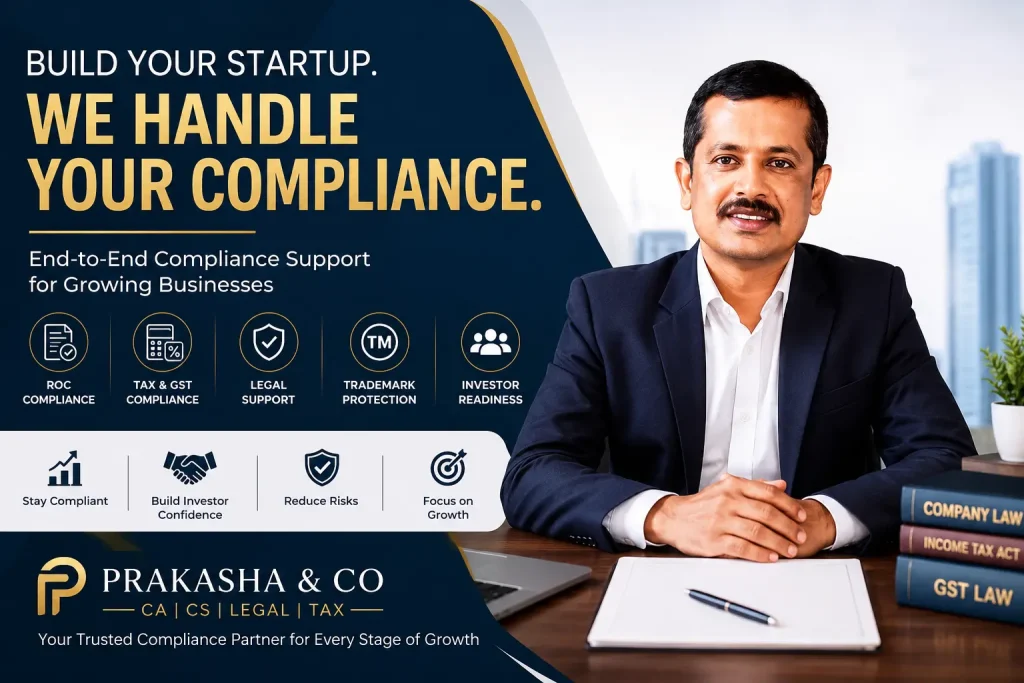
Instead of coordinating between separate Auditor, Company Secretaries, GST consultants, trademark agents, and lawyers, startups can work with one integrated team.
Our professionals handle compliance tracking, legal documentation, regulatory filings, governance support, and strategic compliance planning under a single engagement.
This allows founders to spend less time managing consultants and more time growing their business.
What We Handle
- ROC Compliance & Annual Filings
- GST Compliance & Advisory
- Income Tax & TDS Compliance
- Founder & Shareholder Agreements
- Employment Contracts
- Trademark Protection
- Board & Governance Support
- Investor Due Diligence Readiness
- Regulatory Compliance Monitoring
Missing Something?
Many startup founders assume everything is under control until an investor, bank, auditor, or government authority asks for documents.
Take a quick look at the questions below.
If your answer is “No” or “Not Sure” to any of them, your startup may already have a compliance gap.
- Do you know your next ROC filing due date?
- Have all board decisions been properly documented?
- Are founder rights and responsibilities documented?
- Are employee agreements legally enforceable?
- Have you protected your brand through trademark registration?
- Are GST, TDS and tax compliances being tracked regularly?
- Can you confidently face investor due diligence today?
- Do you have a compliance calendar for the next 12 months?
The reality is simple.
Most startups do not fail because of compliance. They lose opportunities because of compliance.
Funding gets delayed. Bank approvals get delayed. Enterprise contracts get delayed. Valuable management time gets wasted fixing issues that could have been prevented earlier.
Why Notices Arrive
Most regulatory notices are not caused by fraud or wrongdoing.
They are usually caused by lack of awareness, delayed filings, incomplete records, or poor compliance tracking.
We frequently see startups facing issues relating to:
- Pending ROC annual filings
- Missed statutory compliance requirements
- GST filing defaults
- Director compliance issues
- Improper maintenance of company records
- Missing legal agreements
Most of these issues can be corrected early if identified at the right time.
How We Work
Instead of waiting for a notice, investor query, or legal problem, we focus on preventive compliance management.
Our team reviews the business structure, identifies compliance obligations, creates a compliance roadmap, and continuously tracks important deadlines.
This helps founders focus on customers, products, hiring, and revenue growth while we focus on regulatory responsibilities.
Need A Compliance Review?
Speak with our Legal Team for a startup compliance assessment.
Call: 7019827351
Email: crp@prakashaandco.com
Real Startup Stories
Every startup has a growth story. Unfortunately, many also have a compliance story that nobody talks about until a problem appears.
Here are two real situations where timely compliance intervention protected future business opportunities.
Investor Due Diligence Challenge
A Bengaluru-based software company approached us after receiving interest from potential investors.
During preliminary due diligence, investors requested statutory records, ROC filings, board documents, and corporate compliance records.
The founders were surprised to discover that several legal compliances had remained pending since incorporation.
Like many startups, their focus had been on product development, hiring talent, and acquiring customers.
Our team immediately reviewed MCA records, identified pending obligations, completed overdue ROC filings, updated statutory records, and regularized the company’s compliance position.
Result: The company remained active, avoided future compliance complications, and is now building a structured governance framework with long-term plans for significant growth and future public market readiness.
Funding Readiness Transformation
A company operating in the fertilizer sector approached us while exploring external funding opportunities.
Although the business had strong market potential, investors identified concerns relating to licenses, governance processes, financial controls, and regulatory compliance.
Without resolving these issues, raising institutional funding would have been difficult.
Our CA, CS, and Legal team worked closely with management to review operations, strengthen compliance systems, improve documentation, and establish a structured governance framework.
Result: The company successfully strengthened investor confidence, improved operational discipline, and is now pursuing expansion opportunities, including acquisition of competing businesses.
The Common Pattern
In both cases, the problem was not lack of business potential.
The problem was that growth was happening faster than compliance management.
We see this frequently among startups and founder-led businesses.
When compliance falls behind growth, opportunities often slow down.
Investors become cautious. Banks ask additional questions. Due diligence becomes stressful. Regulatory risks increase.
The solution is not more paperwork.
The solution is having the right compliance system and the right team behind the business.
Built For Growing Businesses
Whether you are a newly incorporated startup, a fast-growing technology company, an e-commerce venture, a healthcare business, or a manufacturing enterprise, compliance requirements continue to evolve as your business grows.
Our role is to ensure compliance grows alongside your business, not behind it.
Founder Mistakes We See Often
Most compliance problems do not start with bad intentions.
They start with assumptions.
Founders are busy building products, serving customers, raising funds, and managing teams. Compliance often becomes an afterthought until a notice, investor query, or business opportunity exposes the gap.
1. Assuming Registration Is The Finish Line
Many founders believe company registration completes the legal process.
In reality, incorporation is only the starting point. ROC, GST, tax, employment, and governance obligations begin immediately after incorporation.
2. Missing ROC Filings
One of the most common issues we encounter is delayed annual ROC filings.
What starts as a missed deadline can eventually result in significant additional fees and unnecessary regulatory complications.
3. No Founder Agreement
Friends and family may start a business together with complete trust.
However, disputes often arise later regarding ownership, responsibilities, exits, and future funding decisions.
A properly drafted founder agreement can prevent years of future disputes.
4. Ignoring Trademark Protection
Many startups spend years building a brand before checking whether the name is legally available.
Unfortunately, some discover conflicts only after investing heavily in marketing and customer acquisition.
5. Personal And Business Expenses Mixed Together
Using company accounts for personal expenses creates governance and accounting complications.
This becomes particularly important during audits, investor due diligence, and tax assessments.
6. No Employment Documentation
Hiring employees without proper appointment letters, confidentiality clauses, intellectual property clauses, or employment contracts creates avoidable legal risks.
7. GST Registration Without Compliance Planning
Some businesses obtain GST registration but fail to establish a compliance process.
This often leads to missed returns, reconciliation issues, and notices later.
8. Preparing For Investors Too Late
Many founders begin organising records only after investor discussions start.
By then, valuable time is spent fixing historical issues instead of focusing on business growth.
The Hidden Cost
The actual cost of non-compliance is rarely a government penalty alone.
Lost funding opportunities, delayed contracts, reduced business valuation, and management distraction often have a far greater impact.
Most compliance issues are easier and less expensive to prevent than to repair later.
Are You Investor Ready?
Imagine an investor asks for the following documents tomorrow.
- Company statutory records
- ROC filing history
- Shareholding records
- Founder agreements
- Board resolutions
- Employment agreements
- GST and tax compliance records
- Trademark ownership details
Could your startup produce them confidently?
If the answer is uncertain, now is the right time to review your compliance position before an investor, regulator, or customer asks for it.
Beyond Compliance
Our objective is not simply filing forms.
We help startups build a compliance framework that supports fundraising, expansion, partnerships, acquisitions, and long-term business growth.
Our Compliance Framework
Every startup passes through different stages of growth.
The compliance requirements of a newly incorporated company are very different from a startup preparing for investment or expansion.
That is why we follow a structured compliance framework rather than a one-time filing approach.
Stage 1 – Launch
This is where most startups begin.
The focus is on creating a legally strong foundation for future growth.
- Company or LLP incorporation
- PAN & TAN compliance
- GST registration
- Professional Tax registration
- Shops & Establishment compliance
- Founder documentation
- Trademark planning
Goal: Start correctly and avoid future corrections.
Stage 2 – Operate
As revenue starts flowing, compliance becomes a continuous activity.
This is the stage where many startups unintentionally begin accumulating compliance gaps.
- GST compliance
- TDS compliance
- Accounting supervision
- Employment agreements
- Vendor contracts
- Regulatory tracking
- Compliance calendar management
Goal: Keep the business compliant while management focuses on growth.
Stage 3 – Scale
As teams grow and operations expand, governance becomes increasingly important.
Investors, customers, lenders, and strategic partners start reviewing how the company is managed.
- ROC compliance management
- Board governance support
- Shareholding management
- Legal documentation review
- Risk management
- Trademark protection
- Business expansion support
Goal: Build credibility and operational stability.
Stage 4 – Raise & Expand
Investors look beyond revenue.
They examine governance, compliance records, legal documentation, and management controls before making decisions.
- Investor readiness review
- Due diligence support
- Corporate restructuring
- ESOP advisory support
- Investment documentation support
- Strategic compliance planning
Goal: Create confidence for investors, lenders, and future stakeholders.
What Makes Us Different?
Many firms help startups complete filings.
Few firms take ownership of the complete compliance journey.
At Prakasha & Co, startups receive support from Chartered Accountants, Company Secretaries, Legal Professionals, Tax Advisors, and Trademark Consultants working together as one team.
Instead of coordinating multiple advisors, founders get a single compliance ecosystem.
What Happens In Your First 30 Days?
Plans & Pricing
Every startup has different compliance requirements.
A newly incorporated company requires a different level of support compared to a growing business with employees, investors, multiple contracts, and regulatory obligations.
To make compliance predictable and affordable, we offer flexible engagement models.
Startup Launch Plan
Starting from ₹5,000 per month
Designed for newly incorporated startups looking for professional guidance and compliance monitoring from day one.
- Compliance tracking support
- ROC guidance
- Basic legal advisory
- Regulatory updates
- Compliance calendar monitoring
- Email and phone support
Best For: Early-stage startups and founder-led businesses.
Growth Compliance Plan
Starting from ₹10,000 per month
Suitable for growing businesses requiring continuous compliance supervision and management-level support.
- End-to-end compliance monitoring
- ROC compliance management
- GST and tax coordination
- Board advisory support
- Legal documentation review
- Management compliance reporting
- Priority support
Best For: Businesses with employees, increasing revenue, and operational expansion.
Investor Readiness Plan
Starting from ₹20,000 per month
Built for startups preparing for angel investment, strategic investors, acquisitions, expansion, or future fundraising activities.
- Compliance due diligence review
- Investor readiness assessment
- Corporate governance support
- Strategic compliance planning
- Investment documentation assistance
- Fund-raising compliance guidance
- Senior advisory support
Best For: High-growth startups, funded companies, and expansion-focused businesses.
Need Something Custom?
Many startups have unique business models, industry-specific regulations, or investor requirements.
In such cases, we create customized compliance engagement plans based on the company’s stage, turnover, team size, and growth objectives.
Why Prakasha and Co?
Most firms focus on a single area of compliance.
Startups often end up coordinating between multiple consultants, creating confusion, delays, and gaps in responsibility.
At Prakasha & Co, we bring together multiple disciplines under one roof.
- Chartered Accountants
- Company Secretaries
- Legal Professionals
- Trademark Consultants
- Tax Advisors
- Startup Business Advisors
This integrated approach helps founders make faster decisions while maintaining stronger compliance control.
20+ Years Experience | 1,000+ Businesses Assisted | CA + CS + Legal Experts Under One Roof | Bengaluru Based Advisory Team
About Prakasha CR

Prakasha CR is a Startup Compliance Consultant and Business Advisor helping founders, SMEs, technology companies, healthcare businesses, e-commerce ventures, and manufacturing companies navigate regulatory challenges.
Working alongside experienced Statutory Auditors, Company Secretaries, Advocates, and Tax Professionals, he has supported businesses in company law compliance, taxation, governance, investor readiness, legal documentation, and strategic business growth.

Prakasha CR is a Startup Compliance Consultant and Business Advisor helping founders, SMEs, technology companies, healthcare businesses, e-commerce ventures, and manufacturing companies navigate regulatory challenges.
Working alongside experienced Statutory Auditors, Company Secretaries, Advocates, and Tax Professionals, he has supported businesses in company law compliance, taxation, governance, investor readiness, legal documentation, and strategic business growth.
Let’s Discuss Your Startup
Whether you have recently incorporated a company, received a compliance notice, are preparing for investors, or simply want a professional team to manage compliance, we are ready to help.
Get clarity before small compliance issues become major business problems.
📞 Call: 7019827351
📧 Email: crp@prakashaandco.com
Office:
Prakasha & Co,
Sahakar Nagar, Bengaluru, Karnataka.
Where Are You Today?
Different stages of growth require different levels of compliance support.
Just Started
Need company setup, GST, trademark, agreements, and compliance planning.
Growing Fast
Need compliance monitoring, contracts, tax support, and governance systems.
Scaling Operations
Need stronger controls, board support, legal documentation, and risk management.
Raising Funds
Need investor readiness, due diligence preparation, and governance review.
Investor Ready?
Investors often ask for more than financial statements.
Can your startup confidently provide the following?
- ✓ ROC Filing Records
- ✓ Shareholding Records
- ✓ Founder Agreements
- ✓ Employment Contracts
- ✓ Board Resolutions
- ✓ GST & Tax Compliance Records
- ✓ Trademark Ownership Details
- ✓ Statutory Registers
If not, now is the best time to prepare before investors ask.
Compliance Health Check
Review your current compliance position.
| Area | Status |
|---|---|
| ROC Filings | ✓ / ✗ |
| GST Compliance | ✓ / ✗ |
| Trademark Protection | ✓ / ✗ |
| Founder Agreement | ✓ / ✗ |
| Employee Agreements | ✓ / ✗ |
| Statutory Registers | ✓ / ✗ |
| Investor Readiness | ✓ / ✗ |
If three or more items are missing, your startup should undergo a compliance review.
Startup Compliance Checklist 2026
- □ Company Incorporation
- □ PAN & TAN
- □ GST Registration
- □ Professional Tax Registration
- □ Trademark Registration
- □ Founder Agreement
- □ Employee Agreements
- □ Accounting System
- □ TDS Compliance
- □ ROC Compliance
- □ Annual Filings
- □ Investor Documentation
Your First 30 Days
Step 1
Compliance Health Review.
Step 2
Gap Analysis & Risk Identification.
Step 3
Compliance Roadmap Preparation.
Step 4
Ongoing Monitoring & Advisory Support.
Step 1
Compliance Health Review.
Step 2
Gap Analysis & Risk Identification.
Step 3
Compliance Roadmap Preparation.
Step 4
Ongoing Monitoring & Advisory Support.
Why Founders Switch To Us
Many startups approach us after facing compliance confusion, delayed filings, poor coordination between advisors, or investor concerns.
- ✓ Multiple consultants but no ownership
- ✓ Pending ROC filings
- ✓ GST compliance issues
- ✓ Missing legal documentation
- ✓ Investor due diligence concerns
- ✓ Lack of compliance planning
Our integrated CA, CS, and Legal Team provides a single point of accountability.
Frequently Asked Questions
Do startups need compliance support immediately after incorporation?
Yes. Several legal, ROC, tax, and regulatory obligations begin immediately after registration.
Can one firm handle ROC, tax, GST, and legal compliance?
Yes. Our CA, CS, and Legal team works together under one roof.
What happens if ROC filings are missed?
Additional fees, compliance complications, and regulatory risks may arise.
Can you help before investor due diligence?
Yes. We review records, identify compliance gaps, and prepare documentation.
Do you work with startups outside Bangalore?
Yes. We assist startups across India through online and physical consultations.
How much does startup compliance support cost?
Plans generally start from ₹5,000 per month depending on the stage and requirements of the business.
Last Updated: June 2026