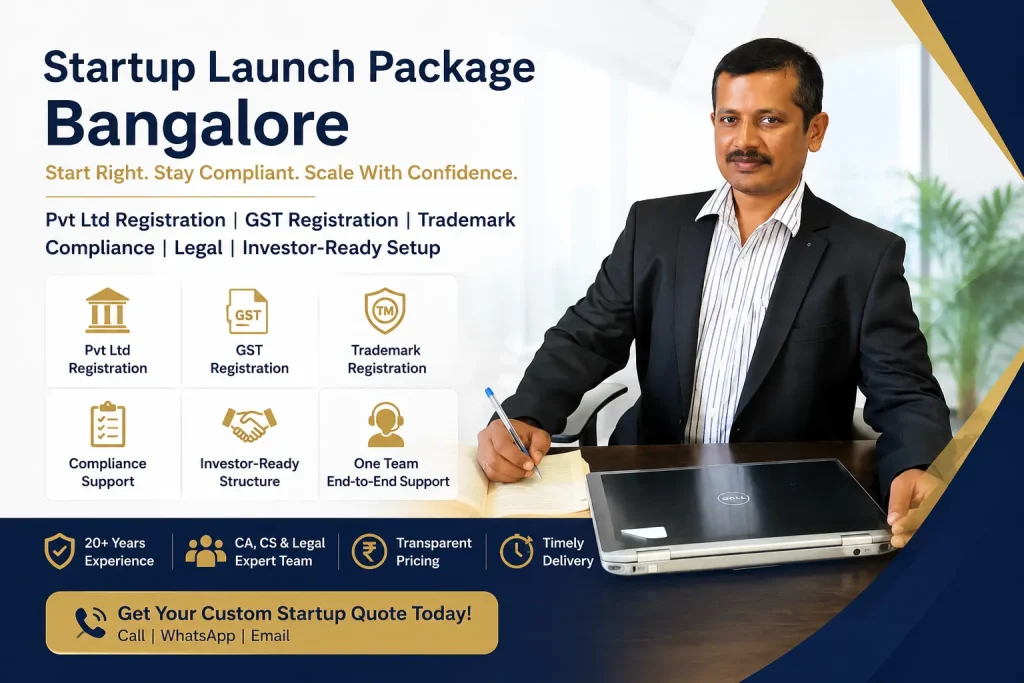
Startup Launch Package Bangalore is designed for founders who want Private Limited Company registration, GST registration, trademark protection, compliance support, and investor-ready business structuring under one roof.
Launching a Startup? Don’t Build It Piece by Piece.
Most founders start by searching for Private Limited Company registration.
A few days later they realize they also need GST registration.
Then they discover their brand name requires trademark protection.
After that come payment gateway requirements, Shops & Establishment registration, Professional Tax registration, bookkeeping, GST returns, ROC compliance, founder agreements, and investor-related documentation.
Suddenly one startup becomes five different service providers.
One consultant for company registration. Another for GST. A third for trademark. Someone else for compliance. And later another lawyer when disputes arise.
This is exactly where many startups lose time, money, and momentum.
At Prakasha & Co., we help founders build the entire foundation correctly from Day One.
Private Limited Company, GST Registration, Trademark Protection, Startup Legal Advisory, ROC Compliance, Tax Structuring, and Investor-Ready Documentation — all under one roof.
The Cost of Getting Startup Setup Wrong
Many online registration portals focus only on obtaining a Certificate of Incorporation.
However, serious founders are concerned about much bigger questions.
- Can investors invest later without restructuring the company?
- Is the shareholding pattern future-ready?
- Is the Memorandum of Association drafted correctly?
- Will GST registration support the business model?
- Can the trademark be protected before competitors register it?
- Will future ROC compliance become difficult?
- Will payment gateways and banking approvals become smoother?
These questions cannot be solved through a simple online form.
They require planning before registration.
Designed for Serious Founders, Not Just Registrations
This service is ideal for:
- Healthcare Startups
- Home Healthcare Platforms
- Elder Care Businesses
- SaaS Companies
- Marketplace Platforms
- Technology Startups
- E-commerce Brands
- D2C Businesses
- Professional Service Platforms
- Fundraising-Focused Startups
Whether you are launching your first startup or preparing for future investment rounds, the objective is the same:
Build the business structure correctly from the beginning.
One Team. One Point of Contact. Complete Startup Setup.
Instead of coordinating multiple vendors, founders receive support from a single team covering:
- Private Limited Company Registration
- GST Registration
- Trademark Registration
- Karnataka Shops & Establishments Registration
- Professional Tax Registration
- Bookkeeping & Accounting
- GST & TDS Compliance
- ROC Annual Compliance
- Startup Legal Advisory
- Funding & Investor Readiness Guidance
Our objective is simple:
Allow founders to focus on building the business while we handle the compliance foundation.
Marketplace, Aggregator & Gig-Worker Models Need Special Planning
Many modern startups operate differently from traditional businesses.
Healthcare platforms, nurse aggregators, service marketplaces, delivery businesses, and technology platforms often involve contractor payouts, commissions, subscriptions, and multiple revenue streams.
In such cases, GST, TDS, agreements, and operational structures must be carefully reviewed before launch.
The objective is to avoid future compliance issues while creating a scalable business model.
What Startup Founders Say About Working With Us
★★★★★
Rajesh
Founder – Gramina Raksha Nidhi Limited
“Getting company registration, GST, trademark, and compliance completed together looked difficult initially. The Prakasha & Co. team coordinated everything professionally and helped us move forward without running between multiple consultants.”
★★★★★
Chetan Kumar
Director – Agrisethu Private Limited
“Many firms promise one-stop support, but Prakasha & Co. actually delivered it. Company incorporation, GST registration, trademark filing, and compliance planning were handled in a structured and professional manner.”
Beyond Registration – Long-Term Startup Support
Most founders need much more than a registration certificate.
As the business grows, legal, tax, compliance, and intellectual property matters become increasingly important.
- Startup Legal Consultant Bangalore
- Indian Trademark Registration
- Corporate Lawyer Bangalore
- Legal Notice Services
- Income Tax Lawyer Bangalore
- GST Registration Services
- ROC Annual Compliance
Building a startup is not a one-time registration activity.
It is an ongoing journey requiring legal, tax, compliance, and business support at every stage of growth.
What Exactly Is Included in Our Startup Launch Package?
Many founders ask us a simple question:
“If I engage your team, what exactly will be completed?”
The answer is straightforward.
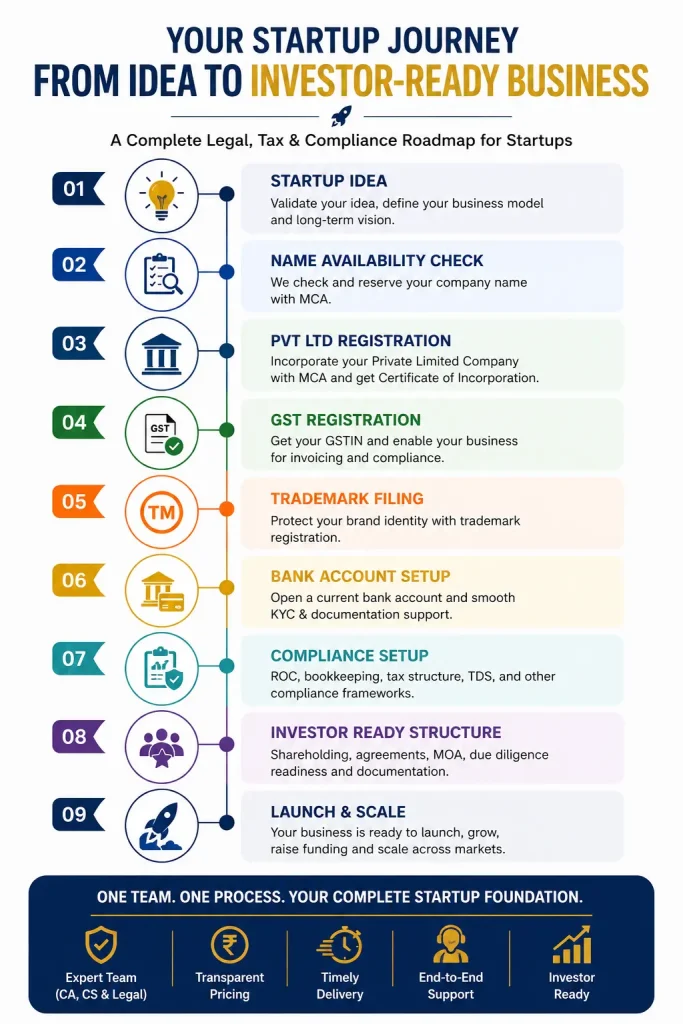
We handle the complete startup foundation required for a serious business launch.
- Private Limited Company Incorporation
- Digital Signature Certificates (DSC)
- Director Identification Numbers (DIN)
- Name Reservation & Approval
- Memorandum & Articles of Association Drafting
- PAN & TAN Allocation
- GST Registration
- Trademark Search & Filing
- Karnataka Shops & Establishments Registration
- Professional Tax Registration
- Initial Compliance Guidance
- Founder Structure Planning
- Investor Readiness Review
The objective is to ensure your startup is operational, compliant, and future-ready from the beginning.
How Long Does the Entire Process Take?
Founders are usually working against launch deadlines, customer onboarding schedules, investor meetings, and payment gateway approvals.
Therefore, realistic timelines matter.
Day 1–2
Initial consultation, document collection, DSC processing.
Day 2–4
Company name reservation and approval process.
Day 4–8
Company incorporation filing with MCA.
Day 8–12
Certificate of Incorporation, PAN, TAN generation.
Day 10–15
GST registration processing.
Day 10–15
Trademark application filing.
Actual timelines may vary depending on government approvals and document readiness.
Investor-Ready From Day One
Many founders register a company first and think about investors later.
Unfortunately, restructuring mistakes discovered during due diligence can become expensive.
Our startup setup process considers future growth from the beginning.
- Founder shareholding structure
- Authorized capital planning
- Business object clauses
- Future fundraising flexibility
- Brand ownership protection
- Compliance readiness
The goal is not merely registration.
The goal is building a company that can grow.
Common Startup Mistakes We Help Founders Avoid
After assisting businesses for over 20 years, we see the same mistakes repeatedly.
- Choosing a company name without trademark verification.
- Using generic business objects in the MoA.
- Incorrect founder shareholding allocation.
- Ignoring GST implications.
- Delaying compliance planning.
- Operating without proper legal documentation.
- Ignoring intellectual property protection.
Fixing these mistakes later usually costs significantly more than getting them right at the beginning.
What Happens After Company Registration?
Many online portals stop once the Certificate of Incorporation is issued.
For founders, that is actually where the real journey begins.
After incorporation, businesses generally require:
- GST filings
- Bookkeeping
- TDS compliance
- ROC annual filings
- Trademark monitoring
- Legal agreements
- Founder documentation
- Investor support
This is why many startups continue working with our team long after incorporation.
No Hidden Charges. No Registration Traps.
One concern many founders express is unexpected costs after onboarding.
We believe professional services should be transparent.
Before engagement, we explain:
- Government fees
- Stamp duty implications
- Professional fees
- Compliance responsibilities
- Expected timelines
Our objective is to build a long-term professional relationship, not a one-time transaction.
Before You Register, Ask the Questions Most Founders Forget
Is my structure investor ready?
Is my brand protected?
Will GST affect my revenue model?
Have I planned for future compliance?
Can investors enter smoothly later?
The answers to these questions often determine whether a startup grows smoothly or faces expensive corrections later.
Frequently Asked Questions by Startup Founders
Launching a startup involves many decisions.
Below are some of the most common questions founders ask before starting their business journey.
Should I start as a Private Limited Company or LLP?
For businesses planning to raise investment, onboard co-founders, issue shares, or scale nationally, a Private Limited Company is usually the preferred structure.
Each situation is different, and the correct structure depends upon your growth plans.
Can I raise funding later if I register today?
Yes.
However, the company structure, shareholding pattern, and constitutional documents should be planned properly from the beginning to avoid future complications during investor due diligence.
How much authorised capital should I keep initially?
There is no one-size-fits-all answer.
The authorised capital should align with your startup’s future growth plans, funding expectations, and operational requirements.
Our team generally advises founders based on the intended business model and expansion roadmap.
Can I change the shareholding later?
Yes.
New shareholders, investors, and co-founders can be added later through proper legal procedures.
However, thoughtful planning at the beginning often reduces future restructuring costs.
Do I need GST immediately after company registration?
Many startups require GST registration for customer invoicing, vendor onboarding, payment gateway approvals, and compliance requirements.
The necessity depends upon the business model and expected turnover.
Can GST affect payment gateway approval?
Yes.
Many payment gateways and financial institutions require business documentation and GST details before onboarding.
This is one reason many startups complete GST registration alongside incorporation.
Should I apply for a trademark before launching?
Ideally, yes.
Protecting the brand early helps reduce the risk of future disputes and prevents others from registering a similar identity.
A trademark search before launch is always advisable.
Which trademark classes should startups choose?
The answer depends on the nature of the business.
Technology platforms, healthcare services, SaaS products, mobile applications, and physical products often require different trademark classifications.
A proper assessment helps avoid inadequate protection.
Can one company operate multiple business activities?
Yes.
However, the Memorandum of Association should be drafted carefully to accommodate current operations and future expansion plans.
How do marketplace and aggregator businesses handle contractor payouts?
Marketplace businesses often involve specialised GST, TDS, agreement structuring, and compliance considerations.
The correct approach depends on the operational model and commercial arrangements.
This is one of the most important areas to review before launch.
Do I need founder agreements if the founders trust each other?
Trust is important.
However, founder agreements help avoid misunderstandings regarding ownership, responsibilities, exits, investments, intellectual property, and future decision-making.
Many startup disputes arise because these matters were never documented.
What happens after incorporation?
Company registration is only the beginning.
Startups generally require accounting, GST compliance, ROC filings, tax support, legal agreements, trademark protection, and ongoing advisory services as they grow.
Will I have a dedicated point of contact?
Yes.
We believe founders should have access to experienced professionals who understand the business and its compliance requirements.
Our team includes Chartered Accountants, Company Secretaries, Legal Experts, and Startup Advisors working together to support growth.
Can you continue supporting us after registration?
Absolutely.
Many of our startup clients continue with us for bookkeeping, GST, TDS, ROC compliance, trademark matters, legal documentation, fundraising readiness, and business advisory support.
Why Many Startups Continue Working With Us Long After Registration
A startup’s biggest challenges usually begin after incorporation.
Customer contracts.
GST compliance.
Employee onboarding.
Trademark protection.
Funding discussions.
ROC filings.
Tax planning.
Legal notices.
Investor due diligence.
Because our team includes legal, tax, compliance, and corporate professionals, founders often continue working with us as their long-term business advisors.
Launching a Startup Is Easy. Building It Correctly Is What Matters.
A registration certificate can be obtained in a few days.
Building a legally compliant, tax-efficient, investor-ready, and protected business requires planning.
That is where experienced advisors make a difference.
The next section explains our startup launch process, expected timelines, and how founders can get started.
Before You Spend ₹1 On Registration, Answer These 7 Questions
- Will you have co-founders?
- Will you raise funding later?
- Will you build technology or software?
- Will you own intellectual property?
- Will contractors or gig workers be involved?
- Will you expand outside Karnataka?
- Will you require investor due diligence in future?
The answers to these questions often determine the correct legal and compliance structure.
Why Many Startup Registrations Create Problems Later
The company registration may be completed successfully.
The problems usually appear later.
- Trademark conflicts
- Co-founder disputes
- Investor objections
- Improper shareholding structures
- GST complications
- Missing legal agreements
- ROC non-compliance
A startup should be designed for growth, not merely registered.
How Much Does A Startup Launch Package Cost?
The cost depends on:
- Number of directors
- Authorized capital
- Trademark classes
- GST requirements
- State registrations
- Compliance scope
Before engagement, we provide a transparent itemized proposal covering government fees, stamp duty, and professional charges.
Who Will Handle Your Startup Project?
Many online platforms operate through sales executives and call centres.
Our startup engagements are handled by qualified professionals including Chartered Accountants, Company Secretaries, Legal Experts, and Startup Advisors.
Founders know exactly who is working on their business.
Preparing For Future Investor Due Diligence
Many founders focus on launching.
Investors focus on documentation.
Shareholding records, compliance filings, trademarks, contracts, GST records, and corporate governance become important during future funding discussions.
Early planning makes future fundraising easier.
Startup Mistakes We Regularly Encounter
- Launching without trademark verification.
- Using personal accounts for business transactions.
- Ignoring GST implications.
- Improper founder equity allocation.
- Operating without agreements.
- Ignoring compliance after incorporation.
Most of these issues are preventable when addressed early.
Built In Bangalore. Designed To Scale.
Bangalore remains India’s leading startup ecosystem.
From healthcare and SaaS to AI, fintech, marketplaces, logistics, and D2C brands, founders require structures capable of supporting future growth.
Our role is to help build that foundation correctly.
You Are Not Looking For A Registration Certificate
You are building a business.
The certificate is only the beginning.
The real objective is creating a compliant, protected, scalable, and investor-ready company.
That is where experienced advisors make the difference.