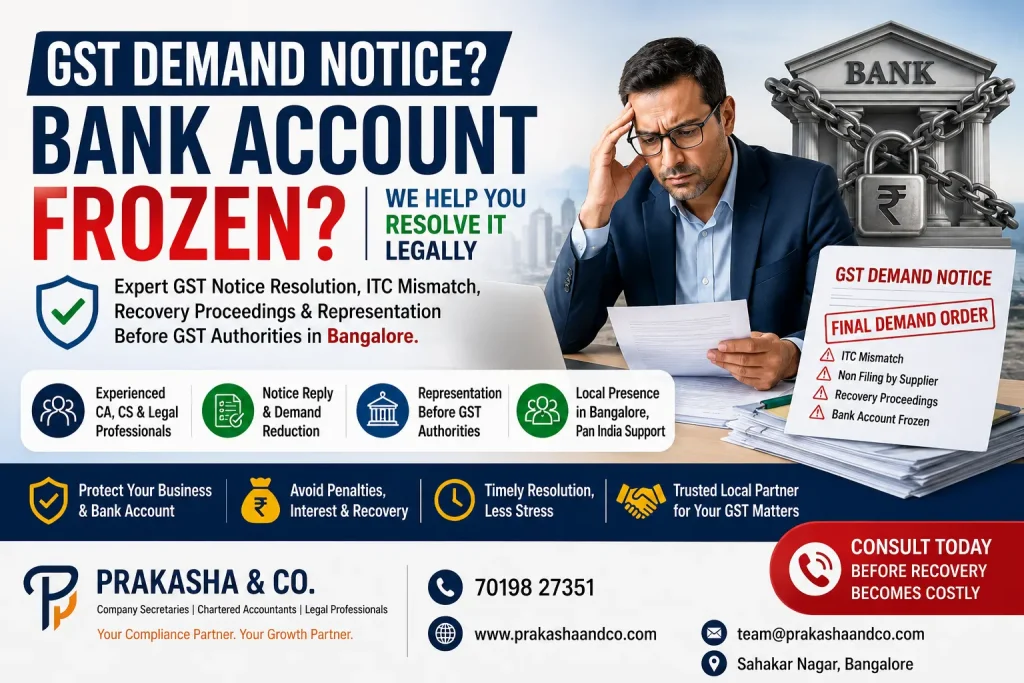
Received a GST Demand Notice, Final Demand Order or Bank Account Freeze? Learn why it happens, how to prevent costly GST recovery proceedings, and the practical steps our GST experts use to resolve these issues before they escalate.
Bank Frozen Due to GST Demand? Know Your Legal Options Before It’s Too Late
One morning, you open your banking app to make payment or EMI, only to find that your bank account has been frozen by the GST Department. No prior phone call. No warning from the bank. Your business suddenly comes to a standstill.
This situation is becoming increasingly common across Bangalore and Karnataka. Many business owners are shocked to learn that an old GST demand notice, Input Tax Credit (ITC) mismatch, or an unanswered GST notice can ultimately lead to recovery proceedings and bank account attachment—even after the business has been closed or the GST registration has been cancelled.
The biggest mistake? Most businesses ignore the initial GST notices, assuming they can deal with them later. Unfortunately, GST proceedings continue in the background, and by the time the Final Demand Order is issued, recovery action may already have started.
A Recent GST Recovery Case We Successfully Resolved
An electronic goods supplier from Bangalore had already closed his business and shifted back to his hometown after business losses. Nearly two years later, he discovered that his SBI bank account had been frozen. The account also held a ₹20 lakh gold loan secured against approximately ₹50 lakh worth of family gold jewellery.
The reason was not tax evasion. It was an old GST Input Tax Credit mismatch that had remained unresolved because several suppliers had failed to file their GST returns. Since the GST notices were never responded to, the department completed the assessment and initiated recovery proceedings.
After a detailed reconciliation, supplier follow-up, and representation before the GST authorities, our team was able to substantially reduce the GST demand. The recovery proceedings were withdrawn, and the bank account was subsequently restored.
This was not an isolated incident. Over the past few years, we have handled several cases where GST notices could have been resolved at an early stage, saving clients from unnecessary financial loss, mental stress, and lengthy litigation.
If you have received a GST notice, GST demand order, ASMT-10, DRC notice, or your bank account has already been frozen, acting immediately gives you the best opportunity to resolve the matter before it escalates further.
Why Bank Accounts Are Being Frozen
Many business owners assume that a bank account is frozen only when there is tax fraud. In reality, most GST recovery cases start with a small compliance issue that remains unattended for months or even years.
We have observed that many businesses receive GST notices on the portal or registered email but fail to respond in time. Once the statutory process is completed, the GST Department can issue a Final Demand Order and begin recovery proceedings, including instructions to banks.
The encouraging part is that many of these cases are compliance-related rather than intentional tax evasion. With timely reconciliation and proper representation, the demand can often be reduced or resolved before it becomes a prolonged legal dispute.
Common Reasons Behind GST Recovery Proceedings
- Claiming Input Tax Credit (ITC) that does not match GSTR-2A or GSTR-2B.
- Suppliers collected GST but failed to file GSTR-1 or GSTR-3B.
- Difference between purchase records and GST portal data.
- GST notices remained unanswered because the business had already closed.
- Business owner changed address, mobile number or email and missed important communications.
- GST registration was cancelled without resolving pending assessments.
- Tax demand was created automatically after no reply was filed within the prescribed time.
A Small Mistake Can Become a Big Business Problem
Once recovery proceedings begin, the impact goes beyond paying tax. Businesses may face frozen bank accounts, delayed salaries, rejected loan renewals, blocked working capital, supplier payment issues and unnecessary stress. In some cases, directors and proprietors only become aware of the GST demand when their banking transactions suddenly stop.
Our experience shows that the earlier the notice is examined, the more options are available. Waiting until the bank account is frozen usually means additional effort, higher costs and more time to resolve the matter.
How We Resolved a Bank Account Freeze – A Real Client Story
Every GST demand has a different background. Some arise due to genuine tax liability, while many others are caused by Input Tax Credit (ITC) mismatches, supplier non-compliance, or missed GST notices. One such case recently came to our office, where timely intervention helped a business owner avoid prolonged recovery proceedings.
The Background
An individual proprietor was supplying electronic goods to corporate customers in Bangalore. After suffering business losses, he applied for cancellation of his GST registration and returned to his hometown to take care of his family’s agricultural activities.
Like many small business owners, he believed that once the GST registration was cancelled, all pending matters had come to an end. Unfortunately, that assumption proved costly.
What Went Wrong?
During our review, we found that several suppliers from Bangalore had either not filed their GSTR-1 and GSTR-3B returns or had not discharged the GST liability despite issuing tax invoices.
As a result, the client’s purchase records reflected higher Input Tax Credit than what appeared in GSTR-2A. This mismatch triggered GST scrutiny and demand proceedings.
Multiple GST notices were issued over time. Since the client had already discontinued the business and relocated, no replies were filed. The proceedings therefore continued without any representation.
The Situation Became Serious
After completing the assessment, the GST Department passed the Final Demand Order and initiated recovery proceedings.
The client only became aware of the issue when his State Bank of India account was frozen.
The situation became even more difficult because the same bank account was linked to a ₹20 lakh gold loan secured against family gold ornaments worth approximately ₹50 lakh. Since the account was under recovery action, routine banking operations and loan renewal were also affected.
Our Step-by-Step Resolution Process
Instead of rushing into litigation, our GST advisory team first carried out a complete factual and compliance review to understand the actual cause of the demand.
- Collected the complete GST case history
We obtained the assessment records, notices, demand orders and recovery documents from the jurisdictional GST office. - Performed detailed GST reconciliation
Our team compared the purchase register, GSTR-2A, GSTR-2B, books of accounts and vendor-wise Input Tax Credit to identify every mismatch. - Contacted defaulting suppliers
Several suppliers had failed to file pending GST returns. We coordinated with them, explained the consequences and continuously followed up until the pending compliances were completed wherever possible. - Prepared supporting documentation
The corrected reconciliation, purchase evidence and supporting records were organised into a structured submission for the GST authorities. - Represented the client before the GST Officer
Our professionals personally explained the factual position, demonstrated the reconciliation and requested reconsideration based on updated compliance by the suppliers.
The Result
After examining the revised reconciliation and supporting documents, the GST Department accepted substantial corrections. The GST demand was significantly reduced, recovery proceedings were withdrawn, and the bank account was restored for normal operations.
The client was finally able to regularise his GST position and move forward without the uncertainty of pending recovery proceedings.
Every GST notice does not have the same solution. However, this case demonstrates that a structured review, proper reconciliation and timely representation before the GST authorities can often produce far better results than ignoring the notices or immediately entering into lengthy appeal proceedings.
How to Prevent a GST Demand Notice from Becoming a Recovery Case
In our experience, most GST recovery cases do not start with a bank account freeze. They begin with a small notice that is ignored, misunderstood or kept aside for later. By the time the business owner realises the seriousness of the matter, the statutory process has already moved to the recovery stage.
The good news is that many GST disputes can be prevented by taking timely action at the notice stage. A prompt response not only protects your business but also reduces unnecessary interest, penalties and legal expenses.
Simple Steps Every Business Should Follow
- Do not ignore any GST notice.
Even if you believe the demand is incorrect, every notice has a response timeline. Missing the deadline may result in an ex-parte order. - Download and review notices regularly.
Many notices are available only on the GST Portal. Businesses often miss them because the registered email or mobile number is no longer active. - Reconcile GSTR-2A and GSTR-2B every month.
Regular reconciliation helps identify supplier defaults before they become GST demands. - Monitor your suppliers’ GST compliance.
Claiming Input Tax Credit is only one part of compliance. Your suppliers must also file their returns correctly and pay the tax collected. - Do not assume GST cancellation ends all responsibilities.
Even after cancellation, the department can continue assessments relating to earlier financial years. - Maintain proper purchase records.
Invoices, payment proofs, e-way bills and reconciliation statements become valuable evidence if a notice is issued. - Consult a GST professional before replying.
A well-prepared reply supported by documents often resolves the matter at the departmental level without lengthy litigation.
A Small GST Notice Today Can Become a Bigger Problem Tomorrow
We have met many business owners who ignored an initial GST notice because they were busy, had already closed the business or believed the demand would automatically disappear. Unfortunately, GST proceedings continue as per law, and the consequences can affect your banking, business reputation and future registrations.
Early professional review is almost always easier and more economical than dealing with recovery proceedings after a Final Demand Order has been passed.
Our Advice to Every Business Owner
If you receive any communication from the GST Department, treat it as an opportunity to resolve the issue—not as a document to postpone. A timely response can often prevent recovery proceedings, attachment of bank accounts and unnecessary financial hardship.
Whether the issue relates to Input Tax Credit mismatch, supplier default, non-filing of returns, GST cancellation, ASMT-10, DRC-01, DRC-07 or a Final Demand Order, obtaining the right guidance at the earliest stage gives you the highest chance of a practical and cost-effective resolution.
How We Help Resolve GST Demand Notices Before They Become Costly Litigation
Every GST notice requires a different strategy. Some matters can be resolved through proper reconciliation and factual clarification, while others may require representation before the GST authorities or statutory remedies under the GST law. Our objective is always to identify the most practical and legally sustainable solution based on the facts of each case.
Rather than preparing a standard reply, we first understand how the GST demand originated, verify whether the liability is actually payable, and then decide the appropriate course of action. This approach has helped many businesses avoid unnecessary litigation, additional costs and prolonged recovery proceedings.
Our GST Notice Resolution Process
Step 1 – Complete Case Assessment
We begin by reviewing every GST notice, demand order, portal communication and previous correspondence to understand the complete history of the case before advising any action.
Step 2 – Technical GST Reconciliation
Our Chartered Accountants reconcile purchase registers, GSTR-2A, GSTR-2B, GSTR-1, GSTR-3B, books of accounts and other supporting records to identify the exact reason behind the demand.
Step 3 – Vendor Compliance Verification
Where the demand arises due to supplier defaults, we examine vendor compliance, communicate with suppliers wherever required and assist in obtaining corrected GST filings whenever legally feasible.
Step 4 – Legal Review of the Demand
Not every GST demand is legally sustainable. We analyse whether the department has correctly applied the GST provisions, issued notices in accordance with law and considered all relevant documents before passing the order.
Step 5 – Representation Before GST Authorities
Our professionals prepare structured submissions supported by reconciliations, documentary evidence and legal reasoning while representing clients before the jurisdictional GST officer.
Step 6 – Exploring Practical Resolution
Where the matter can be resolved during departmental proceedings, we work towards achieving an early settlement based on facts and compliance instead of allowing the issue to unnecessarily escalate.
Step 7 – Appeal Support, Wherever Necessary
If the dispute cannot be resolved at the departmental level, we advise clients on the appropriate appellate remedy and prepare the documentation required for further legal proceedings.
Why Businesses Across Bangalore Consult Us Early
- Practical experience in handling GST notices, ITC mismatch and recovery proceedings.
- Joint approach involving Chartered Accountants, Company Secretaries and legal professionals.
- Strong focus on reconciliation before recommending litigation.
- Experience in dealing with supplier compliance issues affecting Input Tax Credit.
- Professional representation before GST authorities with structured documentation.
- Clear advice on legal options, expected timelines and compliance requirements.
- End-to-end assistance until the matter reaches a practical conclusion.
Our experience has shown that the best time to seek professional advice is when the first GST notice is received—not after recovery proceedings begin. Early intervention often provides more legal options, reduces financial exposure and allows businesses to continue operations without unnecessary disruption.
GST Issues We Help Resolve
Whether you have received a GST notice recently or your bank account has already been frozen, our team helps businesses understand the issue, prepare the right response and represent them before the GST authorities.
- ✔ GST Demand Notice Reply
- ✔ GST ASMT-10 Notice
- ✔ GST DRC-01 & DRC-07 Notices
- ✔ GST Final Demand Orders
- ✔ GST Recovery Proceedings
- ✔ Bank Account Freeze due to GST Recovery
- ✔ Input Tax Credit (ITC) Mismatch
- ✔ GSTR-2A & GSTR-2B Reconciliation
- ✔ Supplier GST Non-Compliance Issues
- ✔ GSTR-1 & GSTR-3B Mismatch
- ✔ GST Registration Cancellation Issues
- ✔ GST Revocation & Restoration
- ✔ GST Appeal Support
- ✔ GST Officer Representation
- ✔ Pending GST Compliance Resolution
Not sure what the notice means? Share your GST notice with us. We will review the documents, explain the actual issue in simple language and guide you on the most appropriate legal and practical solution.
Outside Bangalore? We Can Represent You Before the Bangalore GST Office
Many businesses registered in Bangalore are now operating from other cities or states. Some have shifted their office, closed their Bangalore branch or relocated the promoters. However, their pending GST notice or demand still remains under the jurisdiction of the Bangalore GST office.
Travelling to Bangalore for every hearing, document submission or discussion with the GST department is both expensive and time-consuming. This is where our local presence becomes valuable.
Your Trusted Local GST Representative in Bangalore
Our office regularly assists businesses located outside Bangalore by acting as their local coordination partner. We communicate with the jurisdictional GST office, submit documents, attend hearings wherever permitted, coordinate with officers and keep clients informed throughout the resolution process.
Instead of travelling repeatedly, you can work with our team remotely while we manage the local compliance and representation required before the Bangalore GST authorities.
Whether your business is now operating from another district of Karnataka or anywhere else in India, we can help you manage your Bangalore GST matter professionally and efficiently.
Why Businesses Choose Prakasha & Co.
- ✔ More than 20 years of professional experience.
- ✔ CAs, Company Secretaries and Legal Professionals working together.
- ✔ Practical experience in GST demand and recovery matters.
- ✔ Complete GST reconciliation before recommending legal action.
- ✔ Representation before Bangalore GST authorities.
- ✔ Support for businesses across India having GST matters in Bangalore.
- ✔ Transparent advice focused on practical resolution.
- ✔ End-to-end assistance until the matter reaches closure.
FAQ on GST demands (FAQs)
Can the GST Department freeze my bank account?
Yes. If a GST demand becomes final and recovery proceedings are initiated under the GST law, the department may direct the bank to restrict operations in accordance with the applicable legal provisions.
Can a GST demand be reduced?
It depends on the facts of the case. Where the demand arises due to reconciliation differences, supplier compliance or factual errors, it may be possible to seek appropriate relief through proper representation and supporting evidence.
My GST registration is cancelled. Can I still receive a GST notice?
Yes. Cancellation of GST registration does not automatically close pending assessments or earlier tax periods. Notices may still be issued for previous financial years.
Can you help if I am outside Bangalore?
Yes. Many of our clients now operate from other cities while their GST jurisdiction remains in Bangalore. We assist with local coordination, documentation and representation before the Bangalore GST authorities.
Should I file an appeal immediately?
Not always. Every case should first be reviewed to determine whether it can be resolved at the departmental level or whether an appeal is the appropriate legal remedy.
How quickly should I respond to a GST notice?
As early as possible. Delayed responses may result in ex-parte orders, additional recovery proceedings and fewer options for resolving the matter.
Received a GST Notice? Don’t Wait Until Your Bank Account Gets Frozen.
Many GST disputes can be resolved more efficiently when addressed at the initial notice stage. If you have received a GST demand notice, ASMT-10, DRC-01, DRC-07, recovery notice or your bank account has already been frozen, let our experienced professionals review your case and guide you on the most appropriate course of action.
Our team assists businesses across Bangalore, Karnataka and clients throughout India whose GST matters fall under the jurisdiction of Bangalore GST offices.
Prakasha & Co.
Company Secretaries | Chartered Accountants | Legal Professionals
📍 Sahakar Nagar, Bangalore
📞 70198 27351
Book your GST Notice Consultation today and resolve the issue before recovery proceedings become more complicated.