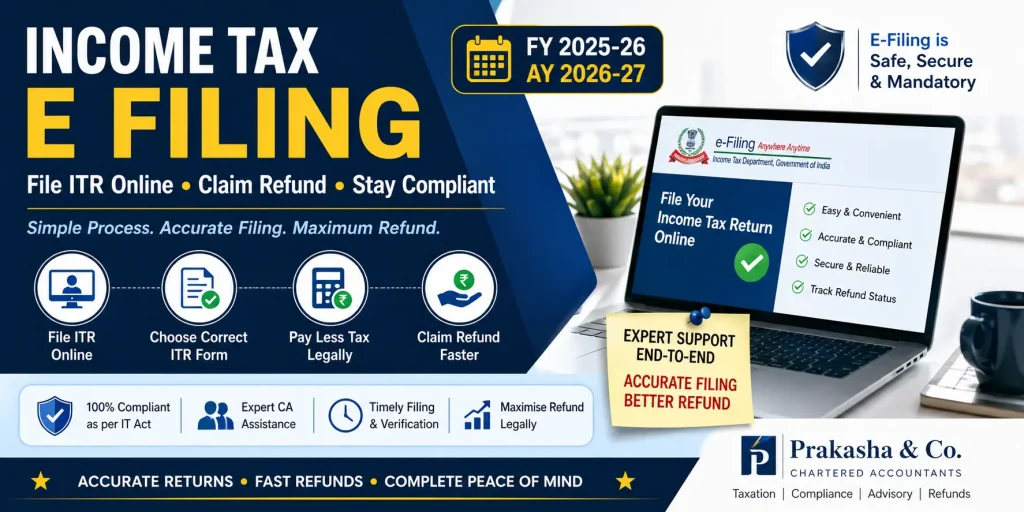
Income tax e filing has become the standard method for filing your Income Tax Return (ITR) in India. While the online system provided by the Income Tax Department simplifies the process, accurate filing requires proper understanding of income disclosure, tax regime selection, and compliance with updated rules.
Many taxpayers attempt to file their ITR online but face challenges such as incorrect form selection, mismatch in AIS/26AS, missed deductions, or wrong tax regime selection, which may lead to refund delays, reduced refund, or notices.
For Financial Year 2025–26, with increased system-based validation and data already available in the portal (AIS, TIS, bank reporting, etc.), it is important to ensure that your return is accurate, properly disclosed, and legally compliant.
With over 20+ years of experience in Bangalore, our CA-assisted team supports individuals, professionals, and businesses in online ITR filing, tax planning, and refund optimisation, ensuring smooth processing without issues.
This guide explains how income tax e filing works, who should file, which ITR form to choose, and how to file your return online correctly.
What is Income Tax E Filing?
Income tax e filing refers to the process of submitting your Income Tax Return (ITR) online through the official Income Tax Department portal. It has replaced the earlier manual filing system and is now mandatory for most taxpayers.
Through the e-filing system, taxpayers can:
- File their Income Tax Return (ITR) online
- Verify and submit returns digitally (Aadhaar OTP, net banking, DSC, etc.)
- Check ITR status and processing updates
- Track income tax refund and reissue requests
- View financial data through AIS, TIS, and Form 26AS
The current e-filing portal is designed with pre-filled data, where income details such as salary, interest, and TDS are already reflected. While this makes filing easier, it is still necessary to verify, correct, and complete the information before submission.
Many taxpayers assume that pre-filled data is complete and accurate. However, in practice, there can be missing entries, incorrect classifications, or additional income not reflected, which must be properly reported to avoid notices or refund issues.
Therefore, income tax e filing is not just about submitting the return online—it involves reviewing, validating, and filing the return correctly as per Income Tax provisions.
Whether you are filing as a salaried individual, freelancer, or business owner, understanding the correct process and disclosures is essential for smooth filing and refund processing.
Who Should File Income Tax Return Online?
Filing your Income Tax Return (ITR) through the income tax e filing portal is mandatory in many cases and beneficial even when not compulsory. It ensures compliance, helps in claiming refunds, and maintains proper financial records.
You should file your ITR online if you fall under any of the following categories:
- Salaried Individuals: Even if tax is deducted by employer (TDS), filing is required to report income and claim refund.
- Freelancers / Consultants: Income received with TDS (Form 16A) or professional income must be reported properly.
- Business Owners & Self-Employed: Required to file ITR based on income, even under presumptive taxation.
- Individuals with Capital Gains: Sale of shares, mutual funds, or property must be disclosed.
- Rental Income Earners: Income from house property needs to be reported.
- Persons with TDS Deducted: To claim refund of excess tax deducted.
- Individuals with Foreign Income or Assets: Mandatory disclosure required under Income Tax provisions.
- High-Value Transactions: Where transactions are reflected in AIS (investments, deposits, etc.).
Even if your income is below the taxable limit, filing your return is advisable when TDS has been deducted or when you need proof of income for loans, visas, or financial records.
Filing your ITR correctly ensures compliance, helps in smooth refund processing, and avoids future notices from the Income Tax Department.
Income Tax E Filing Process – Step-by-Step Guide
The income tax e filing process is carried out through the official Income Tax portal. While the system provides pre-filled data, it is important to review and verify all details before submitting your return.
Below is the step-by-step process to file your ITR online:
- Login to Income Tax Portal: Use your PAN and password to access your account on the e-filing portal.
- Check Pre-Filled Data: Review details available in AIS, TIS, and Form 26AS including salary, interest income, and TDS.
- Select Correct ITR Form: Choose ITR-1, ITR-2, ITR-3, or ITR-4 based on your income type and sources.
- Choose Tax Regime: Compare old vs new tax regime and select the one that results in lower tax liability.
- Enter Additional Income & Deductions: Add any missing income (interest, capital gains, etc.) and claim eligible deductions (80C, 80D, HRA, etc.).
- Verify Tax Calculation: Check total income, tax payable, or refund amount before submission.
- Submit and E-Verify Return: Complete verification using Aadhaar OTP, net banking, or DSC to validate the filing.
- Track Status & Refund: After filing, track ITR processing and refund status through the portal.
Common Issue: Many taxpayers rely only on pre-filled data and miss reporting additional income or incorrect entries, which can lead to notices or refund reduction.
Proper review, correct form selection, and accurate disclosure are essential for smooth processing and timely refund.
If you are unsure about any step in the income tax e filing process, it is advisable to get your return reviewed before submission.
Which ITR Form to Choose for Income Tax E Filing?
Selecting the correct ITR form is a crucial step in the income tax e filing process. Choosing the wrong form can lead to defective return notices or rejection of your filing.
The Income Tax Department provides different ITR forms based on the nature of income. Below is a simplified guide to help you understand which form applies to you:
ITR-1 (Sahaj)
- Salaried individuals with income up to ₹50 lakhs
- Income from one house property
- Other income (interest, etc.)
- Not applicable for capital gains, foreign income, or complex cases
ITR-2
- Individuals with income above ₹50 lakhs
- Capital gains (shares, mutual funds, property)
- Foreign income or foreign assets
- Multiple house properties
ITR-3
- Individuals or HUFs having business or professional income
- Freelancers, consultants, traders
- Income from proprietary business
ITR-4 (Sugam)
- Individuals, HUFs, and firms opting for presumptive taxation
- Business income up to ₹2 crores
- Professional income under presumptive scheme
Important: Filing the wrong ITR form can result in your return being treated as defective under Section 139(9), requiring correction and re-filing.
In many cases, taxpayers are unsure whether to file ITR-1 or ITR-2, especially when they have capital gains, foreign income, or multiple income sources. Proper evaluation is necessary before selecting the form.
Choosing the correct ITR form ensures smooth processing, faster refunds, and avoids notices.
Important for Company Directors, LLP Partners & GST-Registered Businesses:
-
Private Limited Company Directors: Individuals who are directors in a company are generally required to file ITR-2 or ITR-3 depending on income sources.
➡️ If you have business or professional income, you must file ITR-3. -
Holding Unlisted Equity Shares: If you hold shares in a private limited company (unlisted equity), you cannot file ITR-1 or ITR-4.
➡️ In such cases, ITR-2 or ITR-3 becomes applicable. - LLP / Partnership Firm Partners: Individuals receiving income (salary, interest, profit share) from LLP or partnership firms generally need to file ITR-3.
- GST Registered Business / Professionals: If you are registered under GST and carrying on business or professional activity, you are required to file ITR-3 or ITR-4 (if opting for presumptive taxation), based on eligibility.
Selecting the correct ITR form in these cases is critical, as incorrect selection may lead to defective return notices and delay in processing.
Common Mistakes in Income Tax E Filing
While the income tax e filing process appears simple, many taxpayers make errors that lead to refund delays, notices, or defective returns. Avoiding these common mistakes is essential for smooth processing.
Based on practical experience, the following are the most frequent mistakes observed:
- Relying only on pre-filled data: AIS and Form 26AS may not capture all income correctly. Missing or incorrect entries can lead to mismatch.
- Incorrect ITR form selection: Filing ITR-1 instead of ITR-2/3 in cases involving capital gains, foreign income, or directorship can result in defective return under Section 139(9).
- Wrong tax regime selection: Choosing old or new regime without proper calculation may increase tax liability or reduce refund.
- Missing income disclosure: Interest income, trading income, or rental income not reported properly.
- Incorrect deduction claims: HRA, medical insurance, or other deductions claimed without proper documentation.
- Mismatch with AIS / 26AS: Differences between reported income and department records can trigger alerts or notices.
- Incorrect bank details: Errors in bank account details may delay or fail refund processing.
- Failure to verify ITR: Return is not considered valid unless verified within the prescribed time.
Even small mistakes can result in refund being delayed or reduced, or notices being issued by the Income Tax Department.
Proper review, correct form selection, and accurate disclosure are key to successful income tax e filing and smooth refund processing.
If you are unsure about any part of the filing process, it is advisable to get your return reviewed before submission to avoid complications later.
Documents Required for Income Tax E Filing
For income tax e filing, most of your financial data is already available on the Income Tax portal once you log in using your PAN. Our approach is to first review this available data and then collect only the additional details required for accurate filing.
What is Already Available on Portal
- Form 26AS – TDS and tax payment details
- AIS (Annual Information Statement) – income from various sources
- TIS (Taxpayer Information Summary)
- Pre-filled salary and interest income (as reported by employer/banks)
What You Need to Share (If Applicable)
- Form 16: Salary income and TDS details
- Form 16A: TDS on freelance/consulting income
- Bank Statements / Interest Certificates
- Investment Proofs: 80C, 80D, donations, etc.
- HRA Details: Rent receipts and landlord PAN (if applicable)
- LTA Bills: Travel proofs if exemption claimed
- Demat / Trading Statements: For capital gains
- Property Details: Rental income or sale transactions
- Business / Professional Income: Basic income and expense details
- Foreign Income / Assets (if any)
Our Review & Filing Approach
- Login and download AIS, 26AS, and pre-filled data
- Cross-check income, TDS, and disclosures
- Identify mismatches or missing entries
- Advise on correct ITR form and tax regime
- Apply eligible deductions and exemptions
- File ITR with proper compliance and refund optimisation
With this structured process, we ensure accurate filing, faster refund processing, and reduced risk of notices.
Once the ITR filing window opens, you can proceed by sharing your details through the contact option available on this page. Our team will handle the process end-to-end.
Income Tax Refund After E Filing – What You Should Know
One of the key benefits of income tax e filing is the ability to claim a refund when excess tax has been deducted during the year. This typically happens when TDS deducted is higher than your actual tax liability.
Once your ITR is filed and successfully verified, the Income Tax Department processes the return and credits the eligible refund directly to your bank account.
When Does Refund Arise?
- Excess TDS deducted on salary or professional income
- Wrong tax regime applied by employer
- Deductions not considered during the year (80C, 80D, HRA, etc.)
- Advance tax paid more than required
- Interest income or other income not adjusted correctly
Refund Processing Timeline
Based on practical experience, refund timelines vary depending on the amount and accuracy of filing:
- Up to ₹10,000: Usually processed within a few days to 2 weeks
- ₹10,000 – ₹50,000: May take 1 to 3 months
- Above ₹1 lakh: May take longer depending on verification
In certain cases, the department may issue an alert asking you to revise your return if the refund claim does not match with AIS, Form 26AS, or supporting details.
How to Ensure Smooth Refund
- Verify all income with AIS and Form 26AS
- Ensure correct tax regime selection
- Claim deductions with proper supporting documents
- Provide correct bank account details
- File and verify your return on time
Accurate income tax e filing ensures faster refund processing and avoids delays or adjustments.
If your refund is delayed or requires correction, proper review and revision of the return may be necessary to resolve the issue.
Frequently Asked Questions on Income Tax E Filing
Can I file my Income Tax Return online by myself?
Yes, the Income Tax portal allows individuals to file their ITR online. However, correct form selection, income disclosure, and tax calculation are important. Many taxpayers prefer professional assistance to avoid errors and ensure proper refund claims.
Is income tax e filing mandatory?
Yes, for most taxpayers, e-filing is mandatory. Even if your income is below taxable limit, filing is advisable when TDS is deducted or when financial proof is required.
What happens if I choose the wrong ITR form?
The return may be treated as defective under Section 139(9), and you will be required to correct and re-file it within the prescribed time.
How do I check my ITR status after filing?
You can log in to the Income Tax portal and check the status under “View Filed Returns.” It will show whether your return is processed, pending, or requires action.
How long does it take to get income tax refund?
Refund timelines vary based on accuracy of filing and verification. It may take from a few days to a few months depending on the case.
Do I need to verify my ITR after filing?
Yes, verification is mandatory. Without verification, your return will not be processed. It can be done through Aadhaar OTP, net banking, or DSC.
Can I revise my return after filing?
Yes, if you find any error or omission, you can file a revised return within the prescribed time limits under the Income Tax Act.
What if my refund is delayed or reduced?
Refund delays may happen due to mismatch in AIS/26AS, incorrect claims, or verification issues. In such cases, review and correction of the return may be required.
Is professional help required for income tax e filing?
While basic cases can be filed individually, professional assistance is recommended for cases involving multiple income sources, capital gains, foreign income, or refund optimisation.
If you are looking for accurate and hassle-free income tax e filing, you may proceed using the contact option available on this page. Our team will assist you end-to-end.
About the Author

Related Income Tax Guides & Resources
To understand more about income tax filing, refund, and TDS-related matters, you may also refer to the following detailed guides:
- 👉 Income Tax Refund Services in Bangalore – Claim excess TDS and resolve refund delays
- 👉 How to Get Income Tax Refund – Step-by-Step Guide – Check refund status and timelines
- 👉 TDS Refund Process Guide (26QB & TRACES) – Property and excess TDS refund cases
- 👉 ITR Filing for Salaried & Business Income – Complete filing and tax planning guide
These resources will help you avoid common mistakes and ensure smooth income tax e filing with proper compliance.
Property Verification Lawyer in Bangalore: 1–2 Day Legal Due Diligence & Title Search