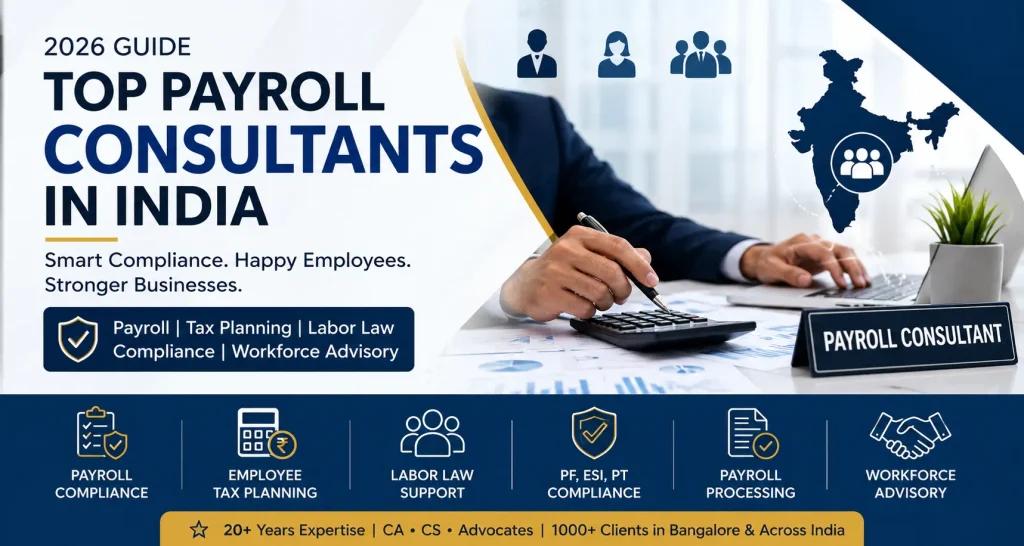
Why Businesses Are Choosing Top Payroll Consultants in India
India’s payroll ecosystem has changed significantly over the last few years. Earlier, most businesses outsourced payroll mainly for salary confidentiality and administrative convenience. However, after continuous changes in the Income Tax Act, new tax regime, labor code implementation, minimum wages rules, PF & ESI compliance expectations, POSH obligations, employee tax planning requirements, and increasing workforce expectations, payroll today has become a critical compliance and workforce management function rather than a simple salary processing activity.
Modern employees are increasingly focused on maximizing take-home salary, proper tax planning, reimbursement optimization, quick settlement during resignation, correct TDS deduction, and transparent payroll handling. At the same time, companies are under pressure to maintain 100% compliance under Income Tax, labor laws, Shops & Establishment regulations, PF, ESI, gratuity, professional tax, and employee welfare obligations while avoiding future notices, disputes, penalties, or employee dissatisfaction.
Because of this, businesses searching for the Top Payroll Consultants in India (2026) are no longer simply comparing software pricing or salary processing cost. They are actually trying to identify which payroll partner can protect the company operationally, compliantly, financially, and legally while improving employee confidence and long-term workforce stability.
From our practical experience at Prakasha & Co., many companies initially select low-cost online payroll platforms expecting easy automation and reduced cost. However, businesses later discover that payroll is not only about generating payslips. Real payroll management involves tax structuring, labor law awareness, employee communication, compliance monitoring, documentation control, exit settlement handling, expat taxation, reimbursement validation, POSH understanding, and adapting continuously to changing regulations and workforce expectations.
A strong payroll consultant today helps businesses balance employee satisfaction, legal compliance, tax efficiency, workforce stability, confidentiality, and operational continuity together. Companies that ignore this often face employee dissatisfaction, tax mismatch issues, labor exposure, or long-term compliance risks later.
Why Businesses Across India Are Outsourcing Payroll More Strategically
Payroll outsourcing in India was traditionally seen as an administrative support function handled mainly to maintain confidentiality of employee salaries from internal departments outside HR. While this still remains important, modern businesses today outsource payroll for much deeper strategic reasons involving compliance management, employee tax planning, workforce governance, operational scalability, and legal risk reduction.
Companies are increasingly realizing that payroll directly affects employee trust, retention, workforce morale, tax efficiency, labor compliance, and even company reputation. Incorrect salary structuring, improper TDS deduction, PF mismatch, delayed settlements, non-compliance with minimum wages, or weak documentation processes can create long-term employee dissatisfaction and compliance exposure for the business.
This becomes even more critical for startups, IT companies, ecommerce businesses, funded ventures, remote workforce models, and rapidly scaling companies where payroll structures involve reimbursements, incentives, ESOPs, hybrid workforce, expat employees, consultants, contractual staff, and multiple state-level labor law considerations simultaneously.
Many companies now prefer outsourcing payroll to specialized CA, CS, and legal-backed payroll advisory firms because payroll decisions today require understanding of taxation, labor law, employee structuring, compliance deadlines, resignation settlement procedures, and future workforce planning together instead of processing salaries in isolation.
Businesses often choose payroll providers based only on software pricing or low monthly processing cost. However, issues later arise involving incorrect TDS deduction, employee tax complaints, improper reimbursement treatment, PF/ESI mismatch, minimum wages non-compliance, delayed full & final settlement, or lack of support during labor inspections and employee disputes.
Payroll Software vs Real Payroll Consultants – What Actually Works Better in India?
One of the biggest mistakes many businesses make while selecting payroll consultants in India is assuming that payroll software and payroll advisory are the same thing. In reality, payroll software primarily automates calculations and processing, whereas experienced payroll consultants help businesses strategically manage taxation, labor compliance, employee structuring, documentation, settlement handling, and workforce risk management.
Online payroll platforms are useful for very basic salary processing where businesses only require automated attendance integration, payslip generation, and simple salary calculations. These platforms generally work well for micro businesses with limited workforce complexity and minimal compliance requirements.
However, as companies grow, payroll becomes much more sensitive and legally interconnected. Businesses start facing situations involving employee tax planning, old vs new regime calculations, ESOP taxation, expat salary structuring, contractor classification, minimum wages review, labor law applicability, resignation settlements, bonus calculations, POSH coordination, and compliance scrutiny where software alone cannot provide practical guidance.
This is where professional payroll consultants become important. Experienced payroll advisory firms understand not only software processing but also the practical legal, taxation, labor, HR, and employee-relations impact behind payroll decisions. A properly structured payroll system helps businesses maintain compliance while also improving employee confidence and workforce stability.
Payroll disputes usually do not arise because software failed to calculate salary. Problems generally occur because taxation, labor law applicability, reimbursement treatment, settlement handling, compliance interpretation, or employee communication were not properly understood from a practical advisory perspective.
How to Choose the Right Payroll Consultant in India (2026)
Choosing the right payroll consultant in India is no longer only about comparing monthly processing charges or payroll software features. Businesses today need to evaluate whether the payroll partner is capable of handling compliance complexity, employee tax planning, labor law interpretation, workforce structuring, and practical HR coordination together under one advisory ecosystem.
Many companies initially select payroll providers purely based on low pricing, automated dashboards, or software presentation. However, payroll mistakes generally become visible only later — during employee resignations, labor inspections, tax scrutiny, reimbursement disputes, PF mismatch, TDS complaints, or internal HR escalations where businesses realize the importance of having experienced payroll professionals with taxation and legal understanding.
An ideal payroll consultant should understand not only payroll processing but also employee expectations, business risk exposure, state-level labor compliance, Income Tax implications, old regime vs new regime planning, contractor classification, POSH coordination, and exit settlement management. This becomes even more critical for companies handling large workforce, hybrid employees, startup teams, expat employees, or multiple branch locations across India.
From our practical experience, businesses that choose payroll partners strategically usually face fewer employee disputes, smoother tax compliance, better workforce confidence, and reduced legal exposure compared to businesses relying only on low-cost software-driven payroll vendors.
A professionally managed payroll structure improves employee confidence, workforce retention, tax transparency, compliance stability, and operational continuity while reducing long-term labor, taxation, and HR-related risks for the company.
Why Cheap Online Payroll Platforms Create Long-Term Compliance Risks
Low-cost payroll platforms have become extremely common across India, especially among startups and small businesses attracted by pricing models such as ₹999 or ₹5,000 monthly payroll processing offers. While these platforms may appear cost-effective initially, many businesses later realize that payroll compliance involves much more than automated salary calculation and payslip generation.
In several practical situations, companies using purely software-driven payroll systems later face employee dissatisfaction, incorrect TDS deduction, poor tax planning, reimbursement rejection, labor compliance mismatch, improper leave treatment, delayed settlement handling, and lack of support during inspections or compliance scrutiny because the platform primarily focused on processing rather than advisory.
Payroll-related issues today often involve interpretation of Income Tax rules, reimbursement eligibility, labor code applicability, state-level minimum wages, gratuity treatment, expat taxation, contractual workforce handling, POSH obligations, employee exit settlements, and documentation validation. These areas generally require practical professional judgment rather than only software automation.
Many businesses also underestimate the importance of local compliance understanding. Payroll rules, Shops & Establishment requirements, professional tax regulations, labor department practices, and employee dispute handling often vary significantly depending on state-level implementation and business structure.
Several companies initially save small monthly payroll cost using low-priced platforms but later incur much higher expense due to employee disputes, incorrect tax deductions, PF mismatch, labor notices, settlement complications, compliance penalties, or restructuring payroll systems after business expansion.
Payroll Compliance Areas Companies Commonly Miss in India
One of the biggest misconceptions among businesses is assuming payroll compliance only means salary processing and monthly TDS deduction. In reality, payroll in India is interconnected with multiple labor laws, employee welfare regulations, tax provisions, documentation requirements, and HR governance responsibilities that continue throughout the employee lifecycle.
Several companies process salaries successfully every month but later face problems because important compliance areas such as minimum wages applicability, reimbursement validation, professional tax filing, gratuity eligibility, leave encashment treatment, POSH committee management, employee classification, bonus applicability, and full & final settlement documentation were not properly monitored.
This becomes even more sensitive after recent workforce changes involving hybrid employment, remote work, contract staffing, startup ESOP structures, expat hiring, performance incentives, and rapidly changing employee expectations regarding take-home salary and tax optimization.
A properly structured payroll advisory ecosystem generally works proactively by reviewing payroll impact not only from HR perspective but also from Income Tax, labor law, documentation, employee relations, and future compliance exposure angles together.
Small payroll mistakes involving reimbursement treatment, PF eligibility, employee classification, minimum wages structure, or delayed statutory filing may initially appear minor but can later create notices, employee dissatisfaction, labor disputes, tax exposure, or financial liabilities for the company.
Companies with properly structured payroll systems generally experience smoother employee retention, fewer compliance disputes, stronger HR governance, and reduced legal exposure compared to businesses handling payroll only as a monthly processing activity.
Employee Tax Planning & Take-Home Salary Optimization Through Payroll
One of the biggest expectations employees have from modern payroll systems is maximizing take-home salary while remaining fully compliant under Income Tax laws. This has become even more important after the introduction of the new tax regime, changes under the Income Tax Act 2025, evolving reimbursement structures, hybrid compensation models, and increasing employee awareness regarding salary structuring and tax deductions.
Today’s workforce, especially IT employees, startup professionals, expat employees, senior management teams, and highly skilled professionals, increasingly evaluate employers not only based on salary package but also on how effectively payroll is managed from taxation and employee benefit perspectives.
Many businesses initially assume payroll software automatically optimizes taxation. However, practical payroll tax planning generally requires understanding of HRA, reimbursements, old vs new regime comparison, bonus treatment, leave encashment, gratuity, ESOP implications, performance incentives, relocation benefits, expat taxation, and employee-specific tax situations.
At Prakasha & Co., we regularly see situations where employees become dissatisfied because improper payroll structuring resulted in excess TDS deduction, lower monthly take-home salary, reimbursement rejection, incorrect declaration treatment, or poor communication regarding tax planning opportunities.
Employees generally appreciate payroll systems that are transparent, tax-efficient, well-structured, and professionally managed. Proper payroll planning helps companies improve retention, workforce confidence, and employee experience while maintaining strong compliance standards.
Payroll Challenges Faced by Startups & Growing Companies in India
Payroll management becomes increasingly complex as startups and growing companies expand their workforce, introduce hybrid salary structures, onboard remote employees, implement ESOP plans, hire consultants or contractual staff, and operate across multiple states in India.
Many startups initially manage payroll internally during early growth stages. However, once employee count increases, businesses start facing challenges involving TDS management, reimbursement approvals, employee tax planning, leave tracking, contractor classification, compliance deadlines, labor law applicability, and maintaining consistency across departments.
Rapidly growing companies also frequently face situations involving urgent employee exits, full & final settlements, expat hiring, incentive calculations, founder remuneration structuring, payroll confidentiality concerns, and employee dissatisfaction regarding take-home salary calculations.
Several startups additionally underestimate the legal implications of payroll documentation, employee classification, PF applicability, gratuity eligibility, and state-level labor compliance until operational scaling or funding due diligence begins. Investors and acquirers increasingly review payroll governance, compliance structure, employee documentation, and tax practices during funding and acquisition discussions.
Many startups focus heavily on hiring speed and payroll automation but delay compliance structuring. This later creates employee disputes, tax mismatch issues, due diligence concerns, labor exposure, and operational confusion during rapid scaling or investor review.
Payroll & Labor Law Changes Impacting Companies in India (2026)
The payroll ecosystem in India is changing rapidly due to continuous updates in labor regulations, Income Tax provisions, digital compliance systems, employee welfare expectations, and workforce structuring models. Businesses can no longer treat payroll as a fixed monthly accounting activity because payroll today directly affects labor compliance, employee retention, taxation exposure, and operational governance.
The proposed labor code implementation, increasing scrutiny on employee classification, minimum wages enforcement, digital compliance monitoring, contractor regulation, POSH accountability, and evolving employee tax structures are making payroll management significantly more sensitive than before.
At the same time, businesses are also adapting to workforce transformation involving hybrid employment, remote teams, AI-driven automation, gig workers, international hiring, startup ESOP structures, and increasing employee expectations regarding flexibility and tax-efficient compensation.
Companies that fail to proactively adapt their payroll systems to these evolving regulations often later face employee dissatisfaction, compliance notices, labor exposure, tax mismatch issues, or operational governance concerns. Because of this, businesses increasingly prefer payroll consultants who continuously monitor legal developments and help implement practical payroll changes proactively.
Modern payroll consultants are expected to help businesses continuously adapt to changing tax laws, labor regulations, workforce models, and employee expectations instead of merely processing monthly salaries through automated software systems.
Top Payroll Consultants in India vs Payroll Software Platforms
Practical Payroll Situations Businesses Commonly Face in India
Payroll-related issues generally become visible only after businesses start facing employee dissatisfaction, compliance scrutiny, tax mismatch, labor inspection, resignation disputes, or operational scaling challenges. Many companies initially believe payroll is functioning correctly because salaries are processed every month. However, practical problems usually emerge later when employee expectations, legal obligations, and compliance interpretation become more complex.
At Prakasha & Co., we regularly assist startups, IT companies, ecommerce businesses, manufacturing units, professional firms, healthcare businesses, and growing enterprises facing payroll-related operational and compliance situations requiring coordinated tax, labor, HR, and legal understanding.
A Bangalore-based technology company approached our payroll advisory team after several employees raised concerns regarding excessive TDS deduction and lower monthly take-home salary despite available tax-saving declarations. After reviewing the payroll structure, reimbursement handling, and tax regime treatment, the payroll process was restructured to improve employee clarity and tax efficiency while maintaining compliance under Income Tax provisions.
A startup scaling aggressively across multiple states initially managed payroll internally through software automation. However, after expansion, the company started facing confusion regarding minimum wages applicability, contractor classification, employee documentation, and state-level compliance requirements. Our payroll advisory ecosystem coordinated structured payroll governance and compliance review support.
A growing company required immediate payroll intervention after employee resignation disputes arose regarding leave encashment, reimbursement settlement, bonus calculation, and final payout communication. Since payroll directly impacts employee relations and legal exposure, structured settlement coordination and documentation support were implemented to resolve the matter professionally.
Top Payroll Consultant Types in India – A Practical Comparison
Payroll consulting services across India are broadly offered through three different models — software-driven payroll platforms, HR outsourcing agencies, and professional advisory firms backed by CA, CS, taxation, and legal expertise. Understanding the difference between these models is extremely important before finalizing a payroll partner because each operates with very different levels of advisory depth, compliance capability, and practical support.
Many businesses initially compare payroll providers only based on pricing or software dashboard appearance. However, long-term payroll success generally depends more on compliance understanding, tax planning capability, labor law awareness, employee handling support, and proactive advisory involvement rather than only automation features.
| Criteria | Online Payroll Platforms | HR Outsourcing Agencies | CA / CS / Legal Payroll Advisory Firms |
|---|---|---|---|
| Main Focus | Software automation | HR process handling | Compliance + payroll strategy |
| Tax Planning Capability | Limited | Basic | Advanced practical advisory |
| Labor Law Understanding | Minimal | Moderate | Comprehensive |
| Employee Settlement Handling | Limited support | Basic coordination | Strategic resolution support |
| POSH & Compliance Awareness | Minimal | Partial | Integrated governance understanding |
| Business Suitability | Small/simple businesses | Mid-level operational support | Startups, SMEs & growing companies |
| Long-Term Compliance Support | Limited | Depends on team | Structured advisory ecosystem |
The best payroll consultant is not always the cheapest software provider. Businesses generally benefit more from payroll partners who understand employee taxation, labor compliance, workforce governance, and practical HR realities together rather than focusing only on automated salary processing.
Why Professional Payroll Advisory Matters More Than Software Automation
As payroll regulations become increasingly interconnected with Income Tax compliance, labor laws, employee welfare obligations, workforce governance, and HR documentation, businesses are gradually realizing that payroll cannot be treated only as a software-driven monthly activity.
Software automation certainly improves efficiency in attendance integration, payslip generation, and repetitive payroll calculations. However, payroll-related business risks usually arise from interpretation issues, compliance gaps, employee dissatisfaction, incorrect tax planning, labor exposure, settlement disputes, reimbursement treatment, and poor payroll governance rather than mathematical calculation errors.
Professional payroll advisory becomes particularly important when businesses need practical guidance regarding employee tax optimization, labor inspections, expat payroll, startup scaling, workforce restructuring, multi-state compliance, contractor management, bonus calculations, gratuity applicability, or exit settlement handling.
From our practical experience, businesses that proactively structure payroll through experienced advisory ecosystems generally maintain better employee retention, smoother compliance management, stronger workforce confidence, and reduced legal exposure compared to businesses relying entirely on automated payroll software platforms.
The future of payroll in India is not purely automation. Businesses increasingly require payroll consultants capable of combining technology, taxation, labor law understanding, employee relations awareness, and compliance strategy together for long-term workforce stability.
Frequently Asked Questions – Payroll Consultants in India
Many companies now require payroll support beyond salary processing, including employee tax planning, labor law compliance, PF & ESI coordination, settlement handling, POSH awareness, and workforce governance support which software alone may not manage effectively.
Yes. Experienced payroll consultants generally assist with tax-efficient salary structuring, reimbursement treatment, old vs new regime planning, and employee tax coordination to improve payroll transparency and employee satisfaction while maintaining compliance.
Is payroll outsourcing suitable for startups and growing companies?
Yes. Startups and growing businesses generally benefit from structured payroll compliance, employee tax planning, documentation control, and scalable payroll governance support during expansion.
Does payroll include PF, ESI, PT and labor law compliance?
Modern payroll advisory usually includes PF, ESI, PT, minimum wages review, TDS compliance, reimbursement validation, employee documentation, and labor law coordination together.
Why do employee payroll disputes happen in companies?
Most payroll disputes arise due to incorrect TDS deduction, poor salary structuring, delayed settlement, reimbursement confusion, weak communication, or lack of proper payroll governance.
What is the approximate payroll outsourcing cost in India?
Payroll outsourcing fees generally start from around ₹5,000 for small businesses and vary depending on employee count, compliance complexity, multi-state operations, and advisory requirements.
Need the Right Payroll Compliance & Advisory Partner for Your Business?
Prakasha & Co is a multidisciplinary professional firm supporting businesses across India with payroll processing, employee tax planning, payroll compliance, labor law coordination, workforce governance, and practical payroll advisory through an integrated ecosystem of Chartered Accountants, Company Secretaries, and practicing Advocates.
Our payroll advisory ecosystem combines:
Many businesses prefer integrated payroll advisory because employee taxation, labor law compliance, payroll governance, settlements, POSH awareness, and workforce documentation today work closely together and require proactive professional coordination instead of isolated processing support.
Payroll outsourcing fees generally start from ₹5,000 for small businesses, depending on employee count and compliance requirements.
Prakasha & Co
Sahakar Nagar, Bengaluru – 560092
Call : 7019827351
Email : crp@prakashaandco.com
Why Top Payroll Consultants in India Still Matter in 2026
Already managing payroll internally?
Many companies today already have in-house HR, payroll software, or accounting teams but still require dedicated external compliance monitoring support for labor law compliance, employee documentation, POSH coordination, PF/ESI review, payroll audit checks, minimum wages monitoring, and workforce compliance supervision from experienced professionals.
For such businesses, Prakasha & Co also provides Payroll Compliance-Only Advisory Support starting from ₹5,000 per month, depending on workforce size and compliance requirements.
Why Businesses Still Prefer Local Payroll Experts with Practical Compliance Experience
Even with increasing payroll automation and AI-driven software platforms, many companies across India still prefer experienced local payroll consultants who understand practical labor law implementation, employee handling, payroll governance, taxation, and compliance realities beyond software processing.
Payroll today involves sensitive employee matters such as salary confidentiality, labor compliance, POSH awareness, employee exits, reimbursement validation, payroll audits, tax planning, and workforce documentation management where practical human judgment continues to play an important role.
While automation helps improve payroll efficiency, businesses still require experienced professionals to interpret changing labor regulations, Income Tax updates, employee structuring challenges, and workforce compliance risks proactively. This becomes especially important during inspections, employee disputes, rapid scaling, expat payroll handling, or compliance review situations.
The best payroll ecosystems today combine automation, compliance monitoring, taxation expertise, labor law understanding, and practical workforce advisory together instead of relying only on software dashboards.

About the Author – Prakasha CR
Prakasha CR is a multidisciplinary payroll, taxation, compliance, and workforce advisory professional with more than 20+ years of practical experience supporting startups, SMEs, manufacturing units, IT companies, exporters, ecommerce businesses, and large organizations across Bangalore and India.
He has practical exposure in employee payroll structuring, taxation, labor compliance, workforce governance, and payroll advisory support for large workforce environments including reputed organizations and manufacturing ecosystems connected with brands such as Nike, Levi’s, Gokuldas, and other workforce-intensive industries.
Working closely with a team of Chartered Accountants, Company Secretaries, payroll professionals, HR compliance experts, and practicing Advocates, Prakasha & Co supports 1,000+ business clients across Bangalore with integrated payroll, labor law, employee compliance, taxation, and workforce governance advisory.
The firm’s multidisciplinary approach combines payroll automation, employee tax planning, compliance supervision, labor law understanding, workforce documentation, and practical business advisory together under one coordinated ecosystem.
Free GST Registration in India
Ref: Minimum Wages 2026