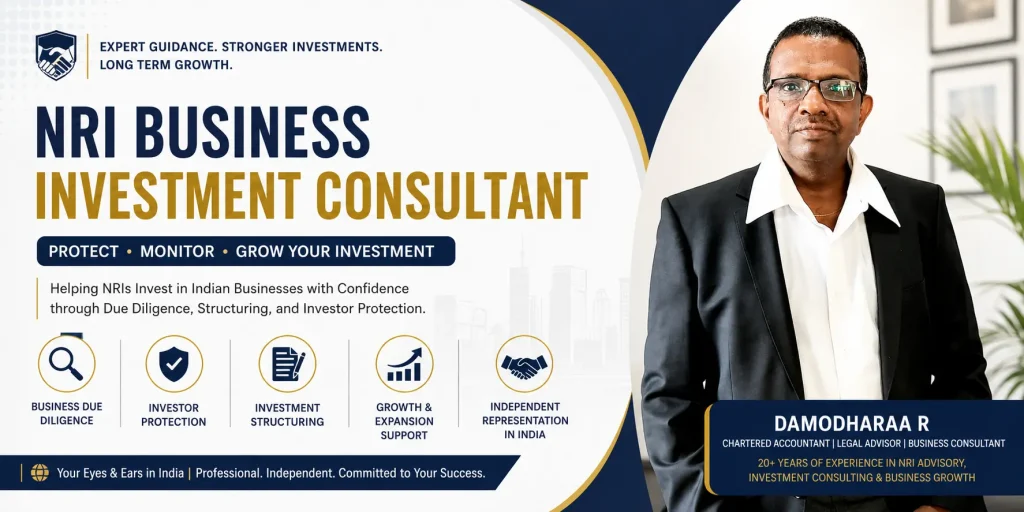
Thinking of Investing in a Business Instead of FD or Property?
Many NRIs in the UK, USA, Canada, Australia, Singapore, and Dubai have substantial funds sitting in NRO accounts, FD’s, inherited assets, or sale proceeds from Indian properties. While traditional investments such as bank deposits and residential apartments continue to be popular, many investors are now exploring a different question:
“Can I invest in a real business in Bangalore and generate better long-term value while maintaining control and security?”
The opportunity certainly exists. Bangalore and Karnataka continue to attract investments into software companies, AI businesses, Ayurvedic products, food processing units, engineering manufacturing, export businesses, agricultural products, healthcare ventures, and innovative startups serving global markets.
However, identifying a good business is only the beginning. The real challenge starts after the investment discussion begins.
NRI Business Investment Risks Nobody Explains Properly
Most business owners focus on presenting growth opportunities, future projections, and expected returns. Very few discussions focus on investor protection.
Before transferring ₹50 Lakhs, ₹80 Lakhs, ₹1 Crore, or more into a private business, every NRI should clearly understand:
- Who controls the money after investment?
- Who monitors the business on a daily basis?
- How will returns be calculated and paid?
- What happens if the project is delayed?
- What happens if the founders disagree later?
- What happens if the investor wants to exit after 5 or 10 years?
- How can the capital be legally recovered?
- Can the investment be repatriated back to the UK, USA, or other countries?
These questions become even more important when investing in privately held businesses, family-run enterprises, manufacturing units, proprietorship concerns, startups, or growing companies where detailed information may not be publicly available.
NRI Business Investment Advisory – Beyond Stocks, Mutual Funds and Portfolio Management
Most online investment advice focuses on shares, mutual funds, PMS schemes, wealth management products, or stock market portfolios.
That is not what this page is about.
We NRI Business Investment Consultant assist NRIs who want to invest directly into operating businesses and growth companies. These investors are not looking for stock market recommendations. They are looking for practical guidance before investing in a software company, Ayurvedic manufacturing business, food processing venture, export company, engineering unit, healthcare startup, agricultural processing business, or another growth opportunity.
Our role is to help investors evaluate opportunities, identify hidden risks, structure transactions properly, negotiate commercial terms, protect capital, establish monitoring mechanisms, and create a practical roadmap for future returns and exit options.
Why Many NRIs Need Independent Representation in India
One of the biggest concerns we hear from overseas investors is simple:
“The business may be in Bangalore, but I am sitting 10,000 kilometres away.”
Many investors have no family members or trusted representatives available locally to supervise project execution, verify business claims, review compliance matters, monitor factory development, attend meetings, or protect their interests after the investment is made.
This creates a significant information gap between the investor and the business operators.
As an NRI Business Investment consultant independent advisors, we help bridge that gap through legal due diligence, commercial review, transaction structuring, investment documentation, compliance monitoring, negotiation support, and ongoing investor representation wherever required.
Before Investing in Any Indian Business, Ask These 8 Questions
- Is the business legally compliant?
- Are the promoters financially reliable?
- What security protects my investment?
- How will returns be generated and documented?
- Who monitors progress on my behalf?
- What happens if the business fails?
- Can I recover my investment legally?
- How can profits and capital be repatriated in future?
The objective is not merely to invest. The objective is to invest with clarity, protection, transparency, and a practical strategy that safeguards both your capital and your family’s future interests.
Why Many NRIs Prefer Investing in Businesses Instead of Just Buying Another Property
For many NRIs and OCI card holders, investing in India is not only about financial returns. It is also about staying connected to India, supporting Indian entrepreneurs, and participating in the growth story of the country they still call home.
Over the years, we have noticed a significant shift. Earlier, many NRIs preferred investing in apartments, plots, or commercial properties. Today, a growing number of investors are exploring opportunities in operating businesses that have the potential to grow both in India and internationally.
Many successful NRIs already understand the markets where they live. They know what consumers in the UK, USA, Canada, Australia, Singapore, and Dubai are actively buying. They understand local regulations, customer expectations, pricing models, distribution channels, and branding requirements.
This creates a unique opportunity that many Indian businesses do not have on their own.
An Indian entrepreneur understands the product. An NRI often understands the global market.
When both sides work together with proper legal and commercial structures, it can become a powerful long-term business relationship.
Taking Indian Products to Global Markets
Karnataka and Bangalore are home to thousands of innovative businesses producing products that have strong demand across international markets.
Some of the sectors attracting interest from NRIs include:
- Ayurvedic and wellness products
- Herbal supplements and nutraceuticals
- Food processing and packaged foods
- Organic and agricultural products
- Coffee, spices and export-oriented products
- Software and SaaS businesses
- Engineering and manufacturing companies
- Healthcare and medical products
- Seafood and food export businesses
- Traditional Indian products with international demand
In many cases, the business already has a successful product in India but lacks international connections, overseas distribution channels, export knowledge, or local market access abroad.
This is where an NRI investor can create significant value beyond simply providing capital.
A Win-Win Model for Both the Investor and the Business
One of the most successful models we see is where the NRI is not merely an investor but also becomes a strategic international partner.
The Indian company focuses on manufacturing, product development, and operations, while the NRI helps create opportunities in overseas markets through local knowledge, distribution networks, and customer relationships.
Instead of competing in crowded local markets, both parties work together to build new revenue streams in international markets.
When structured properly, this can benefit everyone involved:
- The business receives funding and international growth opportunities.
- The investor participates in business growth.
- Indian products reach global consumers.
- New export revenue is generated.
- Both sides can build long-term value rather than seeking short-term gains.
The Missing Piece Is Usually Not Capital – It Is Structure
Many promising business opportunities fail because the expectations between the investor and the founders are never clearly documented.
Questions relating to returns, investment protection, distribution rights, intellectual property, international territories, future ownership, exit rights, and succession planning are often left for future discussion.
Unfortunately, future discussions become future disputes.
A properly structured arrangement from the beginning helps avoid misunderstandings later.
How we Helps NRIs Build Secure Business Relationships
Our role extends beyond reviewing legal documents.
We help create a complete roadmap that balances commercial objectives, legal protection, regulatory compliance, and practical business realities.
Depending on the transaction, our involvement may include:
- Business opportunity assessment
- Promoter and founder verification
- Legal and financial due diligence
- Investment structure planning
- NRO, NRE and FEMA guidance
- Return and repayment structuring
- International distribution arrangements
- Trademark and intellectual property protection
- Shareholder and investor agreements
- Personal guarantee arrangements
- Monitoring and reporting mechanisms
- Exit and repatriation planning
Our objective is simple: to help NRIs invest in genuine businesses with confidence while ensuring that both the opportunity and the risks are fully understood before any funds are committed.
What Makes This Different From Traditional Investment Advisory?
- Not stock market advice.
- Not mutual fund recommendations.
- Not wealth management products.
- Not portfolio management services.
We focus on helping NRIs evaluate, structure, protect, monitor, and grow investments in real operating businesses across Bangalore and Karnataka.
Best Business Opportunities for NRI Investors
Bangalore is often known as India’s technology capital. However, many NRIs are surprised to discover that some of the most attractive investment opportunities today are not limited to software companies.
Karnataka has evolved into a major hub for manufacturing, healthcare, exports, food processing, wellness products, engineering, agricultural innovation, and global services. This creates opportunities for NRIs who wish to combine investment with international business development.
Unlike passive investments, business investments allow NRIs to contribute not only capital but also market knowledge, international connections, distribution channels, and strategic guidance.
For many overseas Indians, this creates a unique opportunity to participate in India’s growth story while building a commercial bridge between India and their country of residence.
Ayurvedic and Wellness Product Businesses
One of the fastest growing sectors attracting NRI attention is the AYUSH and wellness industry.
Global consumers are increasingly looking for natural healthcare products, herbal supplements, wellness formulations, immunity products, Ayurvedic oils, and traditional Indian remedies.
Many small and medium-sized Indian manufacturers possess excellent formulations and product knowledge but lack access to overseas markets.
An NRI who understands local consumer behaviour in the UK, USA, Canada, Australia, or Europe can often add significant value by helping such businesses expand internationally.
In many situations, the investor becomes both a funding partner and a strategic growth partner.
Food Processing and Export Businesses
Indian food products continue to enjoy growing demand across international markets.
Businesses involved in spices, ready-to-eat foods, snacks, organic foods, millet products, traditional Indian foods, frozen foods, and specialty ingredients are witnessing increasing export opportunities.
Many NRIs already understand the retail ecosystem in their country and can help create distribution networks that local manufacturers may struggle to establish independently.
Coffee, Spices and Agricultural Product Exports
Karnataka remains one of India’s leading producers of coffee, pepper, cardamom, spices, organic produce, and agricultural commodities.
International demand for authentic Indian agricultural products continues to increase, particularly among health-conscious consumers and ethnic markets abroad.
Well-structured partnerships between local producers and overseas investors can unlock export opportunities while creating sustainable business growth.
Software, SaaS and Technology Companies
Bangalore’s global reputation as a technology centre continues to attract investors from around the world.
Many software founders possess strong technical capabilities but often require strategic support, funding, international partnerships, and overseas market access.
NRIs with industry experience abroad can sometimes contribute far more than capital by helping companies access customers, partners, and investors in foreign markets.
Engineering and Manufacturing Businesses
Karnataka is home to a wide range of manufacturing businesses producing industrial components, engineering products, machinery, electrical products, automotive parts, and specialized equipment.
Many of these businesses have strong technical capabilities but require expansion capital and international market development.
This creates opportunities for investors seeking exposure to tangible businesses with measurable assets and scalable production capacity.
Healthcare and Medical Product Businesses
The healthcare sector continues to experience strong growth across both domestic and international markets.
Medical devices, healthcare consumables, rehabilitation products, nutraceuticals, wellness products, and healthcare technologies are attracting increasing investor attention.
For NRIs with healthcare experience abroad, these businesses often present opportunities for strategic collaboration and market expansion.
What Makes Bangalore Different?
Few cities offer the combination of entrepreneurial talent, manufacturing capability, research institutions, technology expertise, export infrastructure, and international connectivity that Bangalore provides.
For NRIs seeking genuine business opportunities, the city offers access to founders, manufacturers, exporters, innovators, and growth-stage businesses across multiple industries.
However, identifying an opportunity is only one part of the process.
The most successful investors are not necessarily those who find the best business. They are often the ones who perform the best due diligence before investing.
Before committing funds, every investor should verify the business model, financial position, promoter background, legal compliance status, intellectual property ownership, growth assumptions, and exit possibilities.
This is where a structured investment review becomes essential.
How to Verify a Business Before Investing Your Money
One of the biggest mistakes we see among NRI investors is investing based on trust alone.
The founder may be genuine. The product may be excellent. The business may appear promising. However, successful investing requires more than confidence. It requires verification.
Many investment problems do not arise because of bad intentions. They arise because expectations, risks, financial realities, and legal issues were never properly investigated before funds were transferred.
Before investing in any business in Bangalore or elsewhere in India, an independent review should be carried out to understand exactly what the investor is funding.
Trust is important. Verification is essential.
Why Overseas Investors Face Higher Risks
When the investor lives in the UK, USA, Canada, Australia, Singapore, or Dubai, it becomes difficult to independently verify business information.
The investor is often relying on presentations, WhatsApp messages, video calls, business plans, and personal references.
What is visible online may represent only a small part of the actual picture.
Before investing, an investor should understand:
- Who owns the business?
- Who controls the bank accounts?
- Who owns the brand?
- Who owns the intellectual property?
- Are there any hidden liabilities?
- Are there any ongoing disputes?
- Are tax and compliance filings up to date?
- Can the business realistically deliver its projections?
Different Types of Businesses Require Different Checks
The due diligence process depends on the structure of the business.
Private Limited Companies
For Private Limited Companies, information can often be verified through MCA records, statutory filings, director information, shareholding structures, charges, and compliance history.
LLPs
Limited Liability Partnerships require review of LLP agreements, partner details, contribution structures, compliance filings, and business operations.
Partnership Firms
Partnership firms require verification of partnership deeds, partner obligations, tax records, GST compliance, and operational controls.
Proprietorship Businesses
Many successful Indian businesses still operate as proprietorship concerns. However, these businesses require additional investigation because public information is often limited.
Unlike companies, there may be no MCA filings, no publicly available financial records, and limited visibility regarding actual business performance.
This is why proprietorship investments require careful review of financial records, GST filings, banking patterns, customer base, supplier relationships, licenses, and promoter credibility.
What We Verify Before Recommending an Investment
Every investment opportunity is different, but our review typically focuses on the following areas:
- Business legal structure
- Founder and promoter background
- Business ownership verification
- GST and tax compliance status
- Trademark and brand ownership
- Financial performance review
- Outstanding loans and liabilities
- Pending legal disputes
- Regulatory licences and approvals
- Existing contracts and commitments
- Factory, office or operational facilities
- Scalability of the business model
Who Owns the Brand You Are Investing In?
This question is frequently overlooked.
Many investors assume that because a company sells products under a particular brand, the business automatically owns that brand.
In reality, trademarks may be held by founders personally, family members, third parties, or entirely different entities.
Before investing, ownership of trademarks, domain names, formulations, software, designs, copyrights, and intellectual property should be clearly verified.
For investors planning international expansion, this becomes even more important.
Can the Business Expand Internationally?
Many NRIs invest because they see opportunities in their local overseas market.
A product may already have strong demand potential in the UK, USA, Canada, Australia, Europe, Singapore, or the Middle East.
However, international expansion requires more than a good product.
Questions that should be answered include:
- Can the product legally be exported?
- Are overseas registrations required?
- Does the business have manufacturing capacity?
- Can production scale with demand?
- Who will own international distribution rights?
- How will pricing be determined?
- Who owns future international trademarks?
One Wrong Investment Can Take Years to Recover
Most investors spend months deciding where to invest. Unfortunately, many spend only a few hours verifying the opportunity itself.
A proper due diligence exercise often identifies issues that would otherwise remain hidden until after the investment has been made.
The objective is not to reject opportunities.
The objective is to identify risks early, negotiate appropriate protections, and invest with complete clarity.
Our Due Diligence Objective
Before you invest your money, we want to know exactly what you are investing in, who you are investing with, what protections exist, and how your capital can be protected if things do not go according to plan.
How We Help Protect Your Investment Before and After You Invest
Many investment disputes start with a simple mistake.
The investor and the founders spend weeks discussing the business opportunity, expected returns, future growth plans, and market potential. However, very little attention is given to what happens if things do not go according to plan.
Professional investors focus on protection first and profits second.
Before discussing returns, valuation, or expansion plans, they ensure that proper safeguards are built into the transaction.
Our role is to help NRI investors create those safeguards before funds are released.
Investment Protection Is More Important Than Investment Return
Many businesses can generate profits. Very few investments are properly protected.
Before investing, every NRI should have clear answers to the following questions:
- What security do I receive for my investment?
- Can the founders be held accountable?
- What happens if the project is delayed?
- Can additional funds be demanded later?
- How do I exit the arrangement?
- How can my family recover the investment if required?
- What happens if the business stops operating?
These questions should be addressed before the first rupee is transferred.
Milestone-Based Fund Release Instead of Lump Sum Funding
One of the biggest risks in private business investments is releasing the entire amount upfront.
In many cases, investors transfer large sums based on trust, only to discover later that construction has been delayed, machinery has not been purchased, licences are pending, or working capital has been diverted elsewhere.
Wherever practical, we recommend milestone-based funding structures.
Instead of releasing the full investment amount at once, the funding can be linked to measurable business milestones.
For example:
- Stage 1 – Land, lease, or facility confirmation.
- Stage 2 – Machinery procurement verification.
- Stage 3 – Regulatory approvals and licences.
- Stage 4 – Trial production.
- Stage 5 – Commercial operations.
This creates accountability while reducing risk for the investor.
Personal Guarantees from Founders and Promoters
In many privately managed businesses, the investor’s confidence is based largely on the credibility of the founders.
Where appropriate, personal guarantees can be obtained from promoters in addition to the obligations of the business entity itself.
This provides an additional layer of protection and demonstrates the founders’ commitment to the project.
When founders are willing to stand behind their commitments personally, investor confidence naturally increases.
Creating Clear Investor Rights
Many investors assume they will automatically receive information after investing.
Unfortunately, that is not always the case.
Investor rights should be documented clearly from the beginning.
Depending on the structure of the investment, these rights may include:
- Periodic business updates.
- Access to financial information.
- Project progress reports.
- Management review meetings.
- Budget monitoring.
- Approval rights on major decisions.
- Inspection rights.
Proper documentation prevents misunderstandings later.
Protecting International Distribution Rights
Many NRIs are not only investors. They are also business development partners.
They bring market knowledge, customer relationships, distribution channels, and overseas opportunities.
When an investor helps introduce products into international markets, the commercial understanding should be properly documented.
Questions that should be clarified include:
- Which countries are covered?
- Are the distribution rights exclusive?
- How long will the arrangement continue?
- Who owns customer relationships?
- How will pricing be determined?
- What happens if sales targets are achieved?
These issues become especially important for Ayurvedic products, food products, healthcare products, software solutions, engineering products, and export-oriented businesses.
Planning Your Exit Before You Enter
Most investors focus heavily on entering an investment.
Very few spend enough time planning how they will eventually exit.
A proper investment structure should clearly address:
- Voluntary exit rights.
- Buyback options.
- Succession planning.
- Retirement planning.
- Capital repayment mechanisms.
- Future repatriation possibilities.
For overseas investors, these discussions become particularly important because personal circumstances may change over time.
Many investors ultimately wish to return their capital to the UK, USA, Canada, Australia, Singapore, or other countries after several years.
Planning this pathway early often avoids complications later.
Your Independent Eyes and Ears in Bangalore
One challenge that many NRIs face is the lack of trusted local supervision.
The business may be located in Bangalore, Mysore, Hubballi, Mangaluru, Belagavi, or elsewhere in Karnataka, while the investor is thousands of kilometres away.
This creates a natural information gap.
As part of our advisory support, we can assist investors with ongoing reviews, document verification, compliance monitoring, founder discussions, and independent reporting where required.
This allows investors to make informed decisions based on verified information rather than assumptions.
The goal is not merely to invest money. The goal is to create a structure where the investor, the business, and future growth opportunities are protected from the very beginning.
NRI Investment Structures – Which Model Is Right for You?
Every business opportunity is different. Likewise, every NRI investor has different objectives.
Some investors are looking for long-term wealth creation. Some want a steady return on their capital. Others want to help Indian businesses expand into overseas markets while creating an additional income stream for themselves.
The right investment structure depends on your objectives, risk appetite, involvement level, family situation, and future plans.
One of the most common mistakes we see is investors accepting whatever structure is proposed by the business owner without understanding the alternatives available.
Before investing, it is important to determine which model best protects your interests.
Shareholder Investment Model
This is one of the most common approaches where the investor receives an ownership stake in the company in exchange for capital.
The investor participates in the future growth of the business and benefits from increased business value, dividends, or future exits.
This model is generally suitable where the investor wants a long-term association with the business and is comfortable participating in the growth journey.
However, shareholder investments should always be supported by proper shareholder agreements, investor rights, exit mechanisms, and governance protections.
Strategic Investor Model
Many NRIs contribute more than money.
They bring international market knowledge, overseas contacts, industry expertise, and business development opportunities.
In such situations, the investor may become a strategic growth partner rather than merely a financial investor.
This model works particularly well for software companies, healthcare businesses, Ayurvedic manufacturers, export-oriented enterprises, food processing companies, and consumer brands seeking international expansion.
Investor Plus International Distribution Partner
This is becoming increasingly popular among NRIs.
The investor provides capital to support business growth while simultaneously helping the company enter international markets.
For example, a UK-based NRI may identify strong demand for Ayurvedic products, wellness products, food products, engineering components, or healthcare products in the UK market.
The Indian business focuses on manufacturing and operations while the NRI develops distribution channels overseas.
When structured properly, both parties benefit from business growth without competing against each other.
This model often creates stronger long-term relationships because both parties have a shared interest in expanding the business.
Revenue Sharing Investment Model
Some investors are less interested in ownership and more interested in receiving a predictable return linked to business performance.
In certain situations, a revenue-sharing arrangement may be considered.
Instead of focusing entirely on equity appreciation, the investor receives an agreed percentage linked to revenue, sales, or business performance.
The suitability of this model depends on the nature of the business and applicable legal and tax considerations.
Secured Business Funding Model
Some investors prioritize capital protection above all else.
They may not wish to participate in management or ownership but still want exposure to business growth opportunities.
In these situations, structured funding arrangements supported by appropriate security mechanisms may be explored.
The focus shifts from ownership to protection, repayment, monitoring, and clearly defined commercial obligations.
Sleeping Partner Arrangements
Many NRIs wish to remain passive investors while continuing their professional careers abroad.
They do not wish to participate in daily business operations but still expect transparency, accountability, and regular reporting.
In such cases, governance mechanisms become more important than direct operational involvement.
The investor should clearly understand how information will be shared, how decisions will be made, and how their interests will be protected.
Which Structure Is Best for NRI Investors?
There is no universal answer.
The best structure depends on several factors:
- Total investment amount.
- Business sector.
- Expected return.
- Level of involvement desired.
- International expansion plans.
- Family succession objectives.
- Future repatriation requirements.
- Relationship with the founders.
A structure that works perfectly for an Ayurvedic manufacturing company may not be appropriate for a software startup, food processing business, engineering company, healthcare venture, or export business.
Many NRIs Start With the Wrong Question
One of the most common questions investors ask is:
“How much return can I earn?”
While returns are important, experienced investors usually start with different questions:
- How is my capital protected?
- How do I monitor the business?
- What happens if targets are not achieved?
- Can I exit when required?
- Can my family recover the investment?
- How can the money be repatriated later?
Once these questions are properly addressed, discussions relating to returns become much more meaningful.
Our Approach
Rather than forcing every investor into a standard structure, we help design a practical roadmap based on the business opportunity, investor objectives, family considerations, future exit plans, and applicable legal and tax requirements.
Why NRI Investors Need an Independent Advisor in India
Most NRI investors face one common challenge.
The investment is in India, but they are living thousands of kilometres away.
Even if the founders are genuine, the investor has limited visibility into what is happening on a day-to-day basis.
The biggest risk is not always the business. Sometimes it is the lack of information.
Who Is Monitoring Your Investment?
Before investing, every NRI should ask:
- Who verifies the progress of the project?
- Who reviews the documents?
- Who attends meetings if required?
- Who checks compliance matters?
- Who protects my interests locally?
Without an independent representative, investors often depend entirely on information provided by the business itself.
We Become Your Eyes and Ears in Bangalore
Prakasha & Co. can act as an independent advisor representing your interests throughout the investment lifecycle.
Depending on the requirement, our support may include:
- Reviewing business documents.
- Meeting founders and promoters.
- Monitoring project milestones.
- Reviewing compliance status.
- Checking licences and approvals.
- Attending important discussions.
- Providing independent feedback.
- Supporting investment decisions.
Protecting More Than Just Money
Most investors focus only on returns.
Experienced investors focus on information, control, and accountability.
A well-structured investment should provide visibility into how funds are being used and whether business objectives are being achieved.
Regular Review and Reporting
As businesses grow, investors often need periodic updates rather than surprises.
Regular reviews can help identify concerns early and support better decision-making.
This becomes particularly valuable for investors who cannot frequently travel to India.
Helping Investors Make Informed Decisions
Our role is not to run the business.
Our role is to help investors understand the facts, identify risks, review opportunities, and make informed decisions based on verified information.
This allows investors to remain involved without being involved in daily operations.
A Simple Principle We Follow
Invest with confidence, but verify with evidence.
Independent review, proper documentation, regular monitoring, and clear communication often make the difference between a successful investment and an avoidable dispute.
Common Mistakes NRIs Make When Investing in Indian Businesses
Many investment problems can be avoided by addressing a few critical issues before the money is transferred.
Over the years, we have noticed that most disputes arise not because the business idea was bad, but because proper planning was missing.
Investing Based Only on Trust
Many opportunities come through friends, relatives, business associates, or personal introductions.
While trust is important, investment decisions should always be supported by independent verification.
Even genuine founders can face operational, financial, or market challenges that may affect the investment.
Not Conducting Proper Due Diligence
Many investors review the product but never review the business.
Before investing, it is important to verify:
- Business ownership.
- Financial position.
- GST and tax compliance.
- Licences and approvals.
- Brand ownership.
- Promoter background.
Releasing the Entire Investment Upfront
One of the biggest mistakes is transferring the full amount before important milestones are achieved.
Milestone-based funding often provides better control and accountability.
No Written Investment Agreement
Many investors rely on verbal discussions or informal understandings.
When expectations are not documented, misunderstandings usually follow.
A properly drafted agreement should clearly define:
- Investment amount.
- Return expectations.
- Responsibilities of each party.
- Reporting requirements.
- Exit options.
Ignoring Exit Planning
Most investors focus on entering a business.
Few think about how they will exit.
Every investment should have a practical roadmap covering future repayment, buyback options, succession planning, and capital recovery.
Not Protecting Family Interests
Many NRI investors are building assets for their spouse, children, or future generations.
Proper documentation should address what happens to the investment in the event of retirement, incapacity, or succession.
Ignoring International Expansion Rights
Many NRIs plan to introduce Indian products into overseas markets.
However, they often fail to document:
- Distribution rights.
- Territory rights.
- Pricing arrangements.
- Brand usage rights.
- Export responsibilities.
These issues should be clarified before business begins.
Not Verifying Trademark and Brand Ownership
A successful product does not automatically mean the company owns the brand.
Investors should verify who owns the trademarks, domain names, formulations, copyrights, and intellectual property.
Assuming the Business Will Automatically Provide Updates
Transparency should never be assumed.
Reporting mechanisms, review meetings, and investor rights should be agreed upon from the beginning.
Trying to Save a Small Advisory Cost While Taking a Large Investment Risk
Many investors spend months evaluating the opportunity but very little time reviewing the risks.
A proper review before investing is usually far less expensive than resolving a dispute after the investment is made.
The Most Successful Investors Usually Follow One Rule
Verify first. Invest second.
Proper due diligence, clear documentation, realistic expectations, and ongoing monitoring can significantly improve the chances of a successful long-term investment.
Why Many NRIs Are Investing in Bangalore and Karnataka Businesses
For many NRIs and OCI card holders, investing in India is not only about financial returns. It is also about maintaining a connection with India, creating long-term wealth for their family, and supporting genuine entrepreneurs who are building valuable businesses.
Many NRIs have accumulated savings in NRO accounts, fixed deposits, inherited assets, or proceeds from property sales. Instead of allowing these funds to remain idle, they are exploring opportunities in growing businesses that have the potential to create value over the long term.
Bangalore and Karnataka offer a unique combination of entrepreneurship, innovation, manufacturing capability, export potential, and global connectivity, making them attractive destinations for business investments.
Many NRIs understand overseas markets better than Indian businesses, while Indian businesses understand products better than overseas investors. Together, this can become a powerful growth partnership.
Rather than simply investing and waiting for returns, many NRIs now participate in helping Indian businesses enter international markets where they already have local knowledge, networks, and commercial relationships.
Industries We Commonly Review for NRI Investors
Every investor has different interests and objectives. Some seek stable businesses, while others look for high-growth opportunities with international expansion potential.
Ayurvedic and Wellness Businesses
Ayurvedic products, herbal supplements, wellness formulations, natural healthcare products, and nutraceuticals continue to witness growing demand in the UK, USA, Europe, Australia, and the Middle East.
Many Indian manufacturers have excellent products but limited overseas reach, creating opportunities for NRI investors who understand international markets.
Software and SaaS Companies
Bangalore remains one of the leading technology hubs globally. Software companies, SaaS businesses, AI solutions, and technology platforms often seek strategic investors who can assist with international expansion.
Food Processing and Consumer Brands
Indian food products, ready-to-eat products, millet-based foods, organic products, spices, snacks, and specialty foods continue to gain acceptance in international markets.
NRIs often understand overseas consumer preferences and distribution channels, creating a valuable business advantage.
Coffee, Spices and Agricultural Exports
Karnataka is known globally for coffee, spices, agricultural products, organic produce, and export-oriented businesses. These sectors continue to attract investors looking at international trade opportunities.
Healthcare and Wellness Products
Medical products, wellness products, healthcare technologies, rehabilitation products, and nutraceutical businesses continue to show strong growth potential across domestic and international markets.
Engineering and Manufacturing Businesses
Karnataka has a strong manufacturing ecosystem covering engineering products, industrial components, machinery, electrical products, automotive components, and export-oriented manufacturing units.
Many of these businesses require growth capital and international market access rather than just financial investment.
NRO Account, NRE Account and Future Repatriation Planning
One of the first questions many NRIs ask is whether they will be able to recover or repatriate their investment in the future.
The answer depends on several factors including the source of funds, investment structure, regulatory requirements, and future exit strategy.
Before investing, it is important to understand not only how the money will be invested, but also how it can eventually be returned, transferred, inherited, or repatriated.
Many investors focus on entry into the investment. Experienced investors also plan their exit from the very beginning.
Proper structuring helps avoid future complications and provides greater flexibility for retirement planning, succession planning, and international fund transfers.
Real Situations We Commonly Encounter
Every investment opportunity is different. However, many NRI investors face similar concerns before committing funds.
NRI With Idle NRO Funds Looking Beyond Fixed Deposits
Many NRIs approach us after realizing that substantial funds are sitting in NRO accounts or fixed deposits generating limited returns. They are interested in exploring business opportunities while ensuring that their capital remains protected.
UK-Based Investor Looking to Expand Indian Products Internationally
We recently advised an overseas investor who identified strong demand for Indian wellness products in the UK market. The investor was not only interested in funding business expansion but also wanted to create a structured arrangement for international distribution and future growth.
The key concern was not simply return on investment. The concern was how to protect capital, monitor progress, and create a long-term roadmap that benefited both the investor and the business.
Software Founder Seeking Strategic International Growth
Technology companies often approach investors seeking more than funding. In many situations, founders are looking for overseas connections, market access, customer introductions, and strategic guidance that can accelerate international growth.
For NRIs with industry experience abroad, this creates opportunities to contribute significantly beyond capital.
Manufacturing Expansion Project
One common situation involves an established business seeking funds to expand manufacturing capacity, purchase machinery, establish a factory, or enter new markets.
In such cases, investors often want clarity regarding project costs, expected returns, implementation timelines, monitoring mechanisms, security arrangements, and future repayment options.
A structured review before investment helps both the investor and the business move forward with clear expectations and proper safeguards.
Our NRI Business Investment Advisory Process
Every investment opportunity is different. Some investors want to become shareholders, some prefer structured returns, while others want to combine investment with international business expansion.
Our role is to help investors move from uncertainty to clarity before committing their funds.
Step 1 – Initial Consultation
Understanding the investment opportunity, investor objectives, expected returns, risk appetite, and future plans.
Step 2 – Business Information Collection
Obtaining documents, financial information, licences, ownership details, and commercial proposals.
Step 3 – Due Diligence Review
Reviewing legal, financial, tax, compliance, operational, and promoter-related aspects.
Step 4 – Risk Assessment Report
Identifying strengths, concerns, opportunities, and areas requiring additional safeguards.
Step 5 – Investment Structuring
Designing an appropriate investment model based on investor objectives and business requirements.
Step 6 – Commercial Negotiation
Helping both parties arrive at practical and sustainable commercial terms.
Step 7 – Documentation & Protection
Drafting agreements, guarantees, investor rights, monitoring rights, and exit mechanisms.
Step 8 – Investment Monitoring Support
Providing independent reviews and support after implementation wherever required.

Why Investors Choose Prakasha & Co.
Investing in a private business requires more than legal drafting. It requires commercial understanding, risk evaluation, negotiation experience, tax knowledge, and practical business insight.
Our team combines expertise across Company Law, FEMA, Income Tax, GST, Intellectual Property, Business Structuring, and Commercial Documentation.
- 20+ Years of Professional Experience
- CA, CS, Legal & Register valuer experts Under One Roof
- Experience with Business Due Diligence Assignments
- Experience Assisting NRI Investors
- Bangalore-Based Ground Support
- Investment Structuring & Documentation
- Investor Protection Mechanisms
- International Business Expansion Advisory
- Exit & Repatriation Planning
Most importantly, we act independently. Our objective is not to sell investments. Our objective is to help investors make informed decisions.
Professional Fees
Every investment opportunity is different. Therefore, our fees are generally structured in stages based on the complexity and scope of work involved.
- Initial Consultation – Starting from ₹5,000
- Preliminary Business Review – Based on documents and scope
- Due Diligence Assignment – Based on business size and complexity
- Investment Structuring & Negotiation – Milestone Based
- Agreement Drafting & Documentation – Milestone Based
- Monitoring & Representation Support – As Required
After reviewing the opportunity and understanding the required involvement, we provide a transparent stage-wise proposal so that investors pay only for the services they actually require.
Frequently Asked Questions
Can an NRI invest in an Indian business instead of mutual funds or shares?
Yes. Many NRIs invest directly into businesses such as manufacturing companies, software firms, export businesses, Ayurvedic product companies, food processing units, and startups. The appropriate structure depends on the business and investor objectives.
I have money in an NRO account. Can I invest in a Bangalore business?
Many NRI investors use funds available in India for business investments. However, the structure should be reviewed carefully to address investment protection, tax implications, future repatriation, and documentation requirements.
How do I know whether the business is genuine?
Before investing, legal, financial, compliance, operational, and promoter-level due diligence should be conducted. A proper review helps identify risks before funds are transferred.
Can I invest in a proprietorship business?
Investments in proprietorship businesses require additional care because public information is limited compared to companies and LLPs. Proper documentation and security arrangements become critical.
Can I become a sleeping partner?
Yes. Many NRI investors prefer passive involvement while receiving periodic updates and maintaining appropriate investor protections.
Can I take Indian products and sell them in the UK, USA or other countries?
Yes. Many investments are structured alongside international distribution arrangements. Proper agreements should clearly define territory rights, pricing, responsibilities, and brand usage.
How can I protect my investment?
Protection may include due diligence, structured agreements, milestone-based funding, personal guarantees, investor rights, monitoring mechanisms, and exit planning.
Can Prakasha & Co. represent me in Bangalore?
Yes. Depending on the engagement, we can assist with due diligence, documentation, negotiations, monitoring support, and independent reviews.
How much does NRI investment advisory cost?
Initial consultations generally start from ₹5,000. Further professional fees depend on the complexity of the opportunity and are normally structured in stages.
Before You Invest 60Lac or ₹1 Cr or More, Speak With Us
Every year, NRI’s invest substantial amounts into Indian businesses based on trust, and opportunity.
The most successful investors are usually not the ones who move fastest. They are the ones who perform proper due diligence, structure their investments carefully, and protect their interests from the beginning.
If you are considering investing in a business in Bangalore or anywhere in Karnataka, we can help you evaluate the opportunity before funds are committed.
- Business Due Diligence
- Founder Verification
- Investment Structuring
- Investor Protection
- International Expansion Planning
- NRO/NRE Guidance
- Exit & Repatriation Planning
- Independent Representation in India
Contact:
Prakasha & Co.
Sahakar Nagar, Bangalore
Phone: 7019827351

CA | Legal Advisor | Business Consultant
20+ Years Experience in FEMA, Business Structuring, Due Diligence, Taxation, Corporate Law & NRI Advisory.
Last Updated: April 2026
Related Resources: