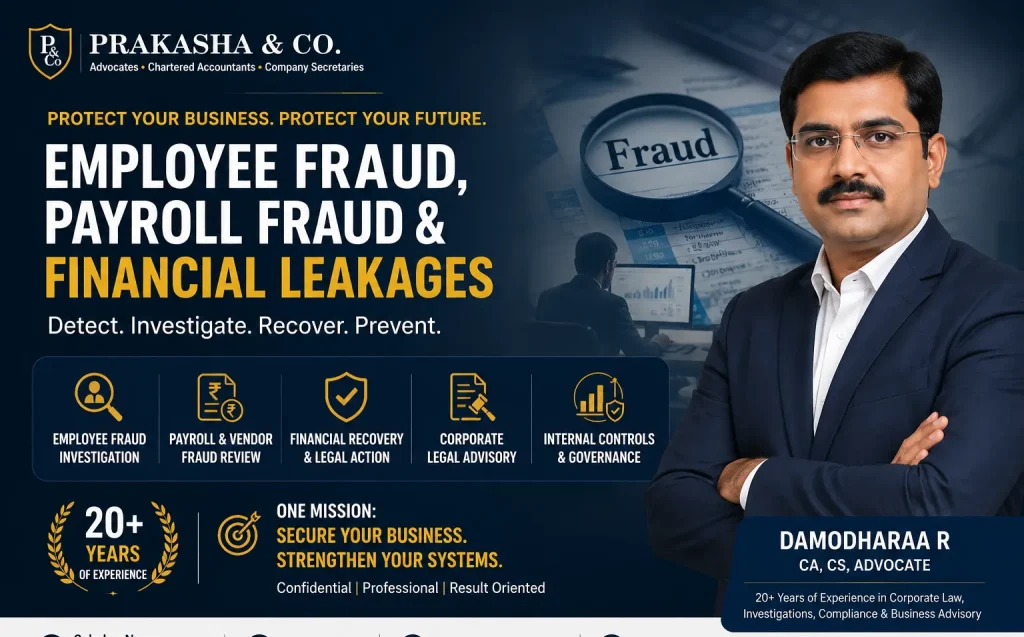
Is Your Business Losing Money Without You Knowing It?
Most business owners worry about competition, sales, GST, taxation, employee retention, and cash flow. Very few worry about the possibility that money may already be leaking from inside the organisation.
The uncomfortable reality is that many financial frauds are committed not by outsiders, but by trusted employees who understand the company’s systems, approval processes, payroll operations, vendor payments, accounting software, and internal controls.
- ✓ Payroll Fraud
- ✓ Accounts Payable Fraud
- ✓ Vendor Payment Diversion
- ✓ Employee Theft
- ✓ Accounting Manipulation
- ✓ Data Theft & Insider Threats
- ✓ Fund Siphoning & Financial Leakages
In many cases, management discovers the issue only after a vendor follows up for payment, payroll expenses unexpectedly increase, cash flow becomes tight, or an internal review reveals discrepancies that were hidden for months.
The Biggest Risk Is Often a Trusted Employee
Fraud rarely begins with a large transaction. It often starts with a small adjustment, a minor reimbursement, or a vendor account update that nobody notices.
Once the employee realizes there is little oversight, the activity gradually increases. What starts as a small manipulation can eventually become a significant financial loss for the business.
The issue is not trust. The issue is allowing one person to control multiple financial functions without independent review.
Does One Person Control Everything?
In Employee fraud investignation, The common weaknesses we see in businesses.
- ✓ Vendor Creation
- ✓ Vendor Payments
- ✓ Payroll Processing
- ✓ Bank Reconciliation
- ✓ Journal Entries
- ✓ Employee Master Records
- ✓ Financial Reporting
When a single employee manages multiple financial functions, management may believe strong controls exist. In reality, the entire system may depend on one person’s integrity.
Tally, SAP & Cloud ERP Systems Do Not Automatically Prevent Fraud
Many businesses assume that because they use SAP, Tally, Zoho Books, Oracle, Microsoft Dynamics, or other cloud-based systems, fraud cannot occur.
The reality is different. Software only follows the permissions granted by management. If access rights, approvals, and review processes are weak, even sophisticated systems can be manipulated.
- ✓ Vendor Master Changes
- ✓ Payroll Manipulation
- ✓ Duplicate Payments
- ✓ Bank Account Changes
- ✓ Journal Entry Alterations
- ✓ Unauthorized Access
Technology without governance often creates a false sense of security.
Real Fraud Does Not Look Like Fraud
In most employee fraud cases, transactions appear completely normal on the surface.
Approvals are obtained. Records are updated. Reports are generated. Vendor ledgers match. Payroll appears processed.
Only later does management discover that funds were diverted, records were altered, or unauthorized payments were made.
That is why businesses need independent validation, periodic reviews, and legal oversight—not just accounting records.
How We Help Businesses Protect Cash, Reputation & Governance
Our role extends beyond fraud detection. We help businesses identify weaknesses before losses occur and provide legal, compliance, and governance solutions to strengthen internal controls.
- ✓ Corporate Fraud Investigation
- ✓ Payroll Fraud Reviews
- ✓ Vendor Payment Verification
- ✓ Employee Theft Investigation
- ✓ Fraud Risk Assessment
- ✓ Internal Control Review
- ✓ Corporate Governance Advisory
- ✓ Recovery & Legal Action Support
The objective is simple: protect business cash flow, prevent financial leakages, strengthen governance, and reduce the risk of future fraud.
Recent Employee Fraud investigation outcome
A ₹30 Lakh Payment Was Made. The Vendor Never Received It.
One of the most concerning fraud patterns we recently encountered involved a branded business that believed all vendor payments were being processed correctly.
Everything appeared normal. The accounting records showed payment completed. Internal approvals had been obtained. The ERP system reflected a successful transaction. Management had no reason to suspect a problem.
The issue surfaced only when the actual vendor contacted the company and asked a simple question:
“When will our payment be released?”
That single follow-up triggered an internal review which uncovered a sophisticated accounts payable fraud.
How the Fraud Was Executed
The employee responsible for handling vendor payments had detailed knowledge of the accounting process, approval workflow, and system controls.
Before processing the payment, the vendor banking details were modified within the accounting system and replaced with a family member’s bank account.
After obtaining routine approvals, the payment was released. Once the transfer was completed, the original vendor details were restored and supporting entries were adjusted to avoid immediate detection.
- ✓ Vendor bank account modified
- ✓ Family member account substituted
- ✓ Routine approvals obtained
- ✓ Payment processed successfully
- ✓ Original records restored
- ✓ Fraud hidden within normal operations
Why Management Did Not Notice Earlier
The fraud was not discovered because management was negligent. The fraud remained hidden because the employee understood the system better than anyone else.
The company relied on standard approvals, accounting reports, and system-generated records. Unfortunately, none of these controls independently verified whether the payment reached the genuine vendor.
This is one of the biggest misconceptions in business finance:
“If the ERP shows the payment was made, the matter is closed.”
In reality, the most important question is:
“Who actually received the money?”
Lessons Every Business Can Learn From This Case
Many businesses operate with similar weaknesses without realizing the risks involved.
- ✓ Vendor master changes should be independently reviewed.
- ✓ Bank account modifications should require secondary approval.
- ✓ Vendor confirmations should be performed periodically.
- ✓ Payment releases should not rely on one individual.
- ✓ ERP audit logs should be reviewed regularly.
- ✓ Vendor onboarding and vendor modification should be separated.
How We Helped Protect the Business
Our involvement extended beyond identifying the fraud. We assisted in reviewing transactions, preserving evidence, assessing legal options, protecting management interests, and strengthening internal controls to reduce the risk of recurrence.
The objective was not only recovery of losses but also protection of the company’s reputation, governance framework, and future financial stability.
In many situations, the most valuable outcome is not simply discovering the fraud—it is ensuring the same weakness cannot be exploited again.
Payroll Fraud: When Salaries Are Paid to People Who Don’t Work
Most business owners review sales, expenses, profitability, and cash flow every month. Very few independently verify whether every salary payment is actually reaching a genuine employee.
This is why payroll fraud often remains undetected for long periods, especially in growing companies where payroll processing is handled by a single individual or outsourced without adequate review.
A Payroll Review Revealed Something Management Never Expected
In a recent matter, management noticed that employee costs were increasing despite no significant increase in workforce strength. Initially, it appeared to be a normal payroll variation.
However, a detailed review of employee records, attendance data, joining records, and salary disbursements revealed irregularities that required further investigation.
The review identified salary payments linked to individuals who were not actively working within the organisation. Certain records had been inserted and maintained within the payroll process without management’s knowledge.
How Payroll Fraud Usually Happens
Payroll fraud is rarely a system failure. It is usually a control failure.
When one person controls employee onboarding, payroll processing, bank account updates, salary approvals, and payroll reporting, opportunities for misuse increase significantly.
- ✓ Ghost employees added to payroll
- ✓ Family members inserted into salary records
- ✓ Duplicate employee records
- ✓ Unauthorized salary revisions
- ✓ Manipulated attendance records
- ✓ Unverified bank account changes
The Reports Looked Perfectly Normal
One reason payroll fraud is difficult to detect is that the reports often appear correct.
Salary sheets match accounting records. Bank transfers are completed. Payroll registers reconcile. Management receives monthly summaries showing everything as expected.
The issue remains hidden because nobody independently verifies whether the employee actually exists, whether the bank account belongs to the employee, or whether the payment was genuinely authorized.
Warning Signs Business Owners Should Never Ignore
- ✓ Payroll costs increasing without workforce growth
- ✓ Employee records missing supporting documents
- ✓ Multiple employees linked to similar bank details
- ✓ Frequent payroll adjustments
- ✓ Employees who never take leave or transfers
- ✓ Payroll controlled by a single individual
- ✓ No independent employee verification process
Simple Controls That Prevent Major Payroll Fraud
Most payroll fraud can be prevented through proper governance and review mechanisms.
- ✓ Independent headcount verification
- ✓ Attendance and payroll reconciliation
- ✓ Employee bank account validation
- ✓ Maker-checker approval process
- ✓ HR and payroll segregation of duties
- ✓ Surprise payroll audits
- ✓ Periodic employee verification exercises
Protecting Cash Flow Is Protecting the Business
Many organisations focus on increasing revenue while overlooking hidden leakages within payroll, vendor payments, reimbursements, and finance operations.
Even small monthly irregularities can accumulate into significant losses over time. Early review, independent validation, and strong internal controls often save more money than businesses realize.
Our Legal team of Advocates, CAS, Auditors, and Compliance Professionals assists businesses in identifying financial leakages, preserving evidence, assessing legal remedies, recovering losses, and strengthening controls to reduce future risk.
10 Hidden Financial Leakages Every Business Owner Should Check
Many business owners focus on increasing sales and profitability while unknowingly losing money through weak internal controls, unnoticed fraud, process gaps, and excessive dependence on key employees.
The surprising reality is that many financial leakages continue for months or years before being discovered. A simple review can often identify weaknesses before they become significant losses.
1. Vendor Bank Account Changes
Who reviews changes to vendor banking details? A single unauthorized modification can redirect large payments without immediate detection.
2. Payroll Verification
Are employee records, attendance, and salary payments independently validated? Ghost employees and unauthorized payroll entries are more common than many businesses realize.
3. Bank Reconciliation Controls
Who verifies that reconciliations are accurate? If the same person handles transactions and reconciliation, important discrepancies may remain hidden.
4. Employee Access Rights
Do former employees still have system access? Excessive permissions often create unnecessary risk.
5. Vendor Master Review
When was the last time management independently reviewed vendor records, duplicate vendors, and related-party transactions?
6. Journal Entry Monitoring
Backdated entries, unusual adjustments, and unexplained write-offs should never go unchecked.
7. Expense Reimbursement Verification
Small unsupported claims can gradually become significant losses if not reviewed regularly.
8. Customer Data Protection
Could employees copy customer databases, pricing information, or confidential business records without authorization?
9. Approval Workflow Review
Does one individual control initiation, approval, processing, and verification of transactions?
10. Independent Fraud Risk Assessment
When was the last time your business underwent an independent review specifically focused on fraud risks and financial leakages?
Why Growing Businesses Face Higher Fraud Risks
Many frauds do not occur because management is careless. They occur because growing businesses often operate with limited resources and rely heavily on a few trusted employees.
In many SMEs, startups, and family-managed businesses, one person may handle accounting, vendor payments, payroll, banking, GST compliance, and management reporting.
While this may seem efficient, it also creates an environment where errors, misuse, or fraud can remain undetected for long periods.
Maker-Checker Controls: One of the Simplest Fraud Prevention Tools
One of the most effective ways to reduce fraud risk is implementing a proper maker-checker system.
- ✓ One person creates the transaction
- ✓ Another person verifies the transaction
- ✓ A separate authority approves the transaction
- ✓ Audit trails are preserved
- ✓ Changes are independently reviewed
Businesses often spend lakhs on software but overlook simple governance controls that can prevent major financial losses.
Fraud Is Often Connected to Larger Risks
Employee fraud is rarely limited to money alone. In many cases, financial irregularities are accompanied by data theft, unauthorized access, customer information misuse, manipulation of digital records, or cyber-related activities.
Businesses facing internal fraud should also evaluate whether confidential information, customer databases, pricing models, contracts, or intellectual property have been exposed.
The Best Time to Detect Fraud Is Before It Becomes a Loss
Most businesses call for help after money has already been lost. The more effective approach is identifying weaknesses before they become financial leakages.
A structured review of payroll, vendor payments, bank reconciliations, ERP access, accounting controls, and governance processes can often reveal risks that management was never aware existed.
Protecting business cash flow is not only about increasing revenue. It is also about preventing unnecessary losses, strengthening governance, and ensuring that the right controls are in place for sustainable growth.
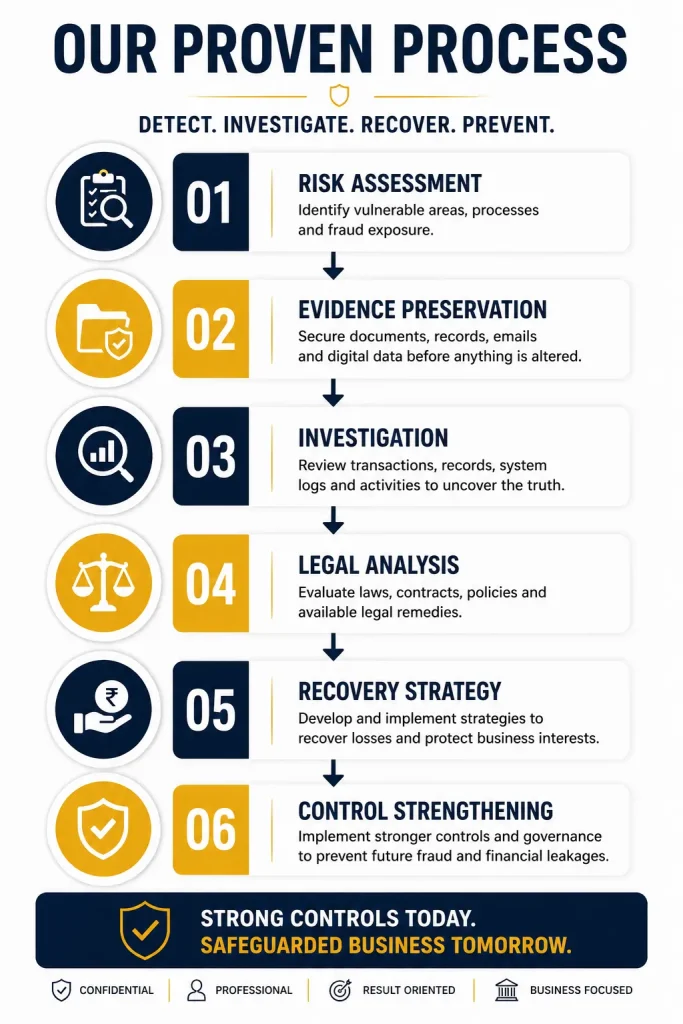
Our Business Fraud Prevention & Recovery Framework
Most businesses approach professionals only after discovering a fraud. By then, money may already be lost, evidence may be compromised, and business relationships may be affected.
Our approach focuses on both recovery of losses and prevention of future frauds.
Step 1: Fraud Risk Assessment
We identify vulnerable areas in payroll, vendor payments, accounting, banking operations, ERP systems, and approval workflows.
Step 2: Evidence Preservation
Before confronting employees or initiating action, we help secure records, emails, accounting entries, access logs, and supporting documents.
Step 3: Financial Investigation
Our team reviews transactions, bank records, payroll data, vendor accounts, journal entries, and system activities to identify irregularities.
Step 4: Legal Assessment
We evaluate available remedies under employment laws, criminal laws, corporate regulations, contractual obligations, and cyber laws.
Step 5: Recovery Strategy
Where possible, we assist businesses in recovering losses, securing undertakings, documenting admissions, and protecting commercial interests.
Step 6: Control Strengthening
We recommend practical controls to reduce the likelihood of future fraud, misuse, or financial leakages.
Simple Controls That Can Save Lakhs of Rupees
Many frauds can be prevented without purchasing expensive software or hiring large teams.
- ✓ Vendor bank account verification
- ✓ Dual approval for payments
- ✓ Independent payroll validation
- ✓ Monthly bank reconciliation review
- ✓ Employee master data verification
- ✓ Vendor master audit
- ✓ Surprise transaction reviews
- ✓ ERP user access review
- ✓ Segregation of duties
- ✓ Related-party transaction monitoring
A Common Mistake Founders and Directors Make
Many business owners believe that because they trust their finance team, no additional review is required.
Trust is important. However, good governance requires verification, independent review, and accountability.
The strongest businesses are not those that trust less. They are the businesses that build systems where trust and verification work together.
As Your Business Grows, Fraud Risks Grow Too
A startup with five employees may operate informally. A company with fifty employees, multiple vendors, growing payroll costs, and expanding banking activities requires stronger controls.
Many businesses outgrow their controls long before management realizes it.
Regular reviews help ensure that growth does not create opportunities for misuse, manipulation, or hidden financial leakages.
Who Should Consider Fraud Control Review?
Many businesses assume fraud reviews are only necessary after a problem is discovered. In reality, the most successful reviews are conducted before losses occur.
If your business depends on employees, vendors, accounting systems, payroll processing, online banking, ERP software, or financial approvals, periodic review is no longer optional—it is part of good governance.
Startup Founders & Business Owners
As businesses grow, founders often delegate finance, payroll, vendor payments, and accounting functions. Independent review helps ensure growth is not creating hidden financial risks.
Managing Directors & CEOs
Management relies on reports and financial information to make decisions. A fraud review helps verify whether the information being reported reflects reality.
CFOs & Finance Heads
Even experienced finance leaders benefit from periodic independent reviews of controls, approvals, reconciliations, and system access rights.
HR Heads & Payroll Managers
Payroll is one of the largest recurring expenses in most organisations. Independent validation can identify payroll leakages before they become significant losses.
Industries Most Vulnerable to Internal Financial Fraud
- ✓ IT & Software Companies
- ✓ SaaS Businesses
- ✓ Startups & Funded Ventures
- ✓ Manufacturing Companies
- ✓ Healthcare & Hospitals
- ✓ Educational Institutions
- ✓ Real Estate Businesses
- ✓ E-Commerce Companies
- ✓ Family-Owned Businesses
- ✓ Shared Service Centres (SSC)
The common factor is not the industry. The common factor is the movement of money, access to systems, and dependence on internal teams.
Signs Your Business May Need an Immediate Review
- ✓ Cash flow issues despite healthy sales
- ✓ Vendors repeatedly following up for payments
- ✓ Unexpected increase in payroll costs
- ✓ Frequent changes to vendor bank accounts
- ✓ Excessive write-offs and adjustments
- ✓ Employees resisting audits or reviews
- ✓ Delays in providing financial records
- ✓ One employee controlling multiple finance functions
- ✓ Weak maker-checker controls
- ✓ Limited management visibility over transactions
“We Are Too Small for Fraud” – A Costly Assumption
This is one of the most common statements we hear from business owners.
Unfortunately, smaller businesses often face higher risks because they operate with fewer employees, limited segregation of duties, and greater dependence on trusted individuals.
Many frauds occur not because controls are intentionally ignored, but because the business has grown faster than its internal processes.
A Financial Control Review Is Like a Health Check for Your Business
Just as regular medical check-ups help identify health issues before they become serious, periodic fraud risk reviews help identify weaknesses before they become financial losses.
The objective is not to create suspicion. The objective is to build stronger systems, improve accountability, protect cash flow, and strengthen governance.
Businesses that review their controls regularly are often better positioned to prevent fraud, detect irregularities early, and maintain long-term financial stability.
The Cost of Not Looking
Many business owners believe that if there is no complaint, there is no problem. Unfortunately, most employee frauds remain hidden until a vendor follows up, a customer raises a concern, an employee resigns, or cash flow starts tightening unexpectedly.
Small monthly leakages often continue for years because they appear as routine business transactions. By the time they are discovered, the cumulative financial impact can be significant.
Employee Fraud or Genuine Mistake?
Not every discrepancy is fraud. Some issues arise from accounting errors, process gaps, inadequate training, or poor supervision.
The key is determining whether there was an intention to conceal, manipulate, divert funds, misuse authority, or gain personal benefit. Proper investigation and evidence review help establish the facts.
Protecting Your Brand While Resolving Fraud
Every fraud case does not require public litigation. Many businesses prefer a structured approach that prioritises evidence preservation, recovery of losses, management protection, and strengthening internal controls.
Where required, legal notices, recovery actions, police complaints, and court proceedings may be initiated. The right strategy depends on the business objectives, available evidence, and the nature of the misconduct.
Corporate Governance Is the First Line of Defence
Strong businesses are built on systems, not individuals. Maker-checker controls, segregation of duties, vendor verification, payroll validation, periodic audits, and independent reviews significantly reduce fraud risks.
The objective is not to create mistrust. The objective is to ensure that no single person has the ability to create, approve, process, reconcile, and report the same transaction without oversight.
Business Protection Services Under One Roof
Modern fraud investigations often involve financial review, legal analysis, cyber evidence, employment issues, data protection concerns, and corporate governance matters.
Our multidisciplinary team of Advocates, Chartered Accountants, Company Secretaries, Auditors, and Compliance Professionals assists businesses with fraud detection, recovery, legal action, internal control reviews, governance improvements, and future risk mitigation.
Related Services
- Cyber Fraud Recovery & Legal Protection
- Customer Data Theft Protection
- Corporate Lawyer Services
- Notary & Document Authentication Services
Before a Fraudster Finds the Weakness, Let Us Find It First
Most fraud investigations begin with a weakness that existed long before the fraud occurred. Identifying those weaknesses early can help protect cash flow, strengthen governance, preserve reputation, and prevent future losses.
Whether your concern involves payroll fraud, vendor payment fraud, accounting fraud, employee theft, financial misappropriation, insider threats, or corporate governance weaknesses, a proactive review can provide valuable insights into risks that may already exist within your organisation.
Frequently Asked Questions
Can money lost through employee fraud be recovered?
In many cases, yes. Recovery depends on the available evidence, transaction trail, employee involvement, asset position, legal strategy, and timely action taken by the business. Early investigation significantly improves recovery opportunities.
Should a company immediately file a police complaint against an employee?
Not always. Businesses should first preserve evidence, secure systems, quantify losses, and obtain legal advice. Depending on the circumstances, recovery, settlement, disciplinary action, police complaint, or court proceedings may be considered.
What is employee fraud?
Employee fraud occurs when an employee intentionally misuses their position, authority, access, or company resources for personal gain.
What is payroll fraud?
Payroll fraud involves unauthorized salary payments, ghost employees, fake reimbursements, manipulated attendance records, or payroll diversion schemes.
What is accounts payable fraud?
Accounts payable fraud generally involves unauthorized vendor payments, fake suppliers, duplicate payments, bank account changes, or payment diversion.
Can fraud happen in SAP, Tally or cloud ERP systems?
Yes. Software follows user permissions. Weak controls, excessive access rights, and inadequate reviews can allow fraud even in advanced systems.
How can I detect ghost employees?
Periodic headcount verification, attendance reviews, payroll reconciliation, and employee validation exercises help identify ghost employee risks.
What are common signs of employee fraud?
Unusual vendor changes, increasing payroll costs, missing records, excessive write-offs, delayed reconciliations, and employees resisting reviews are common warning signs.
Do small businesses need fraud reviews?
Yes. Small and growing businesses often face higher risks because one individual may control multiple financial functions without independent oversight.
Can a company terminate an employee involved in fraud?
Termination should be handled carefully and in accordance with employment laws, company policies, evidence available, and legal advice.
What documents should be preserved during an investigation?
Emails, payroll records, accounting entries, bank statements, system logs, approvals, invoices, communications, and supporting documents should be preserved.
Can vendor payment fraud be traced?
In many cases, transaction records, banking trails, accounting entries, and supporting evidence help trace the movement of funds.
How long does a corporate fraud investigation take?
The timeline depends on the complexity of transactions, volume of records, employee involvement, and the scope of review required.
Can businesses recover money without going to court?
Depending on the circumstances, recovery discussions, undertakings, settlements, and negotiated resolutions may be possible.
Do you provide confidential fraud investigations?
Yes. Many businesses prefer discreet reviews to protect commercial interests, customer confidence, and brand reputation.
Can fraud investigations uncover data theft as well?
Yes. Many internal fraud matters also involve customer data misuse, confidential information leakage, or unauthorized system access.
What industries commonly face employee fraud risks?
IT companies, startups, SaaS businesses, manufacturers, healthcare organisations, educational institutions, e-commerce companies, and family-owned businesses frequently encounter such risks.
Do you assist with police complaints and legal proceedings?
Yes. Our legal team assists with evidence review, legal notices, police complaints, recovery strategies, and court proceedings where required.
Do you conduct fraud risk assessments for businesses?
Yes. We review payroll, vendor payments, banking processes, accounting controls, ERP access rights, governance practices, and fraud exposure areas.
Which locations do you serve?
We assist businesses in Bengaluru, Karnataka, and across India, subject to the nature of the assignment and applicable legal requirements.
Why Businesses Trust Prakasha & Co.
Corporate fraud matters require more than legal knowledge. They often involve accounting records, payroll systems, vendor payments, digital evidence, employment issues, compliance requirements, and recovery strategies.
Our multidisciplinary team of Advocates, Chartered Accountants, Company Secretaries, Auditors, and Compliance Professionals brings together legal, financial, and governance expertise under one roof.
- ✓ Corporate Fraud Investigation
- ✓ Employee Fraud & Payroll Fraud Reviews
- ✓ Vendor Payment Fraud Investigations
- ✓ Financial Recovery Strategies
- ✓ Internal Control Reviews
- ✓ Corporate Governance Advisory
- ✓ Legal & Regulatory Support
Need Assistance with Employee Fraud, Payroll Fraud or Corporate Fraud?
Whether you are facing employee theft, payroll manipulation, vendor payment fraud, accounting irregularities, financial leakages, data misuse, or internal control concerns, timely review can help protect your business.
Prakasha & Co.
Corporate Fraud Investigation | Legal Advisory | Governance & Compliance
Sahakar Nagar, Bengaluru – 560092
📞 7019827351